
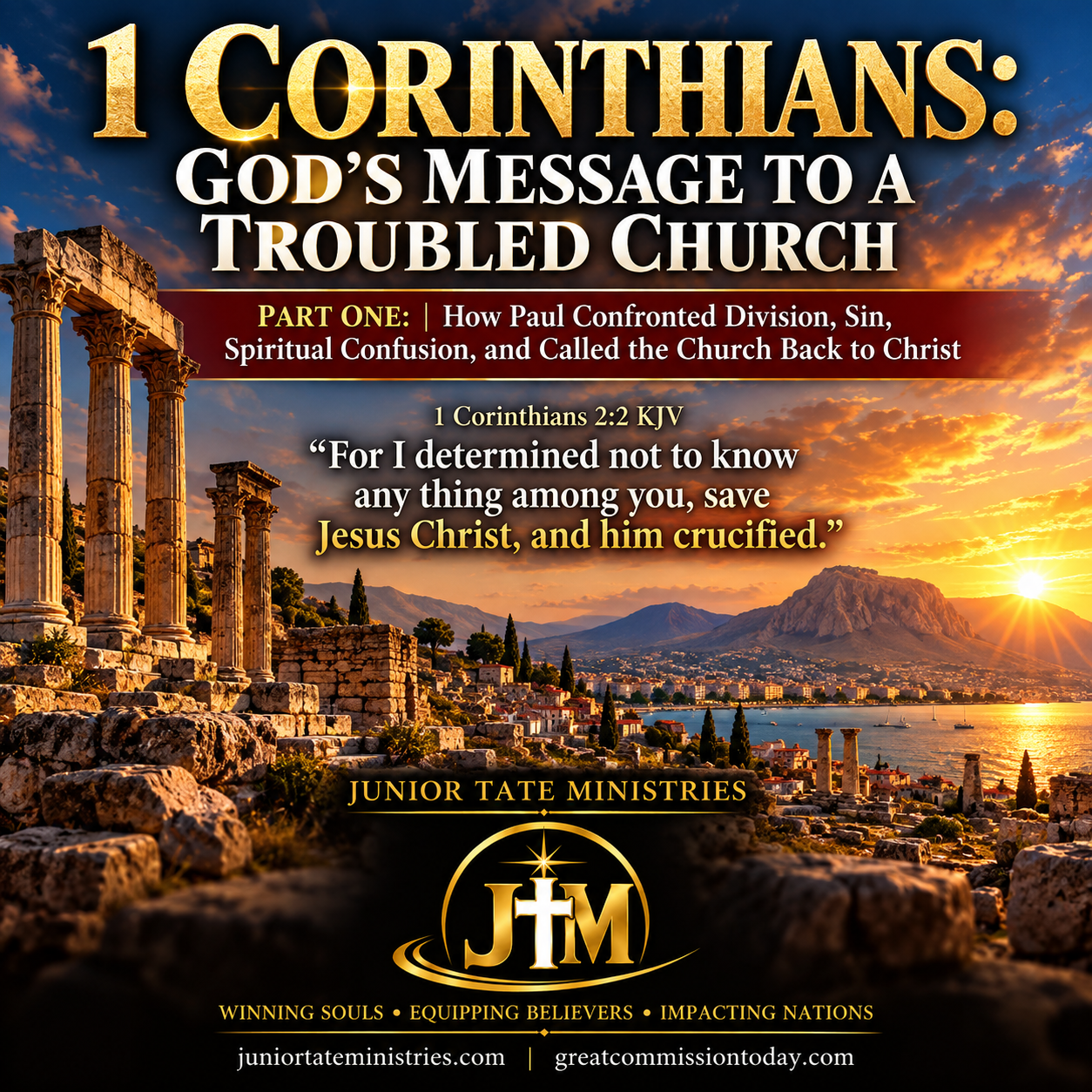
Part One: How Paul Confronted Division, Sin, Spiritual Confusion, and Called the Church Back to Christ
Introduction: A Church Surrounded by the World
When I read 1 Corinthians, I see a church that had been wonderfully reached by the Gospel but was struggling to separate its new life in Jesus Christ from the culture surrounding it. These believers had heard the truth from the Apostle Paul himself. They had experienced the grace of God, possessed spiritual gifts, and gathered together as a church, yet serious problems had developed among them. Division, pride, sexual immorality, lawsuits between believers, questions concerning marriage, disagreements over Christian liberty, disorder at the Lord’s Supper, confusion surrounding spiritual gifts, and even questions about the resurrection had entered the congregation.
That is one reason I believe 1 Corinthians remains so important for the church today. The world around us has changed tremendously since the first century, but human nature has not. Churches can still become divided over personalities and preferences. Christians can still allow the standards of the surrounding culture to influence what they accept. Spiritual gifts and knowledge can still become sources of pride rather than opportunities to serve others. We can still become so occupied with what everyone else is doing that we fail to examine ourselves.
Paul did not respond to the problems at Corinth by giving up on the church. Neither did he pretend that their problems were unimportant. He loved them enough to confront what was wrong and patiently teach them what was right. Throughout the letter, he continually brings them back to Jesus Christ and reminds them that the Gospel should affect not only what they believe but also how they live.
1 Corinthians 1:10 KJV
“Now I beseech you, brethren, by the name of our Lord Jesus Christ, that ye all speak the same thing, and that there be no divisions among you; but that ye be perfectly joined together in the same mind and in the same judgment.”
Paul was not writing to a perfect church. He was writing to a troubled church that needed correction, instruction, and spiritual growth. In many ways, that is what makes this letter so valuable to us. Corinth shows us what can happen when believers begin allowing the attitudes of the world to enter the church, but it also shows us how the Word of God can confront those problems and call God’s people back to Christ.
Corinth: Understanding the City Behind the Letter
To understand 1 Corinthians properly, I believe we need to know something about the city itself. Corinth was located in an important position in Greece near the narrow stretch of land connecting the northern and southern portions of the country. Its location made it a natural center for trade and travel, and people from many different backgrounds passed through the area. Commerce brought prosperity, but it also brought an enormous mixture of cultures, religions, philosophies, and moral practices.
Corinth was therefore a place where the Gospel could spread in many directions, but it was also a difficult environment in which to establish a Christian congregation. Pagan religion was deeply rooted in the surrounding society, and sexual immorality was widely associated with the city’s reputation. The believers in Corinth had been saved out of that environment, but becoming a Christian did not mean that every influence of their former lives immediately disappeared.
That background helps us understand why Paul speaks so strongly about the change salvation should produce.
1 Corinthians 6:9-11 KJV
“Know ye not that the unrighteous shall not inherit the kingdom of God? Be not deceived: neither fornicators, nor idolaters, nor adulterers, nor effeminate, nor abusers of themselves with mankind,
Nor thieves, nor covetous, nor drunkards, nor revilers, nor extortioners, shall inherit the kingdom of God.
And such were some of you: but ye are washed, but ye are sanctified, but ye are justified in the name of the Lord Jesus, and by the Spirit of our God.”
The words “And such were some of you,” are especially important to me. Paul does not pretend these people had no past. Some had come out of very sinful lifestyles, but their past was no longer supposed to control their future. They had been washed, sanctified, and justified in the name of Jesus Christ.
Grace had not simply changed their destination. Grace was supposed to change their direction.
That principle is just as important today. Christians still live in a world that constantly pressures us to accept its standards, values, and definitions of right and wrong. The church cannot isolate itself completely from the people it is called to reach, but neither can it allow the culture it is trying to reach to determine what it believes. God’s Word must remain our standard.
How the Church at Corinth Began
The beginning of the Corinthian church is recorded in Acts 18 during Paul’s second missionary journey. When Paul arrived in Corinth, he met Aquila and Priscilla, a Jewish couple who had recently come from Italy because Emperor Claudius had ordered the Jews to leave Rome. Because they shared Paul’s occupation of tentmaking, he stayed and worked with them while continuing to preach.
Acts 18:2-3 KJV
“And found a certain Jew named Aquila, born in Pontus, lately come from Italy, with his wife Priscilla; (because that Claudius had commanded all Jews to depart from Rome:) and came unto them.
And because he was of the same craft, he abode with them, and wrought: for by their occupation they were tentmakers.”
Paul initially reasoned in the synagogue every sabbath, seeking to persuade both Jews and Greeks. When opposition increased, however, the ministry continued. During this difficult period, the Lord spoke directly to Paul in a vision.
Acts 18:9-10 KJV
“Then spake the Lord to Paul in the night by a vision, Be not afraid, but speak, and hold not thy peace:
For I am with thee, and no man shall set on thee to hurt thee: for I have much people in this city.”
I find those words remarkable considering the reputation of Corinth. God looked at a city filled with paganism and immorality and told Paul, “I have much people in this city.” Where Paul could have seen only opposition and corruption, God saw people who would hear the Gospel and believe.
Paul remained there for an extended period.
Acts 18:11 KJV
“And he continued there a year and six months, teaching the word of God among them.”
Those eighteen months are important because they show us that Paul’s relationship with Corinth was not casual. He had lived among these people, taught them the Word of God, watched believers grow, and helped establish the congregation. When we later hear the strength of his correction, we should remember that it came from someone who knew them and cared deeply about them.
Paul was not attacking the church at Corinth. He was fighting for its spiritual health.
Why Paul Wrote 1 Corinthians
Paul wrote 1 Corinthians from Ephesus, commonly dated around A.D. 55. By then, reports had reached him that serious problems had developed within the congregation. Paul specifically mentions information received through people associated with Chloe.
1 Corinthians 1:11 KJV
“For it hath been declared unto me of you, my brethren, by them which are of the house of Chloe, that there are contentions among you.”
The Corinthians had also written to Paul with questions of their own. We see this when he begins addressing marriage.
1 Corinthians 7:1 KJV
“Now concerning the things whereof ye wrote unto me: It is good for a man not to touch a woman.”
This helps explain why the letter moves through so many different subjects. Paul is dealing both with problems that had been reported to him and with questions the congregation had submitted.
There is also an interesting detail in chapter 5 that shows 1 Corinthians was apparently not Paul’s first written communication with them.
1 Corinthians 5:9 KJV
“I wrote unto you in an epistle not to company with fornicators:”
That earlier letter has not been preserved for us in Scripture. What we call 1 Corinthians is therefore the first inspired letter to Corinth preserved in our New Testament, but Paul’s own words indicate that he had written to them previously.
Understanding this helps us see that Paul’s dealings with Corinth developed over time. There was an ongoing relationship between an apostle and a congregation that needed continued instruction and correction.
When Christians Begin Following Personalities
One of the first problems Paul addresses is division. Groups had formed around different Christian leaders, with some identifying themselves with Paul, others with Apollos, and others with Cephas, or Peter.
1 Corinthians 1:12-13 KJV
“Now this I say, that every one of you saith, I am of Paul; and I of Apollos; and I of Cephas; and I of Christ.
Is Christ divided? was Paul crucified for you? or were ye baptized in the name of Paul?”
Paul immediately brings their attention back to the cross. He does not ask which teacher was the most impressive or which preacher they preferred. He essentially asks them to remember who died for them.
Paul had not been crucified for them. Apollos had not been crucified for them. Peter had not been crucified for them. Jesus Christ had.
There is nothing wrong with appreciating faithful Bible teachers, pastors, or evangelists. God uses people to teach and strengthen His church, and Paul himself acknowledged the different roles servants of God may have. The danger begins when our loyalty to a person becomes greater than our loyalty to Christ and Scripture.
Paul later explains this beautifully.
1 Corinthians 3:6-7 KJV
“I have planted, Apollos watered; but God gave the increase.
So then neither is he that planteth any thing, neither he that watereth; but God that giveth the increase.”
Different servants may have different responsibilities, but God is the One who gives the increase. The ministry should therefore never become about building personalities. Every faithful Christian ministry should ultimately point people beyond the messenger to Jesus Christ.
When the Church Begins Tolerating Sin
In chapter 5, Paul addresses one of the most serious situations in the letter. A man within the congregation was involved in sexual immorality with his father’s wife, and the church had failed to respond appropriately.
1 Corinthians 5:1-2 KJV
“It is reported commonly that there is fornication among you, and such fornication as is not so much as named among the Gentiles, that one should have his father’s wife.
And ye are puffed up, and have not rather mourned, that he that hath done this deed might be taken away from among you.”
What troubles Paul is not only the man’s sin but also the congregation’s attitude toward it. Instead of mourning over what was happening, they were “puffed up.”
This passage teaches a difficult but necessary truth. Biblical love does not require the church to pretend that sin is acceptable. There is a tremendous difference between loving a sinner and approving sin. Jesus Christ showed compassion toward sinners, but He never changed the definition of sin to make anyone comfortable.
At the same time, biblical discipline should never be motivated by revenge, pride, or a desire to embarrass someone. Its purpose should be repentance and eventual restoration. When we come to 2 Corinthians, we will see Paul’s concern that sorrow not become excessive and that forgiveness and comfort be extended where repentance had occurred.
The church must therefore hold grace and truth together. If we speak of grace while refusing to confront sin, grace can be twisted into permission. If we speak truth without compassion, correction can become cruelty. Scripture calls us to something better.
When Christians Fight Before the World
The problems at Corinth had reached the point where believers were taking one another before unbelieving courts. Paul saw something larger than a legal disagreement. He was concerned about what their behavior communicated to the unbelieving world watching them.
1 Corinthians 6:7 KJV
“Now therefore there is utterly a fault among you, because ye go to law one with another. Why do ye not rather take wrong? why do ye not rather suffer yourselves to be defrauded?”
There are times when we can become so determined to prove ourselves right that we never stop to ask whether the way we are fighting is honoring Jesus Christ. Paul wanted the Corinthians to understand that their testimony mattered more than simply winning an argument.
This does not mean that Christians can never deal with legitimate legal matters. Paul’s concern here is believers dragging their disputes with one another before the world rather than handling matters with the wisdom and maturity that should exist within the body of Christ.
Sometimes our greatest testimony is not found in proving that we were right. It is found in demonstrating humility, restraint, forgiveness, and a willingness to place Christ’s honor above our pride.
Marriage, Singleness, and Faithfulness
When Paul reaches chapter 7, he begins answering questions the Corinthians had asked concerning marriage and singleness. He addresses believers who were married, unmarried, widowed, and those whose spouses did not share their faith.
The chapter needs to be read carefully because Paul is responding to particular questions within a congregation facing difficult circumstances. Yet a larger principle runs throughout the discussion: whatever our circumstances, we should seek to honor God faithfully within them.
Marriage is not something Scripture treats casually. It carries responsibilities before God and toward one’s spouse. At the same time, Paul does not treat singleness as though an unmarried Christian is spiritually incomplete. Singleness can provide opportunities for undivided service that married believers may not possess in the same way.
What strikes me is how practical Christianity becomes in Paul’s teaching. The Gospel does not affect only what happens inside a church building. It reaches into marriage, family, relationships, responsibilities, sexuality, and everyday decisions. If Jesus Christ truly has authority over our lives, there should be no area that is completely separated from our faith.
Christian Liberty and the Responsibility to Others
The Corinthians also had questions concerning food that had been offered to idols. Paul uses the issue to teach something much larger about Christian liberty. There are choices where the question is not simply whether something is technically permissible, but whether exercising that freedom is spiritually beneficial.
1 Corinthians 10:23 KJV
“All things are lawful for me, but all things are not expedient: all things are lawful for me, but all things edify not.”
I believe this principle can help Christians in many areas where Scripture does not give a direct command concerning every possible situation. Instead of asking only, “Can I do this?” I should also ask whether it is beneficial, whether it strengthens my testimony, whether it could unnecessarily become a stumbling block to another believer, and whether it brings glory to God.
Paul brings the matter to a simple conclusion.
1 Corinthians 10:31 KJV
“Whether therefore ye eat, or drink, or whatsoever ye do, do all to the glory of God.”
That reaches far beyond food offered to idols. “Whatsoever ye do” covers an enormous amount of Christian life.
Christian liberty is not the freedom to live selfishly. It is the freedom to serve Christ while considering how my choices affect others.
When the Lord’s Supper Loses Its Meaning
Even the Lord’s Supper had become affected by the divisions and selfishness within Corinth. What should have brought the congregation together in remembrance of Christ had instead exposed differences among them. Some were eating while others were left hungry, and Paul rebuked the way they had distorted the purpose of the gathering.
After reminding them of the words of Jesus concerning the bread and cup, Paul tells them:
1 Corinthians 11:28 KJV
“But let a man examine himself, and so let him eat of that bread, and drink of that cup.”
I believe the words “examine himself” deserve our attention. We can become very skilled at examining everyone around us while overlooking what God may be trying to show us about ourselves.
The Lord’s Supper should bring our minds back to the body and blood of Jesus Christ and what He endured for our salvation. When I look toward the cross, there is no room for spiritual pride because I am reminded that I stand before God through the grace of Jesus Christ rather than through my own goodness.
The Corinthians had allowed something sacred to become selfish. Paul calls them back to remembrance, reverence, and self-examination.
Spiritual Gifts Without Spiritual Maturity
Beginning in chapter 12, Paul addresses another area of confusion; spiritual gifts. The Corinthian believers possessed gifts, but they had begun treating certain gifts in ways that encouraged competition and pride rather than unity.
Paul uses the human body to explain how the church should function.
1 Corinthians 12:20-21 KJV
“But now are they many members, yet but one body.
And the eye cannot say unto the hand, I have no need of thee: nor again the head to the feet, I have no need of you.”
Every part of the body has a function, but no individual part is the entire body. In the same way, God gives different believers different responsibilities and abilities. A visible ministry is not necessarily more important than one that few people ever notice.
Corinth teaches us something especially important here: spiritual giftedness is not the same thing as spiritual maturity. A person can have tremendous ability and still struggle with pride, selfishness, jealousy, or poor judgment. Gifts are given by God, but character develops as we submit ourselves to God and allow His Word to change us.
The proper question is therefore not simply, “What gift do I have?” It is also, “How am I using what God has given me to strengthen others and glorify Jesus Christ?”
Why 1 Corinthians 13 Stands in the Middle
First Corinthians 13 is often read at weddings, and its description of charity certainly has application to marriage. Yet we should not miss why Paul places this chapter exactly where he does. It stands between chapters 12 and 14, both of which deal extensively with spiritual gifts and their use within the church.
Paul is showing the Corinthians that spiritual gifts without love can become empty displays.
1 Corinthians 13:1-3 KJV
“Though I speak with the tongues of men and of angels, and have not charity, I am become as sounding brass, or a tinkling cymbal.
And though I have the gift of prophecy, and understand all mysteries, and all knowledge; and though I have all faith, so that I could remove mountains, and have not charity, I am nothing.
And though I bestow all my goods to feed the poor, and though I give my body to be burned, and have not charity, it profiteth me nothing.”
Those words should cause every Christian involved in ministry to examine himself. Knowledge is valuable, spiritual service is important, and sacrifice can accomplish great things, but none of those gives us permission to treat people without love.
At the same time, biblical charity does not mean avoiding truth. The same Paul who wrote this beautiful chapter about love also confronted serious sin in chapter 5. There is no contradiction. Genuine love wants what is spiritually good for another person and sometimes love requires us to speak truth that may initially be difficult to hear.
The church should never have to choose between truth and love. Scripture calls us to both.
Order in the Church
Paul continues his discussion of spiritual gifts in chapter 14, but his concern repeatedly returns to edification and order. Whatever happened when the church assembled should strengthen the body rather than produce confusion or draw unnecessary attention to individuals.
Near the end of the chapter, Paul states the principle plainly.
1 Corinthians 14:40 KJV
“Let all things be done decently and in order.”
God is not glorified by spiritual confusion. The purpose of gathering together is not to create an opportunity for people to display themselves but to worship God, hear His truth, and strengthen one another.
This principle is still important. A church service should never become centered upon personalities or performance. Whatever gifts God has given should operate in a manner consistent with His Word and for the benefit of the body.
The Gospel Paul Had Preached
After addressing so many problems, Paul reaches chapter 15 and returns to the foundation beneath everything else: the Gospel.
1 Corinthians 15:3-4 KJV
“For I delivered unto you first of all that which I also received, how that Christ died for our sins according to the scriptures;
And that he was buried, and that he rose again the third day according to the scriptures:”
Everything Paul had been teaching ultimately rests upon this truth. Jesus Christ died for our sins, was buried, and rose again.
Christianity does not stand upon the teachings of a dead religious leader. Our faith rests upon a risen Savior.
That is why Paul treats denial of the resurrection so seriously.
1 Corinthians 15:17 KJV
“And if Christ be not raised, your faith is vain; ye are yet in your sins.”
If Christ remained in the grave, the entire Christian message would collapse. But Paul’s argument does not end there because Christ did rise from the dead, and His resurrection guarantees that death will not have the final word for those who belong to Him.
We Shall All Be Changed
Later in chapter 15, Paul reveals a wonderful mystery concerning the future of believers.
1 Corinthians 15:51-52 KJV
“Behold, I shew you a mystery; We shall not all sleep, but we shall all be changed,
In a moment, in the twinkling of an eye, at the last trump: for the trumpet shall sound, and the dead shall be raised incorruptible, and we shall be changed.”
Paul makes it clear that not every believer will experience physical death before this transformation occurs. There will be believers who are alive and are changed, while the dead are raised incorruptible.
From my Covenantal Premillennial Pre-Tribulation understanding of Scripture, I believe this passage fits beautifully with Paul’s teaching in 1 Thessalonians 4:13-18 concerning the catching away of the Church. The dead in Christ will rise, living believers will be changed, and together we will be caught up to meet the Lord.
That means the Christian’s ultimate future is not the grave.
Our hope is Jesus Christ.
Death may separate us temporarily from people we love, but death does not have the final victory. Because Christ rose, those who belong to Him have the promise of resurrection.
Paul declares:
1 Corinthians 15:54-55 KJV
“So when this corruptible shall have put on incorruption, and this mortal shall have put on immortality, then shall be brought to pass the saying that is written, Death is swallowed up in victory.
O death, where is thy sting? O grave, where is thy victory?”
For the believer, the grave is not the end of the story.
Because Christ Is Risen, Our Labor Matters
What I especially appreciate about Paul’s teaching on resurrection is that he does not leave it as something merely to discuss or debate. He takes the truth of our future resurrection and applies it directly to how we should live today.
1 Corinthians 15:58 KJV
“Therefore, my beloved brethren, be ye stedfast, unmoveable, always abounding in the work of the Lord, forasmuch as ye know that your labour is not in vain in the Lord.”
Notice that Paul begins with “Therefore.” Because Christ is risen, because resurrection is real, because death will ultimately be defeated, and because believers have an eternal future with Christ, our service to the Lord matters.
There may be times when we wonder whether our work is accomplishing anything. A Sunday School teacher may faithfully prepare lessons without knowing how deeply one of those lessons affected someone. A Christian may pray for a lost family member for years without seeing immediate results. Someone may faithfully serve in a ministry where very few people ever notice what he does.
Paul reminds us that what is done faithfully for Christ is never wasted.
Our labor “is not in vain in the Lord.”
What 1 Corinthians Teaches the Church Today
When I step back and look at the entire letter, I see a church that possessed many things Christians might consider signs of success, yet Paul recognized serious spiritual problems beneath the surface. They had knowledge, gifts, teachers, and activity, but they also had division, pride, immorality, selfishness, confusion, and disorder.
That should remind us that a busy church is not automatically a healthy church, and a gifted Christian is not automatically a mature Christian.
True spiritual maturity is demonstrated when biblical truth changes the way we live.
First Corinthians teaches us that Jesus Christ, rather than personalities, must remain at the center of the church. It teaches us that grace does not excuse sin, that Christian liberty should be governed by love, that worship should be conducted with reverence and order, and that spiritual gifts should strengthen the body rather than elevate individuals. It reminds us that charity must accompany everything we do and that the resurrection of Jesus Christ stands at the center of our hope.
Perhaps most importantly, Paul continually brings a troubled church back to Christ.
Early in the letter, he explains what had been central to his ministry when he first came among them.
1 Corinthians 2:2 KJV
“For I determined not to know any thing among you, save Jesus Christ, and him crucified.”
After all the problems Paul addresses, that foundation remains unchanged.
The church at Corinth did not need a new Gospel. It needed to live according to the Gospel it had already received.
I believe the same is true today. The church does not need to change God’s Word to keep pace with the culture. We do not need to build Christianity around personalities, entertainment, or whatever happens to be popular at the moment. We need the same message Paul carried into Corinth nearly two thousand years ago; Jesus Christ crucified for our sins, buried, risen from the dead, and able to save those who come to Him.
Corinth was a troubled church, but God had not abandoned it. Through His Word, He confronted what was wrong and called His people toward something better.
The story, however, was not finished.
Paul’s relationship with the Corinthians would go through an even more difficult period after this letter. There would be sorrow, confrontation, repentance, questions concerning Paul’s ministry, and eventually some of the most personal words he ever wrote. In 2 Corinthians, we will see the heart behind Paul’s correction and discover powerful truths concerning suffering, forgiveness, reconciliation, weakness, and the sufficiency of God’s grace.
That will be Part Two: 2 Corinthians — Strength Through Weakness.