
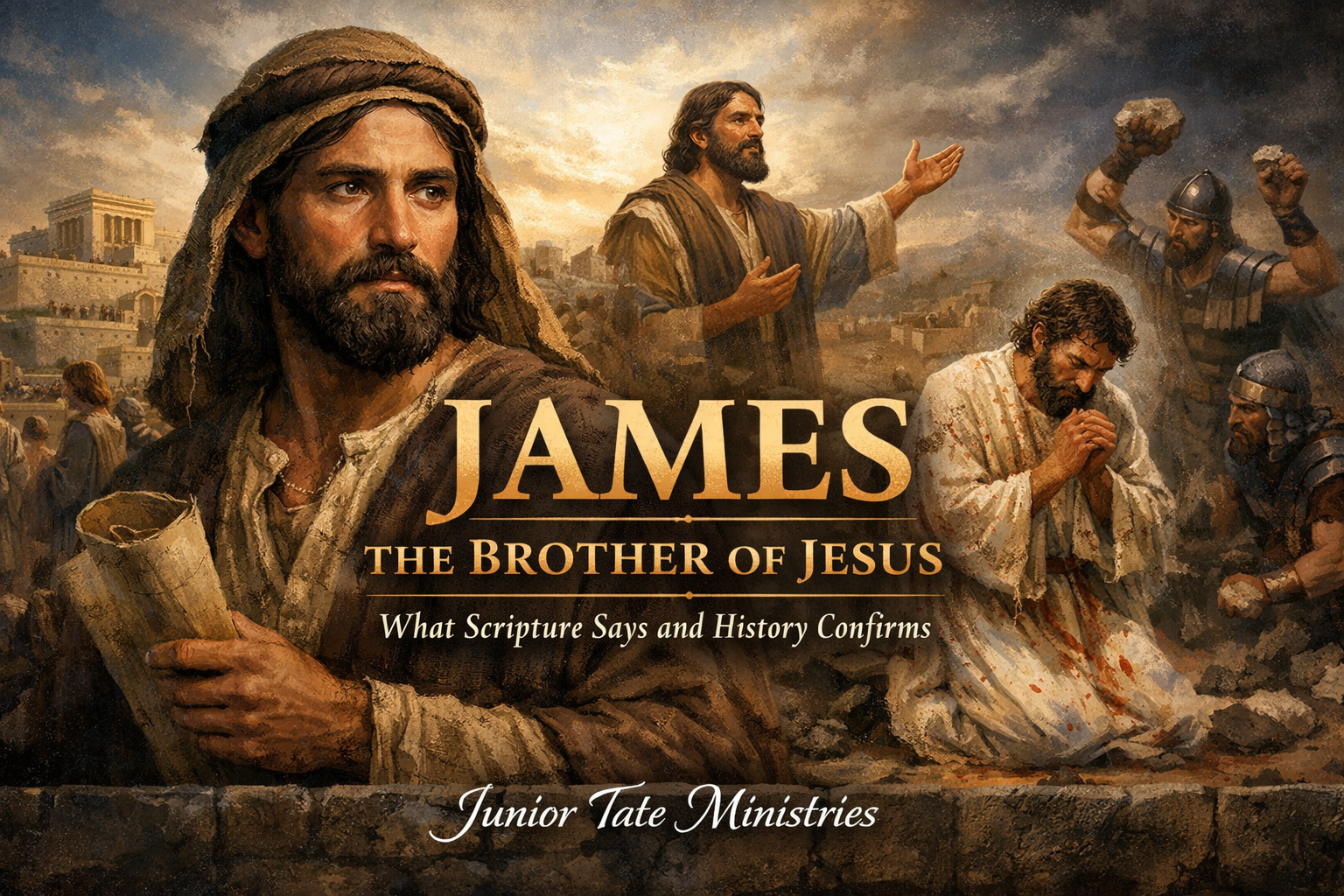
Introduction
Among the figures of the New Testament, few are as remarkable—and often overlooked—as James, the brother of Jesus.
He did not begin as a believer. He grew up in the same household as Jesus of Nazareth, witnessed His life firsthand, and yet initially rejected His messianic claims.
Scripture is honest about this fact.
But after the resurrection of Christ, James underwent a profound transformation.
He would go on to become one of the most influential leaders in the early Church, particularly in Jerusalem, and ultimately lay down his life as a martyr.
This article carefully examines everything Scripture explicitly says about James, quoting the full KJV verses, and then distinguishes that inspired record from what early history confirms about his life and death.
The goal is not speculation, legend, or church tradition elevated to doctrine—but biblical clarity supported by historical testimony.
James Identified as the Brother of Jesus (Scripture)
The New Testament clearly identifies James as one of Jesus’ brothers.
Jesus’ Family Named by the Gospels
Matthew 13:55–56 (KJV)
“Is not this the carpenter’s son? is not his mother called Mary? and his brethren, James, and Joses, and Simon, and Judas? And his sisters, are they not all with us? Whence then hath this man all these things?”
Mark 6:3 (KJV)
“Is not this the carpenter, the son of Mary, the brother of James, and Joses, and of Juda, and Simon? and are not his sisters here with us? And they were offended at him.”
Scripture plainly names James as a brother of Jesus.
The Bible does not attempt to soften or redefine the term.
He is not introduced as an apostle at this stage, nor as a believer—but simply as a family member.
James’ Initial Unbelief (Scripture)
One of the most striking facts about James is that he did not believe in Jesus during His earthly ministry.
John 7:5 (KJV) “For neither did his brethren believe in him.”
This verse includes James among those who lived with Jesus yet did not accept His claims during that time. Scripture does not hide this reality.
It emphasizes the authenticity of the later transformation.
The Resurrection Appearance That Changed Everything (Scripture)
After Jesus’ resurrection, something extraordinary occurred.
1 Corinthians 15:7 (KJV) “After that, he was seen of James; then of all the apostles.”
The Bible does not record the conversation or the details of this meeting—but it records the fact. The risen Christ personally appeared to James.
This moment marks the clear turning point in James’ life.
James Among the Believers After the Ascension (Scripture)
Following the resurrection and ascension, James is no longer listed among skeptics—but among praying believers.
Acts 1:14 (KJV) “These all continued with one accord in prayer and supplication, with the women, and Mary the mother of Jesus, and with his brethren.”
James, once an unbeliever, is now united with the Church in prayer.
James Emerges as a Leader in Jerusalem (Scripture)
Peter Recognizes James’ Authority
Acts 12:17 (KJV) “But he, beckoning unto them with the hand to hold their peace, declared unto them how the Lord had brought him out of the prison. And he said, Go shew these things unto James, and to the brethren. And he departed, and went into another place.”
Peter, one of the Twelve, instructs that news be taken directly to James—demonstrating James’ recognized authority within the Jerusalem church.
James at the Jerusalem Council (Scripture)
James plays a central role in resolving one of the most critical doctrinal issues of the early Church: whether Gentile believers must keep the Law of Moses.
Acts 15:13–21 (KJV)
“And after they had held their peace, James answered, saying, Men and brethren, hearken unto me:
Simeon hath declared how God at the first did visit the Gentiles, to take out of them a people for his name.
And to this agree the words of the prophets; as it is written,
After this I will return, and will build again the tabernacle of David, which is fallen down; and I will build again the ruins thereof, and I will set it up:
That the residue of men might seek after the Lord, and all the Gentiles, upon whom my name is called, saith the Lord, who doeth all these things.
Known unto God are all his works from the beginning of the world.
Wherefore my sentence is, that we trouble not them, which from among the Gentiles are turned to God:
But that we write unto them, that they abstain from pollutions of idols, and from fornication, and from things strangled, and from blood.
For Moses of old time hath in every city them that preach him, being read in the synagogues every sabbath day.”
James does not contradict the apostles—he synthesizes Scripture and affirms salvation by grace while encouraging holiness.
Paul Identifies James as “the Lord’s Brother” (Scripture)
Paul explicitly confirms James’ identity.
Galatians 1:18–19 (KJV)
“Then after three years I went up to Jerusalem to see Peter, and abode with him fifteen days.
But other of the apostles saw I none, save James the Lord’s brother.”
James Named a Pillar of the Church
Galatians 2:9 (KJV) “And when James, Cephas, and John, who seemed to be pillars, perceived the grace that was given unto me, they gave to me and Barnabas the right hands of fellowship; that we should go unto the heathen, and they unto the circumcision.”
James stands alongside Peter and John as a foundational leader.
James’ Continued Leadership Late in Acts (Scripture)
Years later, James remains at the center of Jerusalem leadership.
Acts 21:17–19 (KJV)
“And when we were come to Jerusalem, the brethren received us gladly.
And the day following Paul went in with us unto James; and all the elders were present.
And when he had saluted them, he declared particularly what things God had wrought among the Gentiles by his ministry.”
James presides among the elders—demonstrating long-term stability and leadership.
James the Author of the Epistle of James (Scripture)
James identifies himself not by family connection, but by submission to Christ.
James 1:1 (KJV)
“James, a servant of God and of the Lord Jesus Christ, to the twelve tribes which are scattered abroad, greeting.”
This humility underscores the transformation from skeptic to servant.
What Scripture Does Not Say About James
Scripture does not tell us:
- The details of James’ conversion conversation
- The method of his death
- The date of his martyrdom
- Any physical description or personal anecdotes
Where Scripture is silent, doctrine must remain silent.
What History Confirms About James’ Death (Clearly Labeled)
Josephus (1st-Century Jewish Historian)
Josephus records that James, the brother of Jesus who was called Christ, was condemned by the high priest Ananus and stoned to death during a lapse in Roman authority, commonly dated around A.D. 62.
This is the earliest non-Christian confirmation of James’ death and is widely regarded as historically reliable.
Later Christian Tradition
Later writers (preserved by Eusebius) add further details—such as a confrontation at the temple and being struck after being thrown down.
These accounts may reflect expanded tradition, but they are not Scripture and must not be elevated to doctrine.
A Scripture-Anchored Timeline of James’ Life
- Named as Jesus’ brother (Matt 13:55)
- Did not believe during Jesus’ ministry (John 7:5)
- Saw the risen Christ (1 Cor 15:7)
- Joined believers in prayer (Acts 1:14)
- Became leader in Jerusalem (Acts 12; 15)
- Recognized as pillar by Paul (Gal 2:9)
- Authored the Epistle of James
- Martyred for his faith (confirmed historically)
Conclusion
James stands as powerful testimony to the truth of the resurrection.
A man who grew up with Jesus, doubted Him, then encountered the risen Christ—and spent the rest of his life serving Him faithfully.
Scripture presents James not as a legend, but as a transformed servant, a steady leader, and a faithful witness.
His life reminds believers that the resurrection changes everything, and that true authority in the Church flows not from proximity to Christ—but from submission to Him.
If the Holy Spirit is convicting and pulling at your heart strings today, give in to Him and follow the prayer below for your salvation in Jesus Christ!
You may not ever get another chance to except Christ as your personal Savior and Lord! Your next breath is not promised!
If the Holy Spirit is convicting and pulling at your heart strings today, give in to Him and follow the prayer below for your salvation in Jesus Christ!
You may not ever get another chance to except Christ as your personal Savior and Lord! Your next breath is not promised!
Come! He’s Waiting on You!
Prayer to Salvation
Heavenly Father,
I come before You today admitting that I am a sinner in need of Your mercy and grace.
Your Word says in Romans 10:9–10 that if I confess with my mouth the Lord Jesus and believe in my heart that God hath raised Him from the dead, I shall be saved.
Today, I confess Jesus Christ as my Lord and my Savior. I believe with all my heart that He died for my sins, was buried, and rose again the third day.
Lord Jesus, I ask You to forgive me of all my sins. Wash me clean in Your precious blood. I turn from my old life and surrender fully to You.
Come into my heart, make me a new creature, and fill me with the Holy Spirit. From this day forward, I choose to follow You, live by Your Word, and walk in the new life You have given me.
Thank You, Lord, for saving me, for forgiving me, and for writing my name in the Lamb’s Book of Life. I give You all the glory, honor, and praise.
In Jesus’ name I pray, Amen.
greatcommissiontoday.com
juniortateministries.com