
By: Junior Tate
When Grace Stopped a Persecutor and Raised Up a Preacher
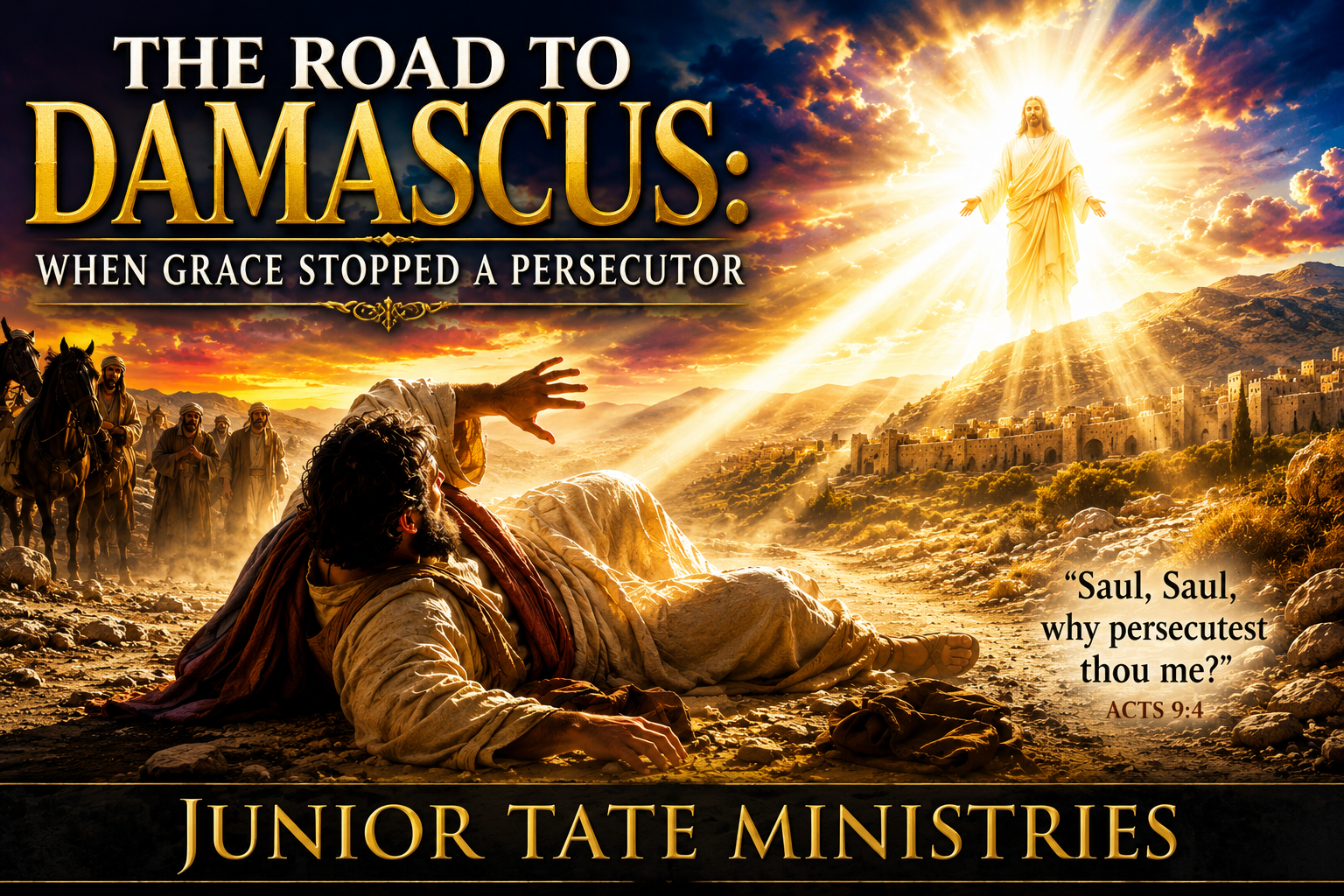
The Road to Damascus is one of the most powerful conversion accounts in all the Word of God. It is not merely the story of a man changing religions. It is the story of the risen Lord Jesus Christ confronting a religious persecutor, breaking his pride, opening his spiritual eyes, and calling him into the ministry of the Gospel.
Before Saul became Paul the apostle, he was a fierce enemy of the early Church. He was religious, educated, zealous, and deeply committed to what he believed was right. But sincerity without truth can still be deadly. Saul thought he was serving God, yet he was fighting against the very people who belonged to Christ.
The Road to Damascus teaches that salvation is by grace, not by religious achievement. It teaches that Jesus is alive, that He knows His people, that persecution against the Church is persecution against Him, and that no sinner is beyond the reach of God’s mercy. Saul did not find Christ because he was searching for grace. Christ found Saul while Saul was breathing out threats against believers.
This moment changed Saul’s life forever. The persecutor became a preacher. The enemy became a servant. The man who once tried to silence the name of Jesus became one of the greatest witnesses of Jesus Christ in biblical history.
Saul Before Damascus
To understand the power of Saul’s conversion, we must understand who he was before the Lord stopped him on the road. Saul was not an atheist. He was not an idol worshiper. He was a deeply religious Jew, trained in the law, zealous for the traditions of his fathers, and convinced that the followers of Jesus were dangerous.
Paul later described his religious background in Philippians.
Philippians 3:5-6 (KJV)
“Circumcised the eighth day, of the stock of Israel, of the tribe of Benjamin, an Hebrew of the Hebrews; as touching the law, a Pharisee;
Concerning zeal, persecuting the church; touching the righteousness which is in the law, blameless.”
Saul had heritage, training, zeal, religion, and outward morality. Yet none of those things saved him. This is very important. A person can be religious and still be lost. A person can know Scripture outwardly and still miss Christ inwardly. Saul had knowledge about God, but he did not yet know Jesus Christ as Lord and Saviour.
He was a Pharisee, and the Pharisees were strict concerning the law. They cared deeply about religious purity, tradition, and outward obedience. But Saul’s zeal was misdirected. He thought he was defending God’s truth, but he was actually opposing God’s Son.
Saul first appears prominently at the death of Stephen, the first Christian martyr recorded in Acts.
Acts 7:58 (KJV)
“And cast him out of the city, and stoned him: and the witnesses laid down their clothes at a young man’s feet, whose name was Saul.”
Stephen had preached Christ boldly to the Jewish leaders. He testified that Israel had resisted the Holy Ghost and rejected the Just One. The people became furious and stoned him. Saul stood there as a young man, watching and consenting to Stephen’s death.
Acts 8:1 (KJV)
“And Saul was consenting unto his death. And at that time there was a great persecution against the church which was at Jerusalem; and they were all scattered abroad throughout the regions of Judaea and Samaria, except the apostles.”
Saul did not merely watch Stephen die. Scripture says he was consenting unto his death. That means he approved of it. He agreed with it. He believed Stephen deserved it. This shows how hardened Saul’s heart was before his conversion.
Then Saul went even further.
Acts 8:3 (KJV)
“As for Saul, he made havock of the church, entering into every house, and haling men and women committed them to prison.”
The phrase “made havock” shows violent destruction. Saul was not lightly disagreeing with Christians. He was hunting them. He entered houses. He dragged away men and women. He helped put believers in prison. This was not political disagreement or simple debate. This was persecution against the body of Christ.
Yet while Saul was pursuing believers, God was pursuing Saul.
Saul’s Mission Against the Church
Acts chapter 9 opens with Saul still filled with hatred against the disciples of the Lord.
Acts 9:1-2 (KJV)
“And Saul, yet breathing out threatenings and slaughter against the disciples of the Lord, went unto the high priest,
And desired of him letters to Damascus to the synagogues, that if he found any of this way, whether they were men or women, he might bring them bound unto Jerusalem.”
This passage shows the condition of Saul’s heart before grace interrupted him. He was “breathing out threatenings and slaughter.” This was not a passing emotion. This was the very air he breathed. His mind was consumed with destroying the followers of Jesus.
He went to the high priest and requested official letters giving him authority to go to Damascus. Damascus was a city outside Jerusalem, showing that Saul’s hatred was spreading. He was not satisfied with persecuting believers nearby. He wanted to travel and bring them back bound to Jerusalem.
The believers are called “the way.” Christianity was not first known as a denomination, political movement, or man-made religion. The followers of Jesus were known as those who walked in the way of Christ. Jesus Himself said:
John 14:6 (KJV)
“Jesus saith unto him, I am the way, the truth, and the life: no man cometh unto the Father, but by me.”
The early believers followed the One who is the Way. Saul was trying to destroy “the way,” but on the road to Damascus he would meet the Way Himself.
This is one of the great truths of the account. Saul had letters from men, but Christ had authority from Heaven. Saul had permission from the high priest, but Jesus is the great High Priest. Saul thought he was in control of the journey, but the Lord was about to stop him in his tracks.
The Light from Heaven
Acts 9:3 (KJV)
“And as he journeyed, he came near Damascus: and suddenly there shined round about him a light from heaven:”
Saul was close to Damascus when the Lord intervened. He was almost at the place where he planned to arrest believers. But before he could carry out his mission, Heaven stepped in.
The light did not come from the earth. It came from Heaven. This was not imagination, emotion, or religious excitement. It was a divine encounter with the risen Christ. The glory of the Lord interrupted Saul’s path.
The word “suddenly” is important. Saul did not schedule this meeting. He did not expect it. He did not prepare for it. Grace came suddenly. God stopped him at the right moment.
Many people think they are too far gone for God to reach them. But Saul’s conversion proves that the Lord can stop a sinner anywhere, at any time, and in any condition. Saul was not sitting in a prayer meeting asking how to be saved. He was on his way to persecute believers. Yet Christ met him there.
The light from Heaven exposed the darkness in Saul’s heart. Saul had physical sight, but he was spiritually blind. He knew religion, but he did not know Christ. He had confidence, but he did not have salvation.
When the glory of Jesus appeared, Saul fell.
“Saul, Saul, Why Persecutest Thou Me?”
Acts 9:4 (KJV)
“And he fell to the earth, and heard a voice saying unto him, Saul, Saul, why persecutest thou me?”
The voice from Heaven called Saul by name. This shows that the Lord knew exactly who he was. Saul was not hidden from God. His hatred, violence, pride, and religious blindness were all known to Christ.
The Lord asked, “Why persecutest thou me?” Jesus did not say, “Why persecutest thou my people?” He said, “Why persecutest thou me?” This reveals a deep spiritual truth. The Church belongs to Christ. Believers are united with Him. To attack the people of Christ is to attack Christ Himself.
This should comfort every believer who suffers for the name of Jesus. The Lord does not ignore the persecution of His people. He sees it. He knows it. He takes it personally. When Stephen was stoned, Jesus saw. When believers were dragged from their homes, Jesus saw. When Saul breathed out threats, Jesus heard.
The question also exposed Saul’s sin. Saul thought he was serving God. But Jesus revealed that Saul was persecuting the very Lord he claimed to serve. This is a frightening reminder that religious zeal without truth can become rebellion against God.
“Who Art Thou, Lord?”
Acts 9:5 (KJV)
“And he said, Who art thou, Lord? And the Lord said, I am Jesus whom thou persecutest: it is hard for thee to kick against the pricks.”
Saul asked, “Who art thou, Lord?” The answer changed his life forever: “I am Jesus whom thou persecutest.”
This means Jesus was alive. Saul had rejected the testimony of the Christians. He had rejected the message that Jesus had risen from the dead. But now the risen Christ spoke to him directly from Heaven.
Jesus did not say, “I was Jesus.” He said, “I am Jesus.” The same Jesus who was crucified had risen. The same Jesus preached by Stephen was alive. The same Jesus Saul hated was Lord.
The phrase “it is hard for thee to kick against the pricks” refers to resisting conviction. A prick was like a sharp goad used to move an animal. If the animal kicked against it, it only hurt itself more. Saul had been resisting the truth. Perhaps Stephen’s testimony had pierced his conscience. Perhaps the courage of the believers had troubled him. Perhaps the Scriptures he knew were pressing against his heart. But Saul had been kicking against conviction.
This shows the mercy of God. Christ had been dealing with Saul before Damascus, but Saul had resisted. Still, the Lord did not abandon him. He confronted him with saving power.
Saul’s Surrender
Acts 9:6 (KJV)
“And he trembling and astonished said, Lord, what wilt thou have me to do? And the Lord said unto him, Arise, and go into the city, and it shall be told thee what thou must do.”
Saul was trembling and astonished. The proud persecutor was now humbled before Jesus Christ. He no longer gave orders. He asked for direction. He no longer led the attack. He submitted to the Lord.
His question is powerful: “Lord, what wilt thou have me to do?” This is the proper response to Christ. Salvation brings surrender. Saul was not saved to continue living for himself. He was saved to belong to Jesus.
The Lord told him to arise and go into the city. Saul would receive further instruction. Notice that the Lord did not tell Saul everything at once. He gave him the next step. This is often how God leads. He does not always show the whole road ahead. He tells us to obey what He has revealed.
Saul entered Damascus differently than he planned. He had intended to enter as a powerful religious enforcer. Instead, he entered humbled, blind, and dependent on others.
The Men Who Journeyed with Saul
Acts 9:7 (KJV)
“And the men which journeyed with him stood speechless, hearing a voice, but seeing no man.”
The men with Saul witnessed something supernatural. They heard a voice, but they saw no man. They stood speechless. This was not something Saul invented privately. The encounter affected those around him.
God made sure there were witnesses to the reality of what happened. Saul’s conversion was not a small emotional experience hidden in a corner. It was a divine interruption with visible consequences.
Saul’s Blindness
Acts 9:8-9 (KJV)
“And Saul arose from the earth; and when his eyes were opened, he saw no man: but they led him by the hand, and brought him into Damascus.
And he was three days without sight, and neither did eat nor drink.”
Saul opened his eyes, but he could not see. This physical blindness reflected his spiritual condition before Christ opened his heart. He had been blind while thinking he saw clearly.
For three days Saul was without sight. He did not eat or drink. These were days of brokenness, reflection, prayer, and surrender. The man who once acted with confidence was now helpless. The man who once dragged believers away now had to be led by the hand.
This was not punishment without purpose. It was preparation. God was stripping Saul of pride and preparing him for a new life.
Three days is also meaningful because it points our minds to death and resurrection. Saul’s old life was ending. A new life was beginning. The persecutor was being buried, and the preacher was about to rise.
Ananias, the Obedient Servant
While Saul prayed in blindness, God spoke to a disciple named Ananias.
Acts 9:10-12 (KJV)
“And there was a certain disciple at Damascus, named Ananias; and to him said the Lord in a vision, Ananias. And he said, Behold, I am here, Lord.
And the Lord said unto him, Arise, and go into the street which is called Straight, and enquire in the house of Judas for one called Saul, of Tarsus: for, behold, he prayeth,
And hath seen in a vision a man named Ananias coming in, and putting his hand on him, that he might receive his sight.”
Ananias was not an apostle. He was a disciple. Yet God used him in a mighty way. This reminds us that God often uses faithful servants who may not be famous. Ananias simply obeyed the Lord.
The Lord told Ananias exactly where Saul was. He named the street, the house, the man, and the situation. God knew Saul’s location. God knew Saul’s prayer. God knew Saul’s future.
The phrase “behold, he prayeth” is beautiful. Saul had likely prayed many times before as a Pharisee, but now he was praying as a humbled sinner before the Lord Jesus Christ. His prayer life had changed because his heart had changed.
Ananias’ Fear
Acts 9:13-14 (KJV)
“Then Ananias answered, Lord, I have heard by many of this man, how much evil he hath done to thy saints at Jerusalem:
And here he hath authority from the chief priests to bind all that call on thy name.”
Ananias knew Saul’s reputation. He had heard about the evil Saul had done to the saints at Jerusalem. He also knew Saul had authority to arrest believers in Damascus. Humanly speaking, Ananias had every reason to be afraid.
This makes his obedience even more powerful. God was asking Ananias to go to the very man who had come to harm Christians. Grace can be shocking. The Church may have expected Saul to be judged, but God was about to use him as a chosen vessel.
Ananias’ fear was honest, but he did not allow fear to cancel obedience. Once the Lord made His will clear, Ananias went.
A Chosen Vessel
Acts 9:15-16 (KJV)
“But the Lord said unto him, Go thy way: for he is a chosen vessel unto me, to bear my name before the Gentiles, and kings, and the children of Israel:
For I will shew him how great things he must suffer for my name’s sake.”
The Lord revealed Saul’s calling. Saul was a chosen vessel. God had a purpose for the man who once persecuted the Church. Saul would bear the name of Jesus before Gentiles, kings, and the children of Israel.
This is one of the most amazing turns in Scripture. Saul had tried to destroy the name of Jesus, but now he would carry that name across the world. He had used his strength to persecute believers, but now his strength would be used to preach Christ.
The Lord also said Saul would suffer for His name’s sake. Salvation did not mean Saul would have an easy life. His calling included hardship, rejection, imprisonment, beatings, and eventually martyrdom. But Saul would learn that suffering for Christ was greater than success without Christ.
This is important for believers today. The call of God is not always comfortable. Obedience may bring suffering. But suffering for Jesus is never wasted.
Brother Saul
Acts 9:17 (KJV)
“And Ananias went his way, and entered into the house; and putting his hands on him said, Brother Saul, the Lord, even Jesus, that appeared unto thee in the way as thou camest, hath sent me, that thou mightest receive thy sight, and be filled with the Holy Ghost.”
Ananias called him “Brother Saul.” What grace! The man who had come to arrest Christians was now received as a brother. This shows the power of the Gospel to reconcile sinners into the family of God.
Ananias did not call him “enemy.” He did not call him “persecutor.” He called him “brother.” That one word shows that Saul’s identity had changed.
The Lord Jesus had appeared to Saul on the way. Now the Lord sent Ananias so Saul might receive his sight and be filled with the Holy Ghost.
This reminds us that salvation is not merely turning over a new leaf. Saul needed spiritual life, spiritual power, and spiritual direction. The Holy Ghost would empower him for the work ahead.
Saul Receives Sight
Acts 9:18 (KJV)
“And immediately there fell from his eyes as it had been scales: and he received sight forthwith, and arose, and was baptized.”
Something like scales fell from Saul’s eyes. He received his sight immediately. The outward healing pictured the inward reality. The man who had been spiritually blind could now see the truth of Christ.
He arose and was baptized. Baptism did not save Saul, but it publicly identified him with Jesus Christ and His people. Saul was no longer standing with those who persecuted Christians. He was now standing with the Christians.
This was a costly step. Everyone knew who Saul was. His baptism made his conversion public. There was no hidden discipleship here. Saul openly identified with the Lord he once opposed.
Saul Strengthened
Acts 9:19 (KJV)
“And when he had received meat, he was strengthened. Then was Saul certain days with the disciples which were at Damascus.”
After three days without food or drink, Saul ate and was strengthened. Then he spent time with the disciples in Damascus. This is beautiful because Saul had come to Damascus to arrest disciples. Now he was staying with them.
Grace changed his relationships. The people he once hated became his family. The people he once sought to bind became his brothers and sisters. The Gospel does not merely change where a person goes when they die. It changes who they are, how they live, and whom they love.
Saul Preaches Christ
Acts 9:20 (KJV)
“And straightway he preached Christ in the synagogues, that he is the Son of God.”
Immediately Saul began preaching Christ. He did not preach himself. He did not preach religion. He did not preach tradition. He preached Christ.
The message was clear: Jesus is the Son of God. This was the truth Saul had once rejected. Now it became the center of his life.
The same synagogues where Saul may have intended to arrest believers became places where he preached Jesus. The transformation was undeniable. Only the grace of God could do this.
The People Were Amazed
Acts 9:21 (KJV)
“But all that heard him were amazed, and said; Is not this he that destroyed them which called on this name in Jerusalem, and came hither for that intent, that he might bring them bound unto the chief priests?”
The people were shocked. They knew Saul’s reputation. They knew he had destroyed those who called on the name of Jesus in Jerusalem. They knew he had come to Damascus to bring believers bound to the chief priests.
Now the destroyer was declaring the name he once tried to destroy.
This is the testimony of grace. When God saves a person, others may be amazed. They may remember what that person used to be. But the Gospel is powerful enough to change the hardest heart.
Saul Increases in Strength
Acts 9:22 (KJV)
“But Saul increased the more in strength, and confounded the Jews which dwelt at Damascus, proving that this is very Christ.”
Saul grew stronger. He confounded the Jews at Damascus by proving that Jesus is the Christ. He knew the Old Testament Scriptures, but now he understood them in the light of Jesus.
Before Damascus, Saul knew the words of Scripture but missed the fulfillment. After meeting Christ, he could see that the law, prophets, and promises pointed to Jesus.
This teaches us that true understanding of Scripture centers on Christ. The Bible is not merely a book of moral lessons. It is the revelation of God’s redemptive plan through Jesus Christ.
The Persecutor Becomes the Persecuted
Acts 9:23-25 (KJV)
“And after that many days were fulfilled, the Jews took counsel to kill him:
But their laying await was known of Saul. And they watched the gates day and night to kill him.
Then the disciples took him by night, and let him down by the wall in a basket.”
The man who once pursued Christians was now being pursued. The persecutor became the persecuted. Those who rejected Christ now wanted Saul dead.
This shows the cost of following Jesus. Saul’s conversion did not make his life easier. It made him a target. But Saul had found something greater than safety. He had found Christ.
The disciples helped him escape by lowering him down the wall in a basket. This was humbling. Saul had once traveled with authority. Now he escaped in weakness. But God was preserving him for the ministry ahead.
Saul and the Apostles
Acts 9:26-27 (KJV)
“And when Saul was come to Jerusalem, he assayed to join himself to the disciples: but they were all afraid of him, and believed not that he was a disciple.
But Barnabas took him, and brought him to the apostles, and declared unto them how he had seen the Lord in the way, and that he had spoken to him, and how he had preached boldly at Damascus in the name of Jesus.”
When Saul came to Jerusalem, the disciples were afraid of him. This was understandable. They remembered what he had done. They were not immediately convinced that he was truly a disciple.
But Barnabas stood with him. Barnabas explained how Saul had seen the Lord, how the Lord had spoken to him, and how Saul had preached boldly in Damascus in the name of Jesus.
Barnabas’ role is important. He helped bridge the gap between Saul and the believers. He encouraged the Church to recognize the work of grace in Saul’s life. God uses encouragers like Barnabas to help restore, receive, and strengthen others.
Saul Speaks Boldly
Acts 9:28-29 (KJV)
“And he was with them coming in and going out at Jerusalem.
And he spake boldly in the name of the Lord Jesus, and disputed against the Grecians: but they went about to slay him.”
Saul continued speaking boldly in the name of the Lord Jesus. The same city where he had approved Stephen’s death now heard Saul preaching the same Christ Stephen proclaimed.
This is another powerful picture of grace. Saul had stood against Stephen. Now Saul stood for Stephen’s Saviour.
But opposition continued. The Grecians went about to kill him. Saul’s life would now be marked by both bold preaching and constant danger.
The Church Has Rest
Acts 9:30-31 (KJV)
“Which when the brethren knew, they brought him down to Caesarea, and sent him forth to Tarsus.
Then had the churches rest throughout all Judaea and Galilee and Samaria, and were edified; and walking in the fear of the Lord, and in the comfort of the Holy Ghost, were multiplied.”
The brethren sent Saul to Tarsus, and the churches had rest. The great persecutor had been stopped. The Church was edified, walking in the fear of the Lord and the comfort of the Holy Ghost. The result was multiplication.
This shows that Christ is Lord over His Church. The enemy may raise up opposition, but Jesus can stop the persecutor. He can protect His people. He can even turn an enemy into a preacher.
Paul’s Own Testimony
Paul later shared his testimony more than once. In Acts 22, he told the people what happened.
Acts 22:6-10 (KJV)
“And it came to pass, that, as I made my journey, and was come nigh unto Damascus about noon, suddenly there shone from heaven a great light round about me.
And I fell unto the ground, and heard a voice saying unto me, Saul, Saul, why persecutest thou me?
And I answered, Who art thou, Lord? And he said unto me, I am Jesus of Nazareth, whom thou persecutest.
And they that were with me saw indeed the light, and were afraid; but they heard not the voice of him that spake to me.
And I said, What shall I do, Lord? And the Lord said unto me, Arise, and go into Damascus; and there it shall be told thee of all things which are appointed for thee to do.”
Paul never got over what Jesus did for him. His testimony was not about his greatness. It was about the mercy of Christ. He remembered the light, the voice, the question, and the command.
In Acts 26, Paul testified before King Agrippa.
Acts 26:13-18 (KJV)
“At midday, O king, I saw in the way a light from heaven, above the brightness of the sun, shining round about me and them which journeyed with me.
And when we were all fallen to the earth, I heard a voice speaking unto me, and saying in the Hebrew tongue, Saul, Saul, why persecutest thou me? it is hard for thee to kick against the pricks.
And I said, Who art thou, Lord? And he said, I am Jesus whom thou persecutest.
But rise, and stand upon thy feet: for I have appeared unto thee for this purpose, to make thee a minister and a witness both of these things which thou hast seen, and of those things in the which I will appear unto thee;
Delivering thee from the people, and from the Gentiles, unto whom now I send thee,
To open their eyes, and to turn them from darkness to light, and from the power of Satan unto God, that they may receive forgiveness of sins, and inheritance among them which are sanctified by faith that is in me.”
This passage explains Paul’s mission. He was sent to open eyes, turn people from darkness to light, and from the power of Satan unto God. That is the Gospel mission. Salvation is not self-improvement. It is deliverance from darkness, forgiveness of sins, and inheritance among those sanctified by faith in Christ.
Grace Greater Than Saul’s Sin
Paul understood that he had been a great sinner, but he also understood that Christ’s grace was greater.
1 Timothy 1:12-16 (KJV)
“And I thank Christ Jesus our Lord, who hath enabled me, for that he counted me faithful, putting me into the ministry;
Who was before a blasphemer, and a persecutor, and injurious: but I obtained mercy, because I did it ignorantly in unbelief.
And the grace of our Lord was exceeding abundant with faith and love which is in Christ Jesus.
This is a faithful saying, and worthy of all acceptation, that Christ Jesus came into the world to save sinners; of whom I am chief.
Howbeit for this cause I obtained mercy, that in me first Jesus Christ might shew forth all longsuffering, for a pattern to them which should hereafter believe on him to life everlasting.”
Paul called himself a blasphemer, a persecutor, and injurious. He did not hide his past. But he also did not glorify his past. He glorified the mercy of Christ.
He said, “Christ Jesus came into the world to save sinners.” That is the heart of the Gospel. Jesus did not come to save good people who had earned Heaven. He came to save sinners.
Paul said he obtained mercy as a pattern to others who would believe. In other words, if Jesus could save Saul, Jesus can save anyone. Saul’s conversion stands as a testimony of God’s longsuffering.
The Road to Damascus Shows the Resurrection Is Real
The whole account depends on one truth: Jesus is alive. Saul did not meet a memory. He did not meet an idea. He met the risen Lord.
If Jesus were still dead, Saul would not have been stopped by His voice from Heaven. But Jesus rose bodily from the dead, ascended to Heaven, and appeared to Saul in glory.
Paul later preached the resurrection as central to the Gospel.
1 Corinthians 15:3-4 (KJV)
“For I delivered unto you first of all that which I also received, how that Christ died for our sins according to the scriptures;
And that he was buried, and that he rose again the third day according to the scriptures:”
The Road to Damascus is one more testimony that Jesus Christ is risen. The persecutor became a witness because he saw the risen Lord.
The Road to Damascus Shows Salvation Is by Grace
Saul was not saved because he deserved it. He was not saved because of religious works. He was saved by the mercy of God.
Ephesians 2:8-9 (KJV)
“For by grace are ye saved through faith; and that not of yourselves: it is the gift of God:
Not of works, lest any man should boast.”
Saul had works. He had religion. He had zeal. But he needed grace. The same is true for every person. No one is saved by church attendance, family background, good intentions, or religious effort. Salvation is the gift of God through faith in Jesus Christ.
The Road to Damascus Shows Christ Changes Lives
Saul’s conversion was not shallow. It changed everything. His direction changed. His message changed. His relationships changed. His purpose changed. His future changed.
2 Corinthians 5:17 (KJV)
“Therefore if any man be in Christ, he is a new creature: old things are passed away; behold, all things are become new.”
This verse perfectly fits Saul’s life. The old Saul was a persecutor. The new Saul became a preacher. The old Saul hated the name of Jesus. The new Saul suffered for the name of Jesus. The old Saul dragged believers away. The new Saul strengthened believers in the faith.
True salvation produces a changed life. A person is not saved by change, but a saved person will be changed by Christ.
The Road to Damascus Speaks to the Lost
For the lost person, Saul’s conversion is both a warning and an invitation.
It is a warning because Saul was religious but lost. He was sincere but wrong. He was zealous but blind. He had knowledge but did not know Christ. Religion without Jesus cannot save.
It is also an invitation because Saul was not beyond mercy. If Jesus saved Saul, He can save any sinner who comes to Him by faith.
Romans 10:9-10 (KJV)
“That if thou shalt confess with thy mouth the Lord Jesus, and shalt believe in thine heart that God hath raised him from the dead, thou shalt be saved.
For with the heart man believeth unto righteousness; and with the mouth confession is made unto salvation.”
Salvation is found in Jesus Christ alone. The same risen Lord who stopped Saul on the road still saves sinners today.
The Road to Damascus Speaks to Believers
For believers, this account is a reminder that no one is too hard for God. The person you think could never be saved may be the very person God is preparing to reach. The enemy of the Gospel today may become a preacher of the Gospel tomorrow.
It also reminds believers not to fear persecution. Jesus sees His people. He knows their suffering. He takes it personally. The Church belongs to Him.
It reminds servants of God to obey like Ananias. Sometimes God calls us to minister to people we fear, people we doubt, or people with painful pasts. But if God has changed them, we must receive what God has done.
It reminds us that God can use broken people. Saul’s past did not disqualify him from grace. His sins were real, but Christ’s mercy was greater.
Conclusion: Grace Met Saul on the Road
The Road to Damascus is not only the story of Saul’s conversion. It is the story of the power of the risen Christ.
Saul left Jerusalem with authority from men, but he was stopped by authority from Heaven. He traveled as an enemy of the Church, but he entered Damascus as a humbled servant of Jesus. He planned to bind Christians, but Christ bound his heart with grace. He came to silence the Gospel, but he became one of its greatest voices.
The message is clear: Jesus Christ is alive. He saves sinners. He changes lives. He calls servants. He builds His Church. He can take the hardest heart and turn it into a testimony of mercy.
Saul’s life proves that no sinner is beyond the reach of grace, no enemy is beyond the power of Christ, and no past is greater than the mercy of God.
The same Jesus who met Saul on the Road to Damascus still saves today.
If the Holy Spirit is convicting and pulling at your heart strings today, give in to Him and follow the prayer below for your salvation in Jesus Christ!
You may not ever get another chance to except Christ as your personal Savior and Lord! Your next breath is not promised!
Come! He’s Waiting on You!
Prayer to Salvation
Heavenly Father,
I come before You today admitting that I am a sinner in need of Your mercy and grace.
Your Word says in Romans 10:9–10 that if I confess with my mouth the Lord Jesus and believe in my heart that God hath raised Him from the dead, I shall be saved.
Today, I confess Jesus Christ as my Lord and my Savior. I believe with all my heart that He died for my sins, was buried, and rose again the third day.
Lord Jesus, I ask You to forgive me of all my sins. Wash me clean in Your precious blood. I turn from my old life and surrender fully to You.
Come into my heart, make me a new creature, and fill me with the Holy Spirit. From this day forward, I choose to follow You, live by Your Word, and walk in the new life You have given me.
Thank You, Lord, for saving me, for forgiving me, and for writing my name in the Lamb’s Book of Life. I give You all the glory, honor, and praise.
In Jesus’ name I pray, Amen.
juniortateministires.com
greatcommissiontoday.com