
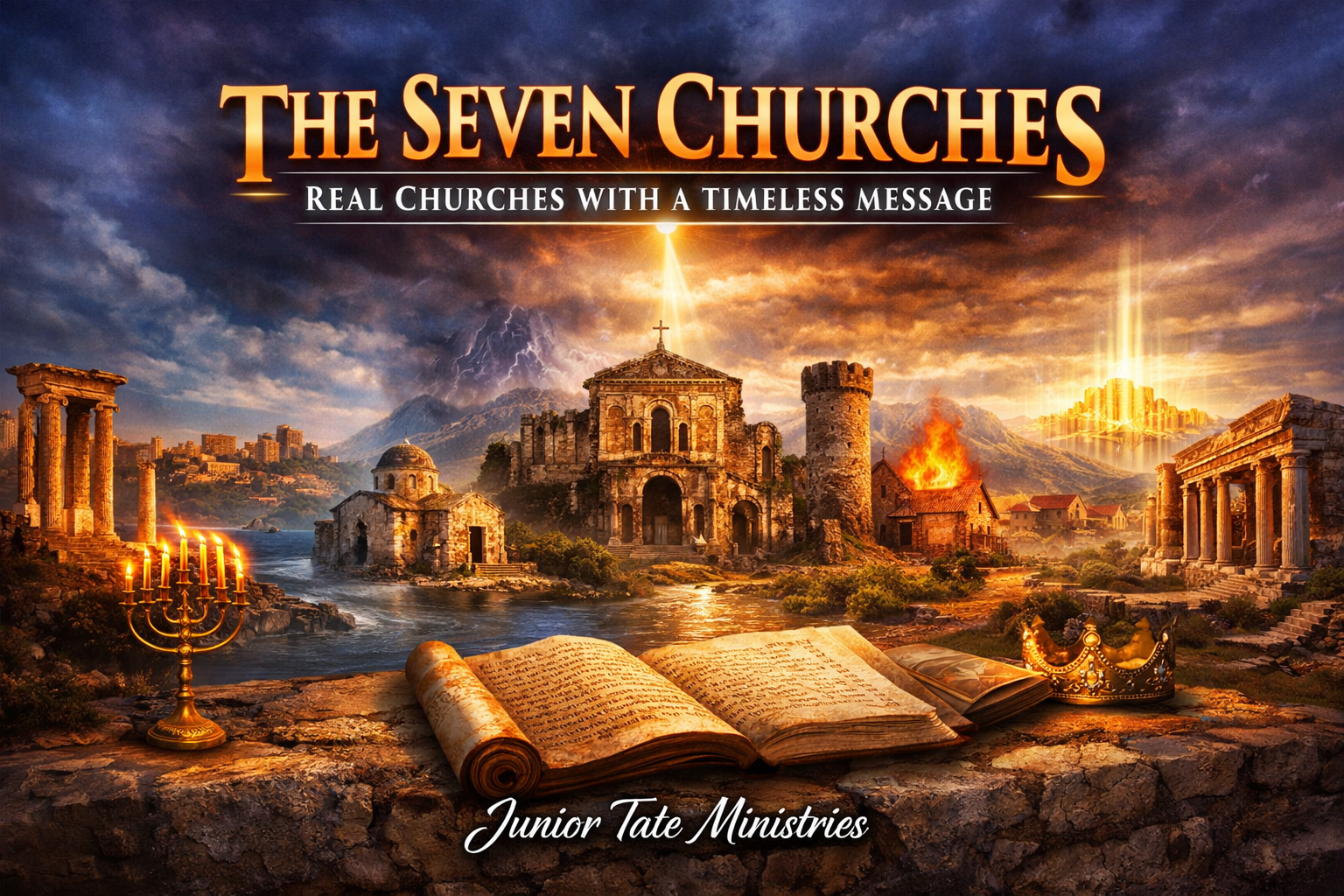
A Scripture-Centered Study from Revelation 1–3 (KJV)
By: Junior Tate Ministries
WHY THE SEVEN CHURCHES MATTER
The Book of Revelation is often treated as if it begins with beasts, judgments, and end-time events.
Yet the first major section of Revelation is not written to governments, armies, or future world leaders, it is written to churches.
Before the seals are opened, before trumpets sound, before vials are poured out, the Lord Jesus Christ speaks directly to His people and to congregations living in a real world of pressure, persecution, temptation, compromise, and spiritual dullness.
These were real churches, located in real cities of Asia (modern-day Turkey).
They faced real spiritual conditions that Christ exposes with perfect knowledge and perfect authority.
And because the Lord chose to preserve these messages in Scripture, their lessons are not limited to the first century; they remain timeless warnings and timeless encouragements for every generation.
The seven churches are not merely historical notes. They are also spiritual mirrors. Christ’s words force every church, and every believer, to face one question:
What does Christ of the church see when He looks at us Christians- “The Church”?
CHRIST’S AUTHORITY OVER THE CHURCHES (REVELATION 1)
Before the Lord addresses the seven churches, Revelation establishes who is speaking: the risen, glorified Jesus Christ, the One who walks among His churches and holds their leadership accountable.
Christ Among the Churches
Revelation 1:12–13 (KJV)
“And I turned to see the voice that spake with me. And being turned, I saw seven golden candlesticks;
And in the midst of the seven candlesticks one like unto the Son of man, clothed with a garment down to the foot, and girt about the paps with a golden girdle.”
Christ is not distant. He is “in the midst” of the candlesticks. The churches are pictured as light-bearing stands, meant to shine. Christ is present among them, not as a guest, but as Lord.
The Meaning of the Candlesticks and Stars
Revelation 1:20 (KJV)
“The mystery of the seven stars which thou sawest in my right hand, and the seven golden candlesticks. The seven stars are the angels of the seven churches: and the seven candlesticks which thou sawest are the seven churches.”
The candlesticks are the churches themselves. The “stars” are the “angels” of the churches (messengers).
Regardless of how one understands “angel” here, the point is clear: Christ holds the messengers/representatives accountable, and He evaluates each congregation.
Christ’s Power and Right to Judge
Revelation 1:17–18 (KJV)
“And when I saw him, I fell at his feet as dead. And he laid his right hand upon me, saying unto me, Fear not; I am the first and the last:
I am he that liveth, and was dead; and, behold, I am alive for evermore, Amen; and have the keys of hell and of death.”
Because Christ is risen and has authority over death, He has full authority to correct, warn, discipline, and commend His churches.
The messages that follow are not suggestions, they are the words of the Lord.
THE PATTERN IN EACH LETTER: CHRIST’S STANDARD FOR HIS CHURCH
When you read Revelation 2–3, a repeated structure appears:
- Christ identifies Himself with an aspect of His glory from Revelation 1
- “I know thy works”—He speaks with perfect knowledge
- Commendation where appropriate
- Rebuke where necessary
- A call to repent (or a call to remain faithful)
- A promise to the overcomer
- “He that hath an ear…”—the message is for more than one church
This repeated pattern shows that Christ cares about; doctrine, love, holiness, courage, endurance, repentance, and spiritual reality.
Christ does not merely measure churches by size, reputation, or activity. He judges by truth and heart.
EPHESUS — RIGHT BELIEFS WITHOUT FIRST LOVE
Revelation 2:1 (KJV)
“Unto the angel of the church of Ephesus write; These things saith he that holdeth the seven stars in his right hand, who walketh in the midst of the seven golden candlesticks;”
Christ introduces Himself as the One who holds and walks among the churches. Ephesus needs to remember that Christ is present, watching, and evaluating.
What Christ Commends
Revelation 2:2–3 (KJV)
“I know thy works, and thy labour, and thy patience, and how thou canst not bear them which are evil: and thou hast tried them which say they are apostles, and are not, and hast found them liars:
And hast borne, and hast patience, and for my name’s sake hast laboured, and hast not fainted.”
Ephesus had labor, endurance, and discernment. They rejected false apostles and refused evil. That is not a small thing. Christ values doctrinal testing and perseverance.
What Christ Rebukes
Revelation 2:4 (KJV)
“Nevertheless I have somewhat against thee, because thou hast left thy first love.”
They did not lose doctrine. They did not stop working. But their love cooled. “First love” speaks of that early devotion—love for Christ that is warm, living, and personal.
The Call to Repent
Revelation 2:5 (KJV)
“Remember therefore from whence thou art fallen, and repent, and do the first works; or else I will come unto thee quickly, and will remove thy candlestick out of his place, except thou repent.”
This is serious: a church can be active and orthodox and still be in danger of losing its light-bearing place. Christ demands love with truth—not truth without love.
Promise to the Overcomer
Revelation 2:7 (KJV)
“He that hath an ear, let him hear what the Spirit saith unto the churches; To him that overcometh will I give to eat of the tree of life, which is in the midst of the paradise of God.”
The reward points back to Eden restored. Christ calls His people to overcome coldness and return to living love.
SMYRNA — THE PERSECUTED CHURCH THAT MUST NOT FEAR
Revelation 2:8 (KJV)
“And unto the angel of the church in Smyrna write; These things saith the first and the last, which was dead, and is alive;”
Christ identifies Himself as the One who died and lives—perfect comfort for a suffering church.
What Christ Knows
Revelation 2:9 (KJV)
“I know thy works, and tribulation, and poverty, (but thou art rich) and I know the blasphemy of them which say they are Jews, and are not, but are the synagogue of Satan.”
Smyrna suffered tribulation and poverty, yet Christ calls them rich. Their suffering did not mean God abandoned them. They also faced spiritual opposition described in severe terms.
The Warning and Encouragement
Revelation 2:10 (KJV)
“Fear none of those things which thou shalt suffer: behold, the devil shall cast some of you into prison, that ye may be tried; and ye shall have tribulation ten days: be thou faithful unto death, and I will give thee a crown of life.”
Christ does not promise escape from suffering here. He promises strength and reward through faithfulness.
Promise to the Overcomer
Revelation 2:11 (KJV)
“He that hath an ear, let him hear what the Spirit saith unto the churches; He that overcometh shall not be hurt of the second death.”
The second death is eternal judgment. Christ assures persecuted believers: death cannot steal your salvation; eternal life is secure in Him.
PERGAMOS — WHERE SATAN’S SEAT IS: COMPROMISE IN A DARK PLACE
Revelation 2:12 (KJV)
“And to the angel of the church in Pergamos write; These things saith he which hath the sharp sword with two edges;”
The sword points to Christ’s Word and His authority to judge and correct.
Faithfulness Under Pressure
Revelation 2:13 (KJV)
“I know thy works, and where thou dwellest, even where Satan’s seat is: and thou holdest fast my name, and hast not denied my faith, even in those days wherein Antipas was my faithful martyr, who was slain among you, where Satan dwelleth.”
They lived in a spiritually dark environment and still held Christ’s name. A martyr named Antipas had been killed. Christ sees and honors steadfastness.
The Rebuke: False Teaching Tolerated
Revelation 2:14–15 (KJV)
“But I have a few things against thee, because thou hast there them that hold the doctrine of Balaam, who taught Balac to cast a stumblingblock before the children of Israel, to eat things sacrificed unto idols, and to commit fornication.
So hast thou also them that hold the doctrine of the Nicolaitans, which thing I hate.”
Pergamos was not only pressured from outside. It was weakened from within by tolerated compromise, doctrines that led toward idolatry and immorality.
The Call to Repent
Revelation 2:16 (KJV)
“Repent; or else I will come unto thee quickly, and will fight against them with the sword of my mouth.”
Christ does not negotiate with tolerated sin. He calls for repentance, or He will bring correction by His Word.
Promise to the Overcomer
Revelation 2:17 (KJV)
“He that hath an ear, let him hear what the Spirit saith unto the churches; To him that overcometh will I give to eat of the hidden manna, and will give him a white stone, and in the stone a new name written, which no man knoweth saving he that receiveth it.”
Hidden manna speaks of God’s provision and fellowship. The white stone and new name picture acceptance and personal belonging to Christ.
THYATIRA — LOVE AND SERVICE, BUT TOLERATING “JEZEBEL”
Revelation 2:18 (KJV)
“And unto the angel of the church in Thyatira write; These things saith the Son of God, who hath his eyes like unto a flame of fire, and his feet are like fine brass;”
Christ’s eyes of fire speak of penetrating judgment. His feet like brass speak of strength and purity in judgment.
What Christ Commends
Revelation 2:19 (KJV)
“I know thy works, and charity, and service, and faith, and thy patience, and thy works; and the last to be more than the first.”
This church had love, service, faith, patience, and growth. Their “last works” exceeded the first, evidence of activity and zeal.
The Rebuke: Toleration of Corrupt Influence
Revelation 2:20–23 (KJV)
“Notwithstanding I have a few things against thee, because thou sufferest that woman Jezebel, which calleth herself a prophetess, to teach and to seduce my servants to commit fornication, and to eat things sacrificed unto idols.
And I gave her space to repent of her fornication; and she repented not.
Behold, I will cast her into a bed, and them that commit adultery with her into great tribulation, except they repent of their deeds.
And I will kill her children with death; and all the churches shall know that I am he which searcheth the reins and hearts: and I will give unto every one of you according to your works.”
Christ explicitly says He searches hearts and repays according to works. He also shows His patience, He gave time to repent, but He will judge unrepentant corruption.
Instruction to the Faithful Remnant
Revelation 2:24–25 (KJV)
“But unto you I say, and unto the rest in Thyatira, as many as have not this doctrine, and which have not known the depths of Satan, as they speak; I will put upon you none other burden.
But that which ye have already hold fast till I come.”
The faithful must hold fast. Notice “till I come”—a future expectation that Christ’s coming remains central.
Promise to the Overcomer
Revelation 2:26–28 (KJV)
“And he that overcometh, and keepeth my works unto the end, to him will I give power over the nations:
And he shall rule them with a rod of iron; as the vessels of a potter shall they be broken to shivers: even as I received of my Father. And I will give him the morning star.”Christ promises participation in His future reign and grants “the morning star,” tied to His own glory and coming.
SARDIS — A NAME THAT LIVED, BUT SPIRITUALLY DEAD
Revelation 3:1 (KJV)
“And unto the angel of the church in Sardis write; These things saith he that hath the seven Spirits of God, and the seven stars; I know thy works, that thou hast a name that thou livest, and art dead.”
Sardis looked alive outwardly—reputation, activity, perhaps numbers—but Christ says they are dead. This is one of the most sobering warnings in Scripture about outward religion without inward life.
The Call to Wake Up
Revelation 3:2–3 (KJV)
“Be watchful, and strengthen the things which remain, that are ready to die: for I have not found thy works perfect before God.
Remember therefore how thou hast received and heard, and hold fast, and repent. If therefore thou shalt not watch, I will come on thee as a thief, and thou shalt not know what hour I will come upon thee.”
They must return to what they received and heard, truth, hold it fast and repent. The “thief” language emphasizes suddenness of judgment upon unwatchfulness.
The Faithful Few
Revelation 3:4 (KJV)
“Thou hast a few names even in Sardis which have not defiled their garments; and they shall walk with me in white: for they are worthy.”
Even in a dead church, Christ sees individuals who remain undefiled.
Promise to the Overcomer
Revelation 3:5 (KJV)
“He that overcometh, the same shall be clothed in white raiment; and I will not blot out his name out of the book of life, but I will confess his name before my Father, and before his angels.”
The overcomer is promised white raiment and public confession by Christ before the Father.
PHILADELPHIA — LITTLE STRENGTH, GREAT FAITHFULNESS
Revelation 3:7–8 (KJV)
“And to the angel of the church in Philadelphia write; These things saith he that is holy, he that is true, he that hath the key of David, he that openeth, and no man shutteth; and shutteth, and no man openeth;
I know thy works: behold, I have set before thee an open door, and no man can shut it: for thou hast a little strength, and hast kept my word, and hast not denied my name.”
Philadelphia is commended: they kept His Word and did not deny His name. They had “little strength,” yet Christ opened a door no one could shut, often understood as opportunity for ministry and testimony by Christ’s authority.
Christ’s Protection and Promise
Revelation 3:10–11 (KJV)
“Because thou hast kept the word of my patience, I also will keep thee from the hour of temptation, which shall come upon all the world, to try them that dwell upon the earth.
Behold, I come quickly: hold that fast which thou hast, that no man take thy crown.”
Christ ties their faithfulness to future protection and urges them to hold fast because He is coming.
Promise to the Overcomer
Revelation 3:12–13 (KJV)
“Him that overcometh will I make a pillar in the temple of my God, and he shall go no more out: and I will write upon him the name of my God, and the name of the city of my God, which is new Jerusalem, which cometh down out of heaven from my God: and I will write upon him my new name. He that hath an ear, let him hear what the Spirit saith unto the churches.”
The overcomer is made a pillar, stability, honor, belonging. The New Jerusalem is explicitly named, connecting the church’s hope to God’s eternal city.
LAODICEA — LUKEWARM, SELF-SUFFICIENT, AND CHRIST OUTSIDE
Revelation 3:14–16 (KJV)
“And unto the angel of the church of the Laodiceans write; These things saith the Amen, the faithful and true witness, the beginning of the creation of God;
I know thy works, that thou art neither cold nor hot: I would thou wert cold or hot.
So then because thou art lukewarm, and neither cold nor hot, I will spue thee out of my mouth.”
Lukewarmness is not a small flaw. It is revolting to Christ. This is a church that has lost spiritual urgency.
The Root Problem: Self-Deception
Revelation 3:17 (KJV)
“Because thou sayest, I am rich, and increased with goods, and have need of nothing; and knowest not that thou art wretched, and miserable, and poor, and blind, and naked:”
They believed they were fine. Christ says they were spiritually ruined. This is a warning against measuring spiritual health by comfort, money, or outward success.
Christ’s Counsel
Revelation 3:18–19 (KJV)
“I counsel thee to buy of me gold tried in the fire, that thou mayest be rich; and white raiment, that thou mayest be clothed, and that the shame of thy nakedness do not appear; and anoint thine eyes with eyesalve, that thou mayest see. As many as I love, I rebuke and chasten: be zealous therefore, and repent.”
Real riches are from Christ. Real covering is His righteousness. Real sight is spiritual discernment from Him. And Christ’s rebuke is love—calling them to zeal and repentance.
Christ Outside the Door
Revelation 3:20 (KJV)
“Behold, I stand at the door, and knock: if any man hear my voice, and open the door, I will come in to him, and will sup with him, and he with me.”
This is often used evangelistically, but in context it is Christ speaking to a church, a sobering picture: a congregation can become so self-sufficient that Christ is effectively outside. Yet He still calls individuals to open to Him.
Promise to the Overcomer
Revelation 3:21–22 (KJV)
“To him that overcometh will I grant to sit with me in my throne, even as I also overcame, and am set down with my Father in his throne. He that hath an ear, let him hear what the Spirit saith unto the churches.”
Even to the lukewarm church, Christ offers a glorious promise to the overcomer, fellowship and reign with Him.
THE TIMELESS MESSAGE: WHAT THE SPIRIT SAYS “UNTO THE CHURCHES”
Each letter includes: “He that hath an ear, let him hear what the Spirit saith unto the churches.” This shows the messages are not locked in the past. They are the Lord’s continuing voice to the body of Christ.
Across the seven churches we learn:
- A church can have truth and labor yet lose love (Ephesus).
- A church can be suffering and poor yet spiritually rich (Smyrna).
- A church can be courageous under pressure yet tolerate compromise (Pergamos).
- A church can be growing in service yet allow corrupt teaching to seduce (Thyatira).
- A church can have reputation without life (Sardis).
- A church can have little strength yet keep Christ’s Word and receive an open door (Philadelphia).
- A church can be comfortable, wealthy, and blind—lukewarm and self-deceived (Laodicea).
Revelation begins with this truth: before Christ judges the world, He speaks to His churches. The Lord does not ignore His people. He corrects, warns, encourages, and promises reward. He calls every congregation and every believer to overcome.
CONCLUSION: CHRIST STILL WALKS AMONG HIS CHURCHES
The seven churches prove that Christ cares deeply about the spiritual condition of His people. He sees beyond appearances. He knows works, motives, doctrine, compromise, endurance, and love. He calls His churches to repentance where needed, and to faithfulness where pressured. And He promises eternal reward to those who overcome.
The great question left for every reader is not merely “What was Ephesus like?” or “What happened in Laodicea?” The question is:
What does Christ see in us, and will we hear and obey what the Spirit says unto the churches?
If the Holy Spirit is convicting and pulling at your heart strings today, give in to Him and follow the prayer below for your salvation in Jesus Christ!
You may not ever get another chance to except Christ as your personal Savior and Lord! Your next breath is not promised!
Come! He’s Waiting on You!
Prayer to Salvation
Heavenly Father,
I come before You today admitting that I am a sinner in need of Your mercy and grace.
Your Word says in Romans 10:9–10 that if I confess with my mouth the Lord Jesus and believe in my heart that God hath raised Him from the dead, I shall be saved.
Today, I confess Jesus Christ as my Lord and my Savior. I believe with all my heart that He died for my sins, was buried, and rose again the third day.
Lord Jesus, I ask You to forgive me of all my sins. Wash me clean in Your precious blood. I turn from my old life and surrender fully to You.
Come into my heart, make me a new creature, and fill me with the Holy Spirit. From this day forward, I choose to follow You, live by Your Word, and walk in the new life You have given me.
Thank You, Lord, for saving me, for forgiving me, and for writing my name in the Lamb’s Book of Life. I give You all the glory, honor, and praise.
In Jesus’ name I pray, Amen.
juniortateministires.com
greatcommissiontoday.com
Top of Form
Bottom of Form