
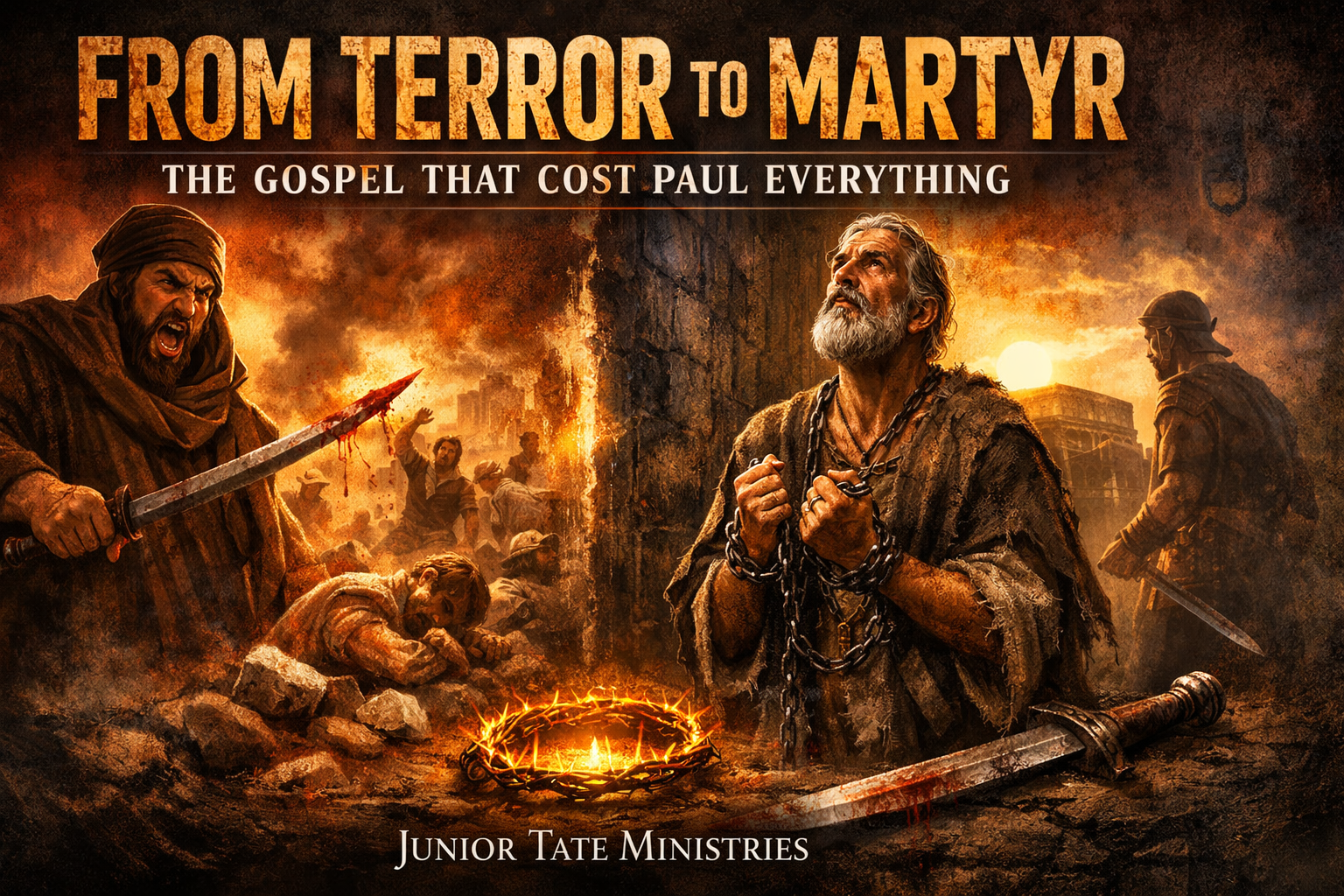
Before he became the apostle whose letters shape much of the New Testament, Paul the Apostle was known as Saul of Tarsus—a man feared by the early church. Scripture does not soften Saul’s past.
It presents him as a relentless persecutor whose mission was to silence the followers of Jesus Christ through imprisonment, violence, and death.
Paul’s later endurance cannot be separated from this transformation. The man who once terrorized the church would become its most persecuted messenger.
His life demonstrates that the gospel does not merely change behavior—it reassigns allegiance, even when obedience leads to suffering.
Saul: A Terror to the Early Church
Saul first appears in Scripture during the execution of Stephen, the first Christian martyr. His presence there marks the beginning of widespread persecution.
Acts 7:58 (KJV)
“And cast him out of the city, and stoned him: and the witnesses laid down their clothes at a young man’s feet, whose name was Saul.”
This detail is intentional. Saul stood as an approving authority figure while Stephen was murdered for his testimony of Christ.
Acts 8:1 (KJV)
“And Saul was consenting unto his death. And at that time there was a great persecution against the church which was at Jerusalem…”
Saul’s consent was not passive agreement—it was active endorsement. His presence emboldened violence against believers.
Acts 8:3 (KJV)
“As for Saul, he made havock of the church, entering into every house, and haling men and women committed them to prison.”
The phrase “made havock” describes violent destruction. Saul did not target leaders alone; he targeted families.
Men and women were dragged from their homes. Fear followed his name wherever it was spoken.
Later, Paul himself would confess the extent of his actions:
Acts 22:4 (KJV)
“And I persecuted this way unto the death, binding and delivering into prisons both men and women.”
In modern terms, Saul functioned as a religious terrorist—using intimidation, force, and violence to eradicate a movement he believed threatened God.
Zeal Without Truth: Religious Blindness
Saul’s actions were fueled by religious confidence, not moral indifference.
Philippians 3:5–6 (KJV)
“Circumcised the eighth day, of the stock of Israel…
Concerning zeal, persecuting the church; touching the righteousness which is in the law, blameless.”
Saul believed he was righteous. He believed he was defending God.
Scripture reveals a sobering truth: zeal without Christ becomes hostility toward Christ.
Saul’s sincerity did not make him right—it made him dangerous.
The Road to Damascus: Christ Stops the Terror
Saul’s campaign of persecution ended abruptly—not through debate, but through divine confrontation.
Acts 9:1–2 (KJV)
“And Saul, yet breathing out threatenings and slaughter against the disciples of the Lord…”
Saul was actively hunting Christians when Christ intervened.
Acts 9:3–6 (KJV)
“And suddenly there shined round about him a light from heaven…
Saul, Saul, why persecutest thou me?
…I am Jesus whom thou persecutest…”
Jesus did not say, “Why do you persecute My followers?” He said, “Why persecutest thou me?” Christ identified Himself fully with His church.
This encounter shattered Saul’s theology, identity, and authority in a single moment.
Broken Before Being Sent
Acts 9:8–9 (KJV)
“And when his eyes were opened, he saw no man… and he was three days without sight…”
Blindness humbled Saul physically and spiritually. The man who once led others now had to be led by the hand. God stripped Saul of self-reliance before granting him new purpose.
Acts 9:15–16 (KJV)
“He is a chosen vessel unto me…
For I will shew him how great things he must suffer for my name’s sake.”
Paul’s calling included suffering from the beginning. Grace did not remove cost—it redefined obedience.
Acts 13:9 (KJV)
“Then Saul, (who also is called Paul,) filled with the Holy Ghost…”
From persecutor to preacher, Saul became Paul—not by reform, but by surrender.
Obedience That Invited Opposition
Paul’s obedience immediately placed him in danger.
Acts 13:50 (KJV)
“But the Jews stirred up… persecution against Paul…”
Acts 16:22–23 (KJV)
“And when they had laid many stripes upon them, they cast them into prison…”
Paul did not soften his message to avoid suffering. Obedience brought conflict because truth confronts darkness.
A Life Marked by Suffering
Paul openly listed his sufferings to expose false teachers who equated success with comfort.
2 Corinthians 11:23–28 (KJV)
“In stripes above measure… in prisons more frequent… once was I stoned… thrice I suffered shipwreck…”
Paul’s endurance proved that faithfulness is measured by perseverance, not applause.
Stoned and Still Faithful
Acts 14:19–20 (KJV)
“Having stoned Paul… supposing he had been dead… he rose up, and came into the city.”
Paul did not retreat. Obedience resumed immediately.
Preserved Through Shipwreck
2 Corinthians 11:25 (KJV)
“Thrice I suffered shipwreck…”
Acts 27:44 (KJV)
“And so it came to pass, that they escaped all safe to land.”
God preserved Paul for continued service, not comfort.
Chains That Advanced the Gospel
Philippians 1:12–13 (KJV)
“The things which happened unto me have fallen out rather unto the furtherance of the gospel…”
Paul’s imprisonment became a platform for Christ.
Strength Through Surrender
Galatians 2:20 (KJV)
“I am crucified with Christ…”
2 Corinthians 12:9 (KJV)
“My grace is sufficient for thee…”
Paul endured because he had already died to self.
The Marks of a Faithful Servant
Galatians 6:17 (KJV)
“I bear in my body the marks of the Lord Jesus.”
Paul’s scars were evidence of obedience.
The Modern Crisis: Discipleship Without Cost
Matthew 16:24 (KJV)
“Let him deny himself, and take up his cross, and follow me.”
Christianity without a cross produces faith without endurance.
Conclusion: From Terror to Testimony
The gospel transformed a man who terrorized the church into a servant who suffered for it.
Philippians 3:8 (KJV)
“I count all things but loss for the excellency of the knowledge of Christ Jesus my Lord…”
Paul’s life leaves one unavoidable question:
If the true gospel turned a terrorist into a faithful servant—
why does ours demand so little sacrifice?
Paul’s Final Testimony: Faithful Unto Death
Scripture does not record Paul’s execution scene in narrative form as it does with Stephen or James.
Instead, the Holy Spirit gives us something more personal and more solemn—Paul’s own inspired words written shortly before his death.
These final letters reveal a man fully aware that his earthly ministry was ending and that his obedience would cost him his life.
Paul did not die confused, defeated, or fearful. He died convinced, surrendered, and faithful.
Paul Knew His Death Was Near
In his final epistle, written from a Roman prison, Paul speaks plainly about his impending death.
2 Timothy 4:6 (KJV)
“For I am now ready to be offered, and the time of my departure is at hand.”
The phrase “ready to be offered” is sacrificial language. Paul understood his death not as an accident or loss, but as an offering poured out to God.
He viewed his execution as the final act of obedience.
2 Timothy 4:7 (KJV)
“I have fought a good fight, I have finished my course, I have kept the faith.”
Paul does not claim success, popularity, or safety. He claims faithfulness. His life had been a battle, a race, and a stewardship—and he completed all three.
Condemned as a Criminal, Yet Unashamed
Paul was imprisoned not for wrongdoing, but for preaching Christ.
2 Timothy 2:9 (KJV)
“Wherein I suffer trouble, as an evildoer, even unto bonds; but the word of God is not bound.”
Paul was treated as a criminal by Rome, yet he understood that chains could never restrain the gospel. His body was bound—but the message was free.
Abandoned by Men, Yet Not by the Lord
As his execution approached, Paul experienced isolation.
2 Timothy 4:16–17 (KJV)
“At my first answer no man stood with me, but all men forsook me…
Notwithstanding the Lord stood with me, and strengthened me…”
Paul’s faith did not rest in human loyalty. Even when deserted, Christ remained faithful.
Delivered Through Death, Not From It
Paul understood that God’s deliverance would come—not by avoiding death—but by passing through it.
2 Timothy 4:18 (KJV)
“And the Lord shall deliver me from every evil work, and will preserve me unto his heavenly kingdom: to whom be glory for ever and ever.”
Paul did not expect rescue from execution. He expected preservation into eternity.
Faithful Unto Death, According to Christ’s Call
Paul’s martyrdom aligns perfectly with Christ’s teaching.
Matthew 10:28 (KJV)
“Fear not them which kill the body, but are not able to kill the soul…”
Paul lived—and died—believing this truth.
Revelation 2:10 (KJV)
“Be thou faithful unto death, and I will give thee a crown of life.”
Though spoken to the church at Smyrna, this command describes Paul’s end precisely. He was faithful unto death.
The Manner of Paul’s Death (Biblical and Historical Consistency)
Scripture confirms Paul was executed for his faith, though it does not describe the method in detail. Paul was a Roman citizen (Acts 22:28), and Roman law forbade crucifixion of citizens.
His repeated references to impending execution, combined with Roman legal practice, align with the consistent early testimony that Paul was put to death by execution in Rome for preaching Christ.
What Scripture makes unmistakably clear is this:
Philippians 1:20–21 (KJV)
“That Christ shall be magnified in my body, whether it be by life, or by death.
For to me to live is Christ, and to die is gain.”
Paul did not merely teach this—he fulfilled it.
From Terror to Martyr: A Gospel That Costs Everything
Paul began reminding the church of who he once was:
1 Timothy 1:13 (KJV)
“Who was before a blasphemer, and a persecutor, and injurious…”
He ended his life confident of what Christ had done:
2 Timothy 4:8 (KJV)
“Henceforth there is laid up for me a crown of righteousness, which the Lord… shall give me at that day.”
The man who once terrorized the church died as one of its greatest witnesses.
Final Conclusion: A Gospel Proven by Blood
Paul’s life—and death—leave the church with a final, unavoidable truth:
The gospel does not call people to comfort.
It calls them to Christ, even when obedience leads to suffering and death.
Paul did not die regretting obedience.
He died having finished his course.
If the true gospel turned a terrorist into a faithful servant—and carried him all the way to martyrdom—then the question remains:
If the Holy Spirit is convicting and pulling at your heart strings today, give in to Him and follow the prayer below for your salvation in Jesus Christ!
You may not ever get another chance to except Christ as your personal Savior and Lord! Your next breath is not promised!
Come! He’s Waiting on You!
Prayer to Salvation
Heavenly Father,
I come before You today admitting that I am a sinner in need of Your mercy and grace.
Your Word says in Romans 10:9–10 that if I confess with my mouth the Lord Jesus and believe in my heart that God hath raised Him from the dead, I shall be saved.
Today, I confess Jesus Christ as my Lord and my Savior. I believe with all my heart that He died for my sins, was buried, and rose again the third day.
Lord Jesus, I ask You to forgive me of all my sins. Wash me clean in Your precious blood. I turn from my old life and surrender fully to You.
Come into my heart, make me a new creature, and fill me with the Holy Spirit. From this day forward, I choose to follow You, live by Your Word, and walk in the new life You have given me.
Thank You, Lord, for saving me, for forgiving me, and for writing my name in the Lamb’s Book of Life. I give You all the glory, honor, and praise.
In Jesus’ name I pray, Amen.
juniortateministries.com
greatcommissiontoday.com