
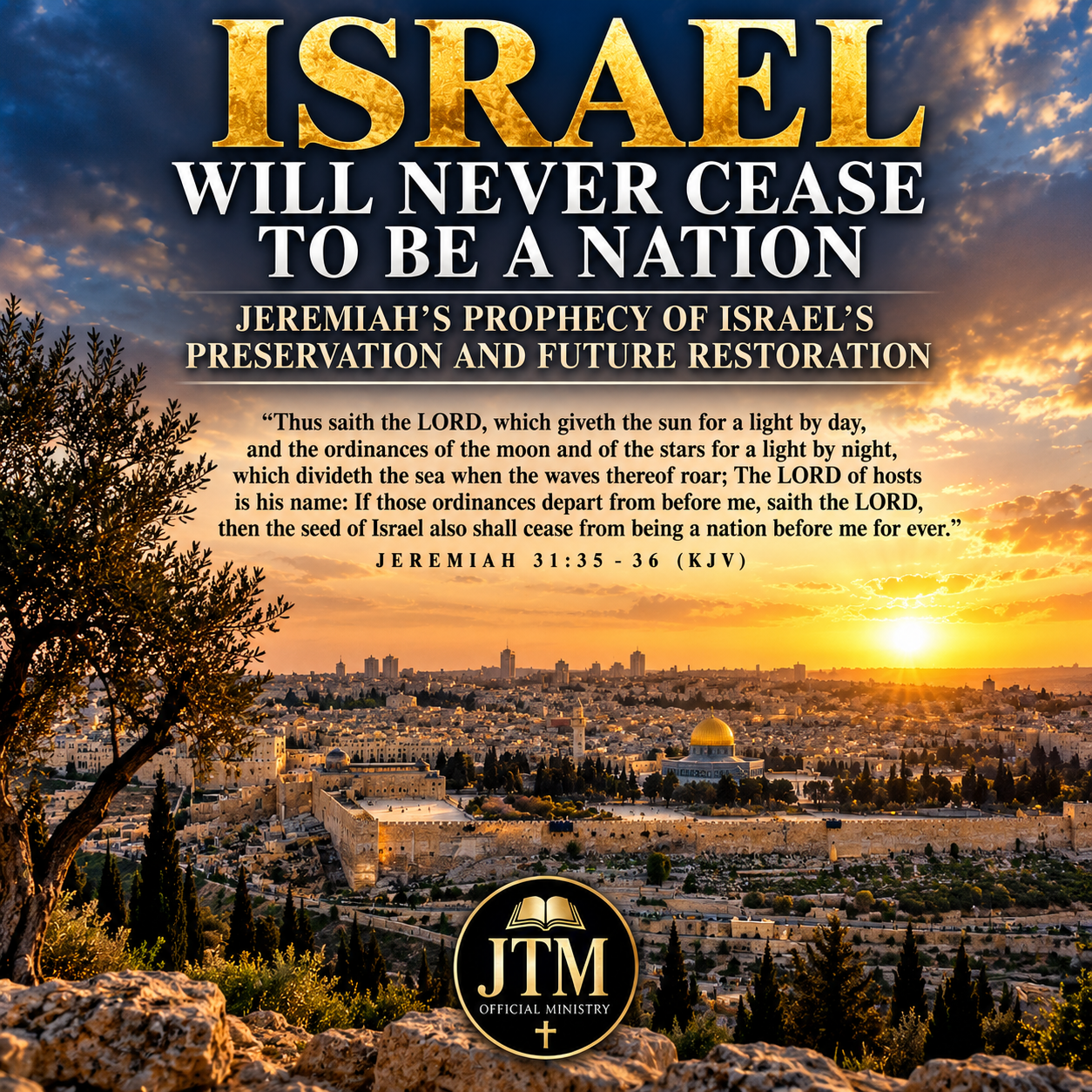
Jeremiah’s Prophecy of Israel’s Preservation and Future Restoration
By: Junior Tate
When I read the book of Jeremiah, one of the things that stands out to me is how serious Israel’s rebellion against God had become and, at the same time, how faithful God remained to the promises He had made. Jeremiah was not preaching during one of Israel’s greatest spiritual periods. He was ministering during a very dark time when idolatry, rebellion, and rejection of God’s Word had become deeply rooted among the people. God had warned them repeatedly through His prophets, but they continued down the same path, and eventually judgment could no longer be delayed.
Jerusalem would suffer. The temple would be destroyed. Many of the people would be carried into Babylonian captivity. Jeremiah himself would live to see much of the judgment he had warned about become reality. Yet when we read Jeremiah carefully, we discover something that I believe is extremely important to understanding Bible prophecy. In the very same book where God announces judgment against Israel and Judah, He also gives some of the strongest promises in the entire Bible concerning their preservation, restoration, and future.
That tells me that we have to make a distinction between God judging His people and God abandoning His people. Those are not the same thing.
I believe this distinction is important because there are those today who teach that Israel’s rebellion caused God to permanently set the nation aside and transfer every promise concerning Israel to someone else. But when I read Jeremiah, I have a difficult time reaching that conclusion. God certainly judged Israel for sin, and Jeremiah never attempts to hide or minimize that fact. Yet God also continued speaking about Israel’s future, their return, their restoration, the New Covenant, the throne of David, and the day when Israel would dwell securely under the rule of the Messiah.
One passage in particular brings the entire subject into focus.
Jeremiah 31:35 through 37 (KJV)
“Thus saith the LORD, which giveth the sun for a light by day, and the ordinances of the moon and of the stars for a light by night, which divideth the sea when the waves thereof roar; The LORD of hosts is his name:
If those ordinances depart from before me, saith the LORD, then the seed of Israel also shall cease from being a nation before me for ever.
Thus saith the LORD; If heaven above can be measured, and the foundations of the earth searched out beneath, I will also cast off all the seed of Israel for all that they have done, saith the LORD.”
Every time I read those verses, I am struck by the strength of the language God chose to use. God does not base Israel’s continued existence before Him upon Israel’s ability to remain perfectly faithful. In fact, He specifically mentions “all that they have done.” God knew their history, their rebellion, and everything that would follow, yet He still tied Israel’s continued existence as a nation before Him to the established order of creation.
In other words, if we want to know whether God has forgotten Israel, He tells us to look at something much bigger than the political condition of the world. He points us toward the sun, moon, stars, heavens, and earth. From my understanding of Scripture, God is telling us that His faithfulness to what He has spoken is more dependable than anything man can accomplish or destroy.
That is where I want to begin this study, because the real subject is larger than Israel. At its heart, this is a study of the faithfulness of God.
Jeremiah Preached During a Time of Coming Judgment
To understand the importance of these promises, we first need to understand the setting in which Jeremiah received them. Jeremiah was not looking at a righteous nation and simply telling them that God had wonderful plans for their future. He was preaching to Judah while the nation was moving closer to judgment, and the northern kingdom of Israel had already experienced devastating consequences because of its rebellion.
God described the spiritual condition of His people in very strong language.
Jeremiah 2:11 through 13 (KJV)
“Hath a nation changed their gods, which are yet no gods? but my people have changed their glory for that which doth not profit.
Be astonished, O ye heavens, at this, and be horribly afraid, be ye very desolate, saith the LORD.
For my people have committed two evils; they have forsaken me the fountain of living waters, and hewed them out cisterns, broken cisterns, that can hold no water.”
When I read those words, I do not see God making excuses for Israel. He tells us exactly what they had done. They had turned away from the fountain of living waters and had chosen something that could never satisfy them. Yet something else catches my attention in this passage. Even while describing their rebellion, God still calls them “my people.”
That did not mean judgment would be avoided. Covenant privilege did not give Israel permission to live however they pleased. In fact, their relationship with God made their rebellion even more serious because they had received His Word, His law, His promises, and His blessings.
Jeremiah spent much of his ministry warning Judah that Babylon was coming. Jerusalem would eventually fall, the temple would be burned, and many of the people would be taken away from the land. God had warned them, and He would carry out that judgment just as He said He would.
This is why I do not believe we should ever talk about Israel’s future without acknowledging Israel’s past rebellion. Scripture certainly does not ignore it. At the same time, we should not talk about Israel’s rebellion while ignoring what God said He would do afterward. If we read only the judgment passages, we are not allowing Jeremiah to give us the whole picture.
The question is not whether Israel deserved judgment. They did, and God said so. The real question is whether that judgment permanently cancelled the promises God had made concerning Israel.
As we continue through Jeremiah, I believe God answers that question Himself.
The God Who Scattered Israel Also Promised to Gather Israel
Jeremiah speaks repeatedly about scattering, but he also speaks about gathering. I believe we need both truths if we are going to understand God’s dealings with Israel correctly.
Listen carefully to what God says:
Jeremiah 30:3 (KJV)
“For, lo, the days come, saith the LORD, that I will bring again the captivity of my people Israel and Judah, saith the LORD: and I will cause them to return to the land that I gave to their fathers, and they shall possess it.”
There are several things in this verse that I do not believe we should pass over too quickly. God specifically identifies Israel and Judah, and He says that He will cause them to return. He then identifies the destination as “the land that I gave to their fathers.”
That language takes us back to covenant.
Even while Jeremiah is dealing with captivity and judgment, God still describes the land in connection with the promise He made to their fathers. The captivity did not cause God to rewrite history as though the covenant had never existed. He remembers exactly what He gave and to whom He gave it.
From my understanding of Scripture, we should allow the language to retain its plain meaning. God scattered Israel because of rebellion, but the same God promised that He would gather His people according to His own purpose. The scattering demonstrated His holiness and justice, while the promised gathering demonstrates His mercy and covenant faithfulness. We do not have to choose one and reject the other because Jeremiah gives us both.
Israel’s Future Includes a Time of Great Trouble
Jeremiah also makes it clear that Israel’s path toward final restoration includes a period of tremendous trouble. This is where we encounter one of the most important prophetic expressions in Jeremiah.
Jeremiah 30:4 through 7 (KJV)
“And these are the words that the LORD spake concerning Israel and concerning Judah.
For thus saith the LORD; We have heard a voice of trembling, of fear, and not of peace.
Ask ye now, and see whether a man doth travail with child? wherefore do I see every man with his hands on his loins, as a woman in travail, and all faces are turned into paleness?
Alas! for that day is great, so that none is like it: it is even the time of Jacob’s trouble; but he shall be saved out of it.”
We will deal with the time of Jacob’s trouble much more fully in another study because that subject deserves an article of its own. For now, however, I want us to notice something that directly relates to Israel’s preservation.
Jeremiah does not say that Jacob will simply disappear during this time of trouble. He says, “but he shall be saved out of it.”
I believe that is extremely important. The trouble Jeremiah describes is severe, but the trouble is not the end of Jacob. From my understanding of Scripture, Jeremiah is looking beyond the immediate Babylonian captivity toward a future period of unprecedented trouble involving Israel. When we compare this with Daniel, the words of Jesus concerning the coming Tribulation, and the events recorded in Revelation, I believe the prophetic picture becomes much clearer.
However, even before we make those connections, Jeremiah gives us the truth we need for this study. Israel faces trouble, but God also promises deliverance. Whatever comes against Jacob, God has already declared that Jacob will come through it.
God Will Correct Israel Without Making an End of Israel
Jeremiah continues the prophecy by describing what God will do after the time of trouble.
Jeremiah 30:8 through 11 (KJV)
“For it shall come to pass in that day, saith the LORD of hosts, that I will break his yoke from off thy neck, and will burst thy bonds, and strangers shall no more serve themselves of him:
But they shall serve the LORD their God, and David their king, whom I will raise up unto them.
Therefore fear thou not, O my servant Jacob, saith the LORD; neither be dismayed, O Israel: for, lo, I will save thee from afar, and thy seed from the land of their captivity; and Jacob shall return, and shall be in rest, and be quiet, and none shall make him afraid.
For I am with thee, saith the LORD, to save thee: though I make a full end of all nations whither I have scattered thee, yet will I not make a full end of thee: but I will correct thee in measure, and will not leave thee altogether unpunished.”
This passage, in my opinion, gives us one of the clearest ways to understand God’s dealings with Israel. God does not pretend that Israel’s sin does not matter, because He plainly says, “I will correct thee in measure, and will not leave thee altogether unpunished.” Yet in that very same verse He also says, “yet will I not make a full end of thee.”
That is the balance I believe we need to maintain throughout this entire subject. God’s faithfulness to Israel does not mean that He overlooks sin, and His judgment of Israel does not mean that He abandons His promises. Both truths are found in the same passage.
When I read Jeremiah, I see a God who is perfectly capable of correcting His people while still bringing His covenant purpose to completion. Israel’s rebellion brought real consequences, but those consequences did not make God forget what He had spoken.
God Says He Has Loved Israel With an Everlasting Love
Jeremiah 31 carries the message of restoration even further and gives us one of the most beautiful statements in the entire book.
Jeremiah 31:1 through 3 (KJV)
“At the same time, saith the LORD, will I be the God of all the families of Israel, and they shall be my people.
Thus saith the LORD, The people which were left of the sword found grace in the wilderness; even Israel, when I went to cause him to rest.
The LORD hath appeared of old unto me, saying, Yea, I have loved thee with an everlasting love: therefore with lovingkindness have I drawn thee.”
I think it is important to remember where these words appear. God is not speaking about a people who had never failed Him. He is speaking in the context of a nation that desperately needed His mercy. Their history had already demonstrated that they could not claim these promises on the basis of their own righteousness.
Yet God says, “I have loved thee with an everlasting love.”
We do need to be careful about what this means. I do not believe Scripture teaches that every Jewish person is automatically saved because of physical descent from Abraham. Salvation has always required faith, and the New Testament makes unmistakably clear that salvation is found in Jesus Christ alone.
But that truth does not require us to erase God’s national covenant purposes for Israel. Individual salvation and God’s prophetic dealings with the nation are related subjects, but they are not identical questions. A Jewish person needs Jesus Christ just as surely as a Gentile does, while God can still remain faithful to the promises He made concerning Israel as a people.
He That Scattered Israel Will Gather Him
A few verses later, God makes the connection between scattering and gathering so plainly that I believe it should settle much of the confusion surrounding this subject.
Jeremiah 31:10 through 12 (KJV)
“Hear the word of the LORD, O ye nations, and declare it in the isles afar off, and say, He that scattered Israel will gather him, and keep him, as a shepherd doth his flock.
For the LORD hath redeemed Jacob, and ransomed him from the hand of him that was stronger than he.
Therefore they shall come and sing in the height of Zion, and shall flow together to the goodness of the LORD, for wheat, and for wine, and for oil, and for the young of the flock and of the herd: and their soul shall be as a watered garden; and they shall not sorrow any more at all.”
Notice that God does not separate the One who scattered Israel from the One who gathers Israel. He says, “He that scattered Israel will gather him.” The same God is responsible for both actions, although they serve different purposes.
This is one of the reasons I have difficulty with an interpretation that takes Israel literally when God announces judgment but changes the meaning of Israel when God announces restoration. If the scattering happened to Israel, then I believe the natural reading is that the promised gathering concerns Israel as well.
We should not make the restoration less real than the judgment. God meant what He said when He warned Israel, and I believe He means what He says when He promises to gather them.
There Is Hope in Israel’s End
Jeremiah continues with a picture of tremendous sorrow, but once again sorrow is not the final word.
Jeremiah 31:15 through 17 (KJV)
“Thus saith the LORD; A voice was heard in Ramah, lamentation, and bitter weeping; Rahel weeping for her children refused to be comforted for her children, because they were not.
Thus saith the LORD; Refrain thy voice from weeping, and thine eyes from tears: for thy work shall be rewarded, saith the LORD; and they shall come again from the land of the enemy.
And there is hope in thine end, saith the LORD, that thy children shall come again to their own border.”
The words that especially stand out to me are, “there is hope in thine end.” Jeremiah has already spoken about judgment, tears, captivity, scattering, and loss, yet God tells His people that none of those things represent the final chapter of their story.
There is hope because God is still working.
There is hope because God remembers His Word.
There is hope because the future of Israel does not ultimately rest upon Israel’s strength, military power, political alliances, or ability to preserve itself. Their prophetic future rests upon what God has determined to accomplish.
That does not mean every event in Israel’s history should automatically be labeled a fulfillment of prophecy. We need to be careful with Scripture and not make it say more than it says. But it does mean that when God promises a future for Israel, I believe we should take Him seriously.
The New Covenant Was Promised to Israel and Judah
We now come to one of the most important passages in Jeremiah, and really one of the most important covenant passages anywhere in the Bible.
Jeremiah 31:31 through 34 (KJV)
“Behold, the days come, saith the LORD, that I will make a new covenant with the house of Israel, and with the house of Judah:
Not according to the covenant that I made with their fathers in the day that I took them by the hand to bring them out of the land of Egypt; which my covenant they brake, although I was an husband unto them, saith the LORD:
But this shall be the covenant that I will make with the house of Israel; After those days, saith the LORD, I will put my law in their inward parts, and write it in their hearts; and will be their God, and they shall be my people.
And they shall teach no more every man his neighbour, and every man his brother, saying, Know the LORD: for they shall all know me, from the least of them unto the greatest of them, saith the LORD: for I will forgive their iniquity, and I will remember their sin no more.”
When I read this passage, the first thing I want to do is allow God to identify the parties to the covenant Himself. He says that He will make the New Covenant “with the house of Israel, and with the house of Judah.” That language is very specific.
We know from the New Testament that the New Covenant is established through the blood of Jesus Christ and that believers today enjoy the spiritual blessings made possible through Christ. I praise God for that. But I do not believe the Church receiving blessings through Christ gives us the right to remove Israel and Judah from a promise in which God specifically names them.
In fact, the passage itself emphasizes Israel’s failure under the previous covenant. God says, “which my covenant they brake.” He knew exactly what Israel had done, yet His answer to their failure was not to become unfaithful Himself. He promised a work of grace in which He would change hearts, forgive iniquity, and restore relationship.
This is why I keep coming back to the faithfulness of God. The New Covenant does not demonstrate how dependable man is. It demonstrates how dependable God is.
God’s Future Purpose for Israel Is Not a Return to the Law
I also want to make something very clear concerning Israel’s future because I do not want anyone to misunderstand what I am saying. I do not believe that after the Rapture of the Church God will simply turn the clock backward and place Israel under the Law of Moses again. Jesus Christ fulfilled the Law, and through His death on the cross He accomplished what the sacrifices and ordinances of the Law could never accomplish. The way of salvation during the Tribulation will still be through Jesus Christ, because there has never been and never will be another Savior.
What I do believe is that God will once again bring Israel to the forefront of His prophetic program, and throughout that terrible period of Tribulation He will continue extending the message of salvation to both Jew and Gentile. Revelation shows us an enormous multitude coming out of the Great Tribulation from “all nations, and kindreds, and people, and tongues” (Revelation 7:9 through 14). God will not forget Israel, but neither will He forget the nations. Even during the darkest period this world has ever known, God will continue giving people the opportunity to turn to Jesus Christ and be saved. To me, that is one of the remarkable things about the Tribulation; while God is pouring out righteous judgment upon a rebellious world, His mercy will still be calling sinners to salvation through Jesus Christ.
The Fulness of the Gentiles
I also believe the Rapture of the Church marks a very important transition in God’s prophetic program. Paul tells us in Romans 11:25 (KJV), “For I would not, brethren, that ye should be ignorant of this mystery, lest ye should be wise in your own conceits; that blindness in part is happened to Israel, until the fulness of the Gentiles be come in.”
From my understanding of Scripture, I believe the fulness of the Gentiles is completed when the Church is caught up to be with Christ. At that point, God’s purpose for Israel comes once again to the forefront of prophecy, not by returning Israel to the Law of Moses, but by bringing His covenant people through the events of the Tribulation and ultimately to their Messiah, Jesus Christ.
This does not mean Gentiles can no longer be saved during the Tribulation, because Revelation clearly shows people from every nation coming to Christ during that time. Rather, I believe it marks the completion of the present Church Age and a major transition in God’s prophetic dealings with Israel.
God Uses the Sun, Moon, and Stars as His Guarantee
Immediately after the New Covenant promise, God gives one of the strongest declarations concerning Israel’s continued existence that I know anywhere in Scripture.
Jeremiah 31:35 through 37 (KJV)
“Thus saith the LORD, which giveth the sun for a light by day, and the ordinances of the moon and of the stars for a light by night, which divideth the sea when the waves thereof roar; The LORD of hosts is his name:
If those ordinances depart from before me, saith the LORD, then the seed of Israel also shall cease from being a nation before me for ever.
Thus saith the LORD; If heaven above can be measured, and the foundations of the earth searched out beneath, I will also cast off all the seed of Israel for all that they have done, saith the LORD.”
I want us to really think about what God is saying instead of reading over these verses too quickly. God points toward things that human beings did not create and cannot control. He speaks of the sun, the moon, the stars, the sea, the heavens, and the foundations of the earth, and then He connects those established ordinances with Israel’s continued existence as a nation before Him.
What makes the promise even more remarkable is the way verse 37 ends. God says He will not cast off all the seed of Israel “for all that they have done.”
That removes any idea that God made this promise without knowing how badly Israel would fail. He knew everything. He knew their idolatry, rebellion, unbelief, and future history, yet His promise remained.
When I look at this passage, I believe the message is clear. Israel’s future rests ultimately upon the faithfulness of the One who made the promise. If we are waiting for Israel to deserve God’s covenant faithfulness, we have missed the point. Covenant faithfulness reveals the character of God.
Paul Asked Whether God Had Cast Away His People
When we move into the New Testament, Paul addresses the very question that naturally comes from Israel’s unbelief.
Romans 11:1 through 2 (KJV)
“I say then, Hath God cast away his people? God forbid. For I also am an Israelite, of the seed of Abraham, of the tribe of Benjamin.
God hath not cast away his people which he foreknew. Wot ye not what the scripture saith of Elias? how he maketh intercession to God against Israel, saying,”
I appreciate how plainly Paul answers the question. He does not leave us wondering whether Israel’s unbelief means that God has permanently abandoned His people. His answer is “God forbid.”
Later in the chapter, Paul gives us even more information.
Romans 11:25 through 29 (KJV)
“For I would not, brethren, that ye should be ignorant of this mystery, lest ye should be wise in your own conceits; that blindness in part is happened to Israel, until the fulness of the Gentiles be come in.
And so all Israel shall be saved: as it is written, There shall come out of Sion the Deliverer, and shall turn away ungodliness from Jacob:
For this is my covenant unto them, when I shall take away their sins.
As concerning the gospel, they are enemies for your sakes: but as touching the election, they are beloved for the fathers’ sakes.
For the gifts and calling of God are without repentance.”
There are several expressions here that remind me immediately of Jeremiah. Paul speaks about Israel, Jacob, covenant, and the fathers, and he says that Israel’s blindness is “in part” and continues “until” an appointed point in God’s plan.
From my understanding of Scripture, this does not sound like a people whose prophetic story has ended. It sounds like a people presently experiencing spiritual blindness while God continues working out a purpose that He has already promised to complete.
Paul also warns Gentile believers against becoming “wise in your own conceits.” I believe that warning matters greatly. The Church should never look at Israel’s unbelief and respond with pride. If anything, Israel’s history should remind us how desperately every one of us depends upon the grace of God.
Jeremiah Connects Israel’s Future With the Son of David
Jeremiah’s prophecies of restoration eventually bring us to the Davidic promises and the coming King.
Jeremiah 33:14 through 17 (KJV)
“Behold, the days come, saith the LORD, that I will perform that good thing which I have promised unto the house of Israel and to the house of Judah.
In those days, and at that time, will I cause the Branch of righteousness to grow up unto David; and he shall execute judgment and righteousness in the land.
In those days shall Judah be saved, and Jerusalem shall dwell safely: and this is the name wherewith she shall be called, The LORD our righteousness.
For thus saith the LORD; David shall never want a man to sit upon the throne of the house of Israel;”
This is where the subject becomes especially exciting to me because Israel’s future is not merely about the survival of a nation. Jeremiah points us toward the Branch of righteousness, the promise connected with David, righteous judgment, Judah, Jerusalem, and the throne.
From my understanding of Scripture, the Branch points us ultimately to Jesus Christ, the Son of David and the rightful King. Therefore, the future restoration of Israel cannot properly be understood apart from Him.
God’s prophetic purpose does not end with Israel simply surviving among the nations. It leads us toward the reign of the Messiah.
This is also why I believe Bible prophecy should always bring us back to Jesus Christ. If all we talk about is Israel, wars, nations, political movements, and prophetic timelines, but somehow Christ becomes secondary, then we have missed the heart of prophecy. Jesus is not a side issue in the prophetic plan. He is the King toward whom the entire plan is moving.
God Again Uses Creation to Confirm His Covenant
Jeremiah 33 uses language very similar to what we found in Jeremiah 31.
Jeremiah 33:20 through 22 (KJV)
“Thus saith the LORD; If ye can break my covenant of the day, and my covenant of the night, and that there should not be day and night in their season;
Then may also my covenant be broken with David my servant, that he should not have a son to reign upon his throne; and with the Levites the priests, my ministers.
As the host of heaven cannot be numbered, neither the sand of the sea measured: so will I multiply the seed of David my servant, and the Levites that minister unto me.”
I do not believe it is accidental that God keeps bringing His people back to the created order when He speaks about the certainty of His covenant promises. Day follows night because God established it. The heavens remain because God sustains them. In the same way, God wants His people to understand that His covenant rests upon something far stronger than human ability.
It rests upon His Word.
When God makes a promise, the passing of centuries does not weaken that promise. Human rebellion does not catch Him by surprise, and changing world conditions do not force Him to rewrite His plan.
God Answers Those Who Say Israel Has Been Cast Off
The next passage may be one of the most important in this entire study because Jeremiah records people saying something remarkably similar to what has been said about Israel many times since.
Jeremiah 33:23 through 26 (KJV)
“Moreover the word of the LORD came to Jeremiah, saying,
Considerest thou not what this people have spoken, saying, The two families which the LORD hath chosen, he hath even cast them off? thus they have despised my people, that they should be no more a nation before them.
Thus saith the LORD; If my covenant be not with day and night, and if I have not appointed the ordinances of heaven and earth;
Then will I cast away the seed of Jacob, and David my servant, so that I will not take any of his seed to be rulers over the seed of Abraham, Isaac, and Jacob: for I will cause their captivity to return, and have mercy on them.”
Notice exactly what people were saying. They were looking at what had happened and concluding that the families God had chosen had been cast off. In their eyes, Israel would “be no more a nation.”
God answers that idea Himself.
Once again He points toward day and night and the ordinances of heaven and earth. Then He speaks about Jacob, David, Abraham, Isaac, and Jacob, and finishes by promising restoration and mercy.
When I read that, I do not see God saying that His earlier promises had been transferred away from the people to whom He originally gave them. I see God defending the certainty of His covenant purpose even while His people are experiencing judgment.
Israel’s Preservation Shows Us the Faithfulness of God
At this point, I believe we can see why this study is about much more than the history of one nation. The preservation and future restoration of Israel teach us something about the character of God.
Israel failed God repeatedly, but Israel’s failure did not cause God to become unfaithful. God brought judgment because He is holy, but He continued remembering His covenant because He is faithful. Those two attributes never work against each other.
Paul expressed the principle this way:
Romans 3:3 through 4 (KJV)
“For what if some did not believe? shall their unbelief make the faith of God without effect?
God forbid: yea, let God be true, but every man a liar; as it is written, That thou mightest be justified in thy sayings, and mightest overcome when thou art judged.”
I believe those words reach the heart of the matter. Human unbelief cannot make God unfaithful.
That should encourage every believer because if God’s promises depended upon perfect human performance, none of us would have any security. We have all failed God. We have all fallen short. Our hope rests upon His grace and His faithfulness, not upon our ability to become worthy of His promises.
When I study God’s dealings with Israel, I am reminded that He does not forget what He has spoken simply because centuries pass or circumstances change.
How Should We Look at Israel Today?
When we look at the modern nation of Israel, I believe we need to do so carefully, biblically, and without allowing either politics or emotion to become our final authority.
Believing that God still has a prophetic purpose for Israel does not mean that every decision made by the Israeli government is automatically right. No human government should be treated as though it is above moral evaluation. Israel today is not a sinless nation, and the existence of the modern State of Israel does not mean that every Old Testament prophecy has already reached its complete fulfillment.
We should also be careful about attaching a Bible verse to every headline coming out of the Middle East. I love Bible prophecy, but I believe we need to respect Scripture enough not to claim fulfillment where God has not given us enough information to do so.
At the same time, when I read Jeremiah 30, Jeremiah 31, Jeremiah 33, Romans 11, and the many other passages dealing with Israel’s future, I cannot conclude that Israel has no remaining place in God’s prophetic plan.
From my understanding of Scripture, the preservation of the Jewish people through history and the existence of Israel as a nation are certainly consistent with what Jeremiah tells us about a people whom God said would not cease from being a nation before Him. I would simply stop short of claiming that every detail of modern Israel represents the complete fulfillment of Jeremiah’s prophecies, because much of what Jeremiah describes still awaits its fulfillment.
Israel’s Greatest Need Is Jesus Christ
There is another truth that I believe must be stated clearly whenever we talk about Israel. National preservation is not the same thing as spiritual salvation.
Israel’s greatest need is not simply land, military strength, security, or recognition among the nations. Israel needs the Messiah.
Zechariah gives us a remarkable picture of a future turning toward the One who was pierced.
Zechariah 12:10 (KJV)
“And I will pour upon the house of David, and upon the inhabitants of Jerusalem, the spirit of grace and of supplications: and they shall look upon me whom they have pierced, and they shall mourn for him, as one mourneth for his only son, and shall be in bitterness for him, as one that is in bitterness for his firstborn.”
From my understanding of Scripture, this points toward a future spiritual awakening involving Israel and recognition of Jesus Christ.
That is where the prophetic story must ultimately lead. The Messiah Israel needs is Jesus Christ, and the King who will fulfill the Davidic promises is Jesus Christ. God’s preservation of Israel is not intended to move our attention away from Christ but to demonstrate the faithfulness of the God whose entire redemptive purpose finds its fulfillment in Him.
What Israel’s Preservation Should Teach the Church
I believe there is a tremendous lesson here for the Church. We often study prophecy because we want to know what will happen next, and there is certainly nothing wrong with wanting to understand the future. But prophecy does something else that is just as important. It teaches us to trust the God who controls the future.
Think about how much history has passed since Jeremiah wrote these words. Empires have risen and disappeared. Jerusalem has experienced repeated conquest and destruction. The Jewish people have been scattered throughout the world and have endured terrible persecution. Generations have come and gone, yet the Word of God has not changed.
That encourages me because the same God who remembers what He promised thousands of years ago is the God in whom we have placed our faith.
When Jesus promises eternal life, we can believe Him. When Scripture promises resurrection, we can believe it. When Jesus says He will come again, we can believe Him. The passing of time does not weaken a promise made by God because His ability to fulfill His Word does not decrease with the passing of centuries.
Studying Israel should therefore strengthen our confidence in God rather than merely satisfy our curiosity about prophecy.
The Church Should Never Become Proud Against Israel
Paul gives Gentile believers a warning that I believe is especially important whenever we discuss Israel.
Romans 11:18 through 21 (KJV)
“Boast not against the branches. But if thou boast, thou bearest not the root, but the root thee.
Thou wilt say then, The branches were broken off, that I might be graffed in.
Well; because of unbelief they were broken off, and thou standest by faith. Be not highminded, but fear:
For if God spared not the natural branches, take heed lest he also spare not thee.”
Paul does not tell Gentile believers to look at Israel’s unbelief and congratulate themselves. He warns against pride.
I believe the proper Christian attitude toward Israel should include humility, gratitude, prayer, and a genuine desire for Jewish people to come to know Jesus Christ. We should never use prophecy as an excuse for arrogance or hostility, nor should we place Israel in a position that belongs only to Christ.
Israel Must Never Take the Place of Jesus Christ
Believing what God says about Israel does not mean worshipping Israel, and believing what God says about Jerusalem does not mean worshipping Jerusalem. Our worship belongs to God alone.
Peter made the way of salvation unmistakably clear.
Acts 4:10 through 12 (KJV)
“Be it known unto you all, and to all the people of Israel, that by the name of Jesus Christ of Nazareth, whom ye crucified, whom God raised from the dead, even by him doth this man stand here before you whole.
This is the stone which was set at nought of you builders, which is become the head of the corner.
Neither is there salvation in any other: for there is none other name under heaven given among men, whereby we must be saved.”
There is not one way of salvation for Jewish people and another way for Gentiles. Every sinner needs the same Savior, and that Savior is Jesus Christ.
We can believe every covenant promise God made to Israel without ever confusing those promises with the Gospel. In fact, I believe keeping the two subjects clear allows us to honor both. God will keep His promises concerning Israel, and salvation for every individual is found only through Jesus Christ.
We Should Not Erase What God Has Clearly Said
While we must never elevate Israel above Christ, I believe we should also avoid the opposite mistake of explaining away what God has plainly promised.
When Scripture says Israel, I believe we should allow Israel to mean Israel unless the context itself gives us a biblical reason to understand it differently. The same is true when God names Judah, Jerusalem, Abraham, Isaac, Jacob, and David.
I have always believed that our theology should come from Scripture rather than making Scripture conform to a theological system we have already decided must be correct.
When we follow Jeremiah’s argument naturally, the picture is consistent. Israel rebelled and God brought judgment, yet the same God promised restoration. He promised a New Covenant, declared that Israel would not cease from being a nation before Him, tied that promise to the ordinances of creation, reaffirmed His covenant with David, and directly answered those who claimed that the families He chose had been cast away.
For me, the cumulative testimony carries far more weight than any theological argument designed to make those promises mean something entirely different.
Why I Believe Israel Will Never Cease to Be a Nation
After reading these passages together, the reason I believe Israel will never cease to be a nation before God is actually very simple. My confidence does not rest upon Israel’s goodness, Israel’s government, Israel’s military strength, or the faithfulness of individual Jewish people. It rests upon the Word of God.
God Himself said:
Jeremiah 31:36 (KJV)
“If those ordinances depart from before me, saith the LORD, then the seed of Israel also shall cease from being a nation before me for ever.”
When I look at the sun, moon, and stars, I am reminded that the God who established their order is the same God who spoke those words through Jeremiah.
That is why I believe this prophecy remains so powerful. God did not tell us to measure His faithfulness by what the political situation looks like in any particular year. He connected His promise with His own sovereign order over creation.
Israel’s future ultimately rests upon God being who He says He is.
The Greatest Message Is Still the Gospel
Before bringing this study to a close, I do not want anyone to misunderstand the most important message in Scripture. A person can know everything about Israel, understand Jeremiah’s prophecies, study the Tribulation, learn prophetic timelines, and still die lost without Jesus Christ.
Paul summarized the Gospel plainly.
1 Corinthians 15:3 through 4 (KJV)
“For I delivered unto you first of all that which I also received, how that Christ died for our sins according to the scriptures;
And that he was buried, and that he rose again the third day according to the scriptures:”
That is where our hope is found.
Jesus Christ died for our sins, was buried, and rose again. Prophecy cannot save us, knowledge cannot save us, nationality cannot save us, religion cannot save us, and understanding Israel cannot save us. Salvation is found in Jesus Christ alone.
If our study of prophecy does not eventually bring us closer to Christ, then we have missed the greatest purpose of studying it.
Conclusion: God Has Not Forgotten Israel
As I bring this study to a close, I keep coming back to something very simple. God has not forgotten what He promised.
Jeremiah ministered during some of Israel’s darkest days. He watched rebellion increase and warned repeatedly that judgment was coming. Jerusalem would fall, the temple would be destroyed, and captivity would follow. If we stopped reading at the judgment, we might easily conclude that Israel’s story had ended.
But Jeremiah does not stop there.
The same God who announced judgment promised that He would gather the people He had scattered. He said Jacob would be saved out of his time of trouble. He promised restoration, mercy, a New Covenant, and the coming Branch of David. He declared that Israel would not cease from being a nation before Him, and He tied the certainty of that promise to the sun, moon, stars, day, night, heavens, and earth.
From my understanding of Scripture, I do not believe God could have made His point much clearer.
Israel’s history certainly demonstrates human failure, but Israel’s future demonstrates divine faithfulness. That does not mean every Jewish person is saved, because salvation comes only through Jesus Christ. It does not mean the modern government of Israel is always right, and it does not mean that every event in the Middle East should immediately be labeled a fulfillment of prophecy.
What it does mean is that God has not forgotten His Word.
That matters to me far beyond the subject of Israel because the God who made promises to Abraham, Isaac, Jacob, David, and Israel is the same God who has promised eternal life to those who trust in His Son. If He remembers His Word across thousands of years of history, then I can trust what He has promised me through Jesus Christ.
The sun still rises, the moon still shines, and the stars still appear in the heavens. Every time they do, Jeremiah 31 reminds us that the God who established those ordinances has not forgotten the words He spoke concerning Israel.
I believe He will fulfill them because I believe God means what He says.
And if God has spoken concerning the return of Jesus Christ, I believe He will fulfill that promise too.
A Word to the Unsaved
If you are reading this article and you have never trusted Jesus Christ as your personal Savior, I want to speak to you personally before you leave this page. Understanding Bible prophecy is important, but understanding prophecy will not save your soul. You can know about Israel, Jerusalem, the Tribulation, and the coming Kingdom and still enter eternity without Christ.
The Bible tells us exactly where salvation is found.
Romans 10:9 through 13 (KJV)
“That if thou shalt confess with thy mouth the Lord Jesus, and shalt believe in thine heart that God hath raised him from the dead, thou shalt be saved.
For with the heart man believeth unto righteousness; and with the mouth confession is made unto salvation.
For the scripture saith, Whosoever believeth on him shall not be ashamed.
For there is no difference between the Jew and the Greek: for the same Lord over all is rich unto all that call upon him.
For whosoever shall call upon the name of the Lord shall be saved.”
If the Holy Spirit is convicting and pulling at your heart today, please do not put Him off. Your next breath is not promised, and none of us knows how much time we have left. Jesus Christ died for your sins, was buried, and rose again. Come to Him in faith and trust Him as your personal Savior and Lord.
Prayer of Salvation
Heavenly Father,
I come before You today admitting that I am a sinner in need of Your mercy and grace. I believe with all my heart that Jesus Christ died for my sins, was buried, and rose again the third day.
Today I confess Jesus Christ as my Lord and Savior. Lord Jesus, I ask You to forgive me of all my sins and wash me clean in Your precious blood. I turn from my old life and place my faith and trust in You.
Come into my heart, make me a new creature, and help me from this day forward to follow You, live according to Your Word, and walk in the new life You have given me.
Thank You, Lord, for Your mercy, Your forgiveness, and the salvation You have provided through Jesus Christ.
In Jesus’ name I pray, Amen.
juniortateministires.com
greatcommissiontoday.com