
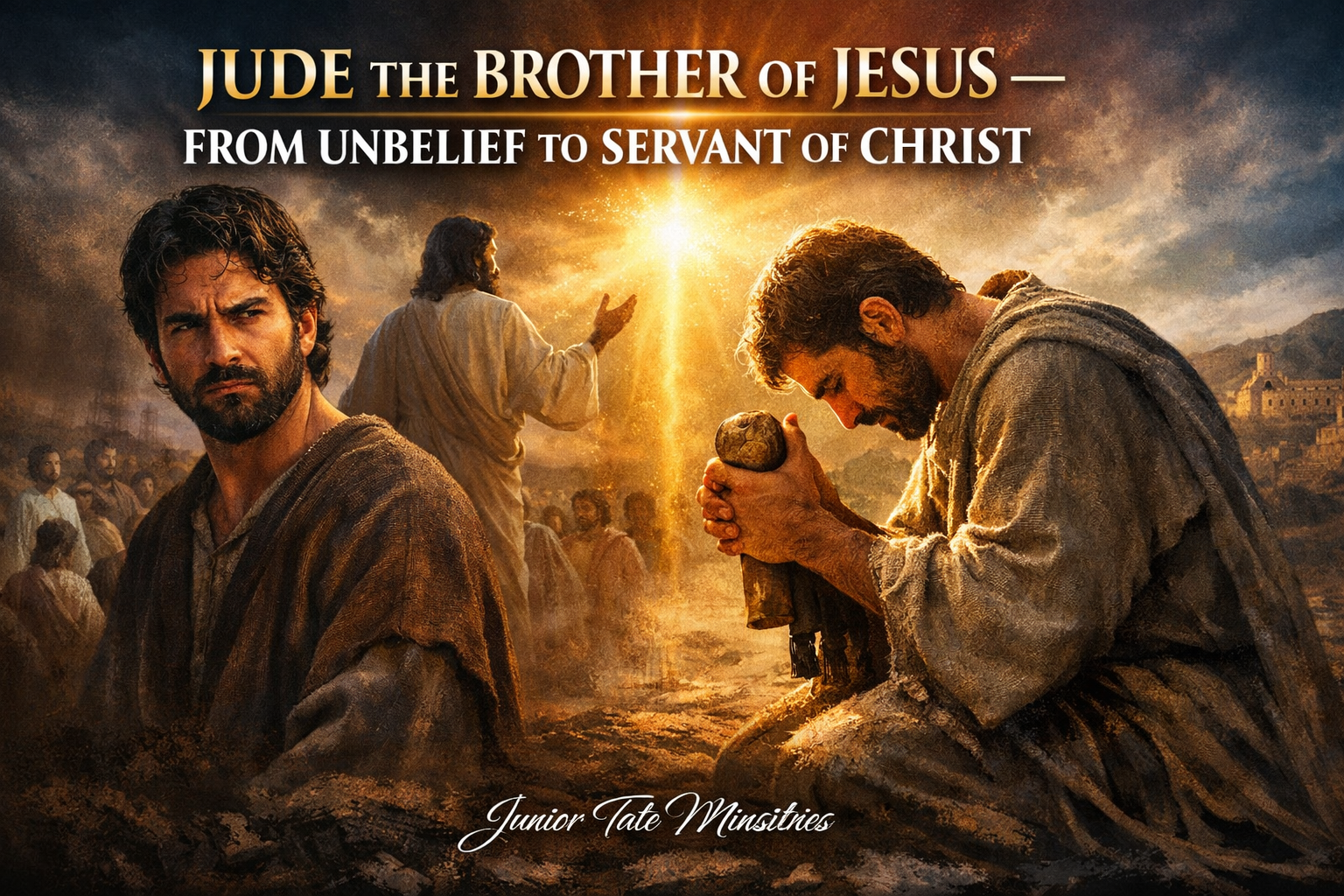
Jude is one of the most remarkable, yet often misunderstood figures connected to the early church. Unlike the apostles who followed Jesus during His earthly ministry, Jude’s story is far more personal and far more sobering. He grew up in the same household as Jesus Christ. He shared the same mother. He witnessed the daily life, character, and conduct of the Son of God from childhood. Yet Scripture plainly teaches that Jude did not believe in Jesus during His ministry. Only after the resurrection did Jude come to true faith. Later, under the inspiration of the Holy Ghost, Jude wrote the powerful New Testament letter that bears his name.
Jude’s life stands as a testimony to the reality that physical proximity to Jesus does not guarantee spiritual surrender, and that resurrection faith changes everything.
Jude’s Identity in Scripture — Brother of Jesus
The Bible clearly and plainly identifies Jude as one of Jesus’ earthly brothers.
Matthew 13:55–56 (KJV)
“Is not this the carpenter’s son? is not his mother called Mary? and his brethren, James, and Joses, and Simon, and Judas?
And his sisters, are they not all with us? Whence then hath this man all these things?”
Here Scripture establishes several key facts:
- Jesus was known publicly as the “carpenter’s son.”
- His mother is clearly identified as Mary.
- His brothers are named:
- James
- Joses
- Simon
- Judas (this is Jude)
- He also had sisters, though they are not named.
This same list is repeated in another Gospel account:
Mark 6:3 (KJV)
“Is not this the carpenter, the son of Mary, the brother of James, and Joses, and of Juda, and Simon? and are not his sisters here with us? And they were offended at him.”
From these two passages alone, Scripture clearly teaches:
- Jude was one of the natural sons of Mary and Joseph.
- Jude was therefore the half-brother of Jesus, since Jesus was conceived of the Holy Ghost.
- Jude grew up in the same household as Jesus in Nazareth.
- Jude lived in daily proximity to the sinless Son of God.
Jude’s Early Life — Growing Up with Jesus
The Bible does not give direct descriptions of Jude’s childhood, but Scripture allows us to understand the environment in which he grew.
Jesus is described as:
Luke 2:52 (KJV)
“And Jesus increased in wisdom and stature, and in favour with God and man.”
Jesus lived a sinless, obedient life under His earthly parents. Jude would have:
- Watched Jesus obey His parents.
- Observed Jesus work as a carpenter.
- Witnessed His perfect integrity.
- Seen His compassion toward others.
- Observed His prayer life.
- Heard His teaching even before the public ministry.
Yet none of this, by itself, brought Jude to saving faith.
Jude’s Unbelief During Jesus’ Earthly Ministry
The Gospel of John explicitly states that the brothers of Jesus did not believe in Him during His ministry.
John 7:3–5 (KJV)
“His brethren therefore said unto him, Depart hence, and go into Judaea, that thy disciples also may see the works that thou doest.
For there is no man that doeth any thing in secret, and he himself seeketh to be known openly. If thou do these things, shew thyself to the world.
For neither did his brethren believe in him.”
This is direct, plain Scripture:
- Jude did not believe Jesus was the Messiah at this point.
- Jude heard Jesus teach.
- Jude saw miracles.
- Jude heard the claims.
- Yet Jude remained an unbeliever.
This tells us that miracles alone do not create faith. Faith comes by revelation from God.
Jude Before the Cross
During the crucifixion of Jesus, Jude is not mentioned at the cross. Instead, Jesus commits the care of His mother Mary to the apostle John.
John 19:26–27 (KJV)
“When Jesus therefore saw his mother, and the disciple standing by, whom he loved, he saith unto his mother, Woman, behold thy son!
Then saith he to the disciple, Behold thy mother! And from that hour that disciple took her unto his own home.”
This strongly indicates that His brothers were not yet believers, because Jesus did not entrust Mary to them at that moment.
At this point in Jude’s life:
- He is still an unbeliever.
- He has not yet accepted Christ as Lord.
The Resurrection — The Turning Point in Jude’s Life
Everything changes with the resurrection of Jesus Christ.
1 Corinthians 15:3–7 (KJV)
“For I delivered unto you first of all that which I also received, how that Christ died for our sins according to the scriptures;
And that he was buried, and that he rose again the third day according to the scriptures:
And that he was seen of Cephas, then of the twelve:
After that, he was seen of above five hundred brethren at once…
After that, he was seen of James…”
The resurrected Christ appeared to James, Jude’s brother. After this, the entire family is found among believers.
Acts 1:14 (KJV)
“These all continued with one accord in prayer and supplication, with the women, and Mary the mother of Jesus, and with his brethren.”
This includes Jude.
Now Jude is:
- A believer.
- A worshiper.
- A praying follower of Christ.
- Waiting for the Holy Ghost with the early church.
The resurrection convinced Jude that the One he grew up with was truly the Son of God, the risen Lord.
Jude’s New Identity — Servant of Jesus Christ
When Jude later writes his New Testament letter, he introduces himself with great humility:
Jude 1:1 (KJV)
“Jude, the servant of Jesus Christ, and brother of James, to them that are sanctified by God the Father, and preserved in Jesus Christ, and called:”
This verse is foundational to understanding Jude:
- Jude does not call himself “the brother of Jesus.”
- Jude calls himself “the servant of Jesus Christ.”
- Jude identifies himself through submission, not family.
- Jude refers to James because James was widely recognized as a leader in the Jerusalem church.
This shows Jude’s full surrender to Christ as Lord.
Why Jude Wrote His Epistle
Jude tells us exactly why he wrote his letter:
Jude 1:3–4 (KJV)
“Beloved, when I gave all diligence to write unto you of the common salvation, it was needful for me to write unto you, and exhort you that ye should earnestly contend for the faith which was once delivered unto the saints.
For there are certain men crept in unawares… ungodly men, turning the grace of our God into lasciviousness, and denying the only Lord God, and our Lord Jesus Christ.”
The problem Jude addressed was:
- False teachers.
- Moral compromise.
- Abuse of grace.
- Denial of Christ’s authority.
Jude writes not from speculation, but from spiritual urgency.
Jude’s Warnings from Scripture
Jude bases his warnings entirely on biblical history:
Israel’s Unbelief
Jude 1:5 (KJV)
“The Lord, having saved the people out of the land of Egypt, afterward destroyed them that believed not.”
Angels That Sinned
Jude 1:6 (KJV)
“And the angels which kept not their first estate… he hath reserved in everlasting chains under darkness unto the judgment of the great day.”
Sodom and Gomorrha
Jude 1:7 (KJV)
“Even as Sodom and Gomorrha… are set forth for an example, suffering the vengeance of eternal fire.”
Cain, Balaam, and Korah
Jude 1:11 (KJV)
“Woe unto them! for they have gone in the way of Cain, and ran greedily after the error of Balaam for reward, and perished in the gainsaying of Core.”
Every warning Jude gives is rooted in Scripture, not opinion.
Jude’s Prophecy of the Lord’s Return
Jude 1:14–15 (KJV)
“Behold, the Lord cometh with ten thousands of his saints,
To execute judgment upon all…”
Jude, once an unbeliever, now boldly proclaims:
- The return of Christ.
- The coming judgment.
- The accountability of all ungodliness.
Jude’s Final Exhortations to Believers
Building Faith
Jude 1:20–21 (KJV)
“But ye, beloved, building up yourselves on your most holy faith, praying in the Holy Ghost, Keep yourselves in the love of God, looking for the mercy of our Lord Jesus Christ unto eternal life.”
Dealing with the Erring
Jude 1:22–23 (KJV)
“And of some have compassion, making a difference:
And others save with fear, pulling them out of the fire…”
Jude’s Closing Doxology
Jude 1:24–25 (KJV)
“Now unto him that is able to keep you from falling, and to present you faultless before the presence of his glory with exceeding joy, To the only wise God our Saviour, be glory and majesty, dominion and power, both now and ever. Amen.”
What Scripture Teaches Us About Jude
From the Bible alone, we know that Jude:
- Was the half-brother of Jesus.
- Did not believe during Jesus’ ministry.
- Was converted after the resurrection.
- Became a servant of Jesus Christ.
- Wrote a letter defending the faith.
- Warned the church against false teachers.
- Proclaimed the return and judgment of Christ.
- Trusted fully in God’s keeping power.
Conclusion
Jude’s life is a testimony of resurrection faith, humility, and spiritual authority. The man who once doubted Jesus as his brother later worshiped Him as Lord, defended His truth with holy boldness, and left the church one of its strongest warnings and greatest promises.
If the Holy Spirit is convicting and pulling at your heart strings today, give in to Him and follow the prayer below for your salvation in Jesus Christ!
You may not ever get another chance to except Christ as your personal Savior and Lord! Your next breath is not promised!
Come! He’s Waiting on You!
Prayer to Salvation
Heavenly Father,
I come before You today admitting that I am a sinner in need of Your mercy and grace.
Your Word says in Romans 10:9–10 that if I confess with my mouth the Lord Jesus and believe in my heart that God hath raised Him from the dead, I shall be saved.
Today, I confess Jesus Christ as my Lord and my Savior. I believe with all my heart that He died for my sins, was buried, and rose again the third day.
Lord Jesus, I ask You to forgive me of all my sins. Wash me clean in Your precious blood. I turn from my old life and surrender fully to You.
Come into my heart, make me a new creature, and fill me with the Holy Spirit. From this day forward, I choose to follow You, live by Your Word, and walk in the new life You have given me.
Thank You, Lord, for saving me, for forgiving me, and for writing my name in the Lamb’s Book of Life. I give You all the glory, honor, and praise.
In Jesus’ name I pray, Amen.
Junior Tate Ministries
greatcommissiontoday.com
juniortateministries.com