
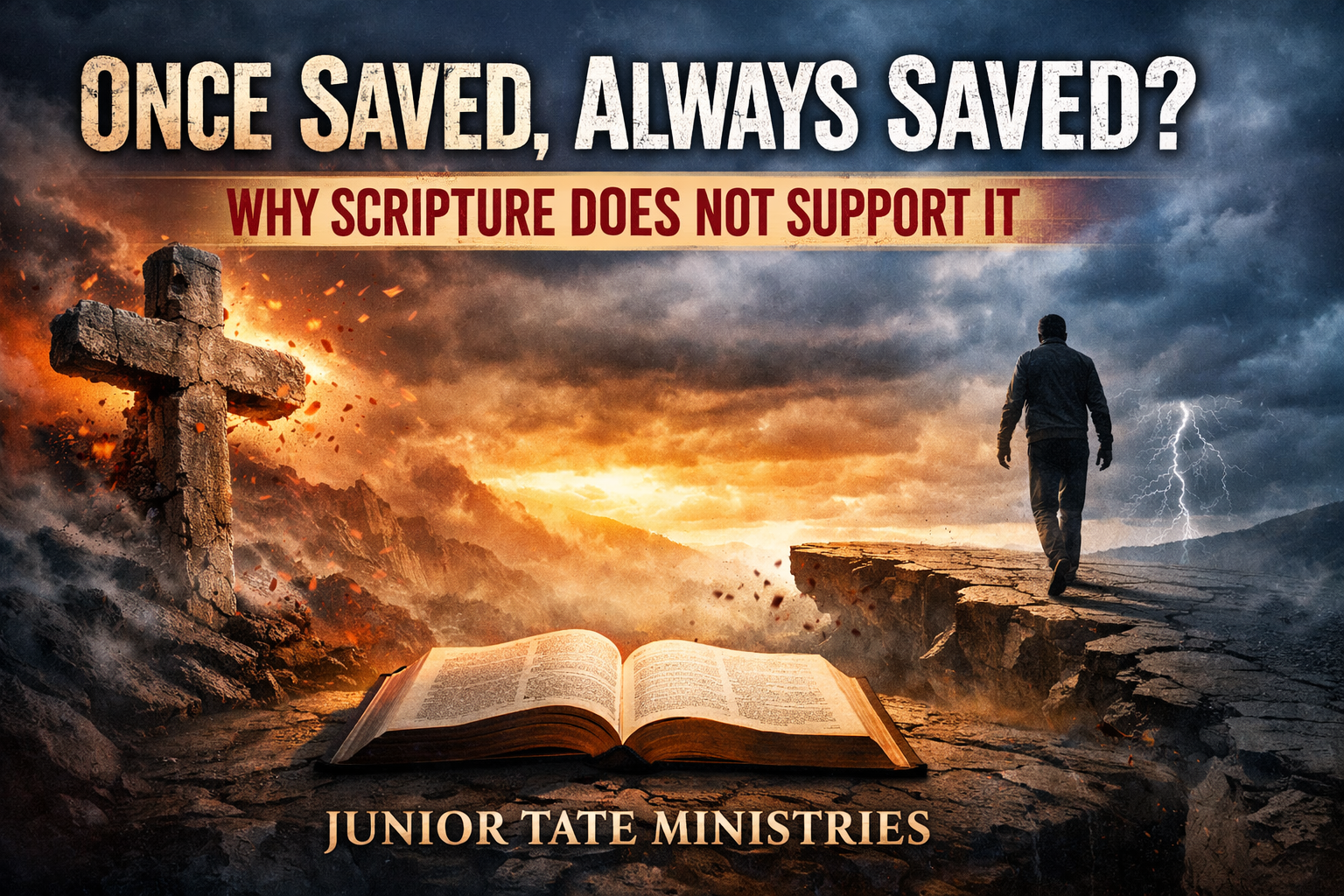
Introduction: Why This Question Matters
Few topics create more confusion—and more false assurance—than the phrase “Once Saved, Always Saved.” Many people use it to mean: “If I once prayed a prayer, walked an aisle, or made a profession of faith, then heaven is guaranteed no matter how I live afterward.”
But when we let Scripture speak for itself, the Bible repeatedly teaches that saving faith is a living faith that continues, and that God gives real warnings to real people about departing, falling away, drawing back, and turning again into sin and unbelief.
This article is not built on denominational traditions or emotional arguments. The goal is simple: Let the Bible define the doctrine. We will use the King James Version (KJV) and quote Scripture in full when we cite it.
You can’t lose Salvation because it was a gift from Christ to start with, but you can forfeit Salvation by continually willful sinning. As Scripture says; you can depart from your faith and turn back to your old ways before Salvation.
Salvation Is by Grace Through Faith — But Saving Faith Is Not “One Moment Then Done.”
The Bible is clear: salvation is not earned by works, religious rituals, or moral improvement. Salvation is a gift of God.
Ephesians 2:8–10 (KJV)
“For by grace are ye saved through faith; and that not of yourselves: it is the gift of God:
Not of works, lest any man should boast.
For we are his workmanship, created in Christ Jesus unto good works, which God hath before ordained that we should walk in them.”
Notice: we are saved by grace through faith—and we are created in Christ unto good works, not to earn salvation, but because a true new birth produces a new walk.
Scripture also shows that a faith that has no fruit is not saving faith.
James 2:17–20 (KJV)
“Even so faith, if it hath not works, is dead, being alone.
Yea, a man may say, Thou hast faith, and I have works: shew me thy faith without thy works, and I will shew thee my faith by my works.
Thou believest that there is one God; thou doest well: the devils also believe, and tremble.
But wilt thou know, O vain man, that faith without works is dead?”
So, Scripture distinguishes between living faith and dead faith. A person can claim to believe, but if their “faith” is merely mental agreement with no transformation, the Bible says it is dead.
The Bible Commands Believers to Continue and Endure — Not Assume
A core problem with the OSAS slogan is that it can turn assurance into presumption—the idea that past words guarantee future salvation regardless of present reality.
Scripture repeatedly calls God’s people to continue, hold fast, and endure.
Continue in the Faith
Colossians 1:21–23 (KJV)
“And you, that were sometime alienated and enemies in your mind by wicked works, yet now hath he reconciled
In the body of his flesh through death, to present you holy and unblameable and unreproveable in his sight:
If ye continue in the faith grounded and settled, and be not moved away from the hope of the gospel, which ye have heard, and which was preached to every creature which is under heaven; whereof I Paul am made a minister;”
Note the word “If.” Paul describes reconciliation and God’s aim to present believers holy—if they continue and are not moved away. This is not “one-time profession no matter what.” Scripture ties salvation reality to perseverance in the faith.
Hold Fast
Hebrews 3:12–14 (KJV)
“Take heed, brethren, lest there be in any of you an evil heart of unbelief, in departing from the living God.
But exhort one another daily, while it is called To day; lest any of you be hardened through the deceitfulness of sin.
For we are made partakers of Christ, if we hold the beginning of our confidence stedfast unto the end;”
This passage is devastating to casual OSAS thinking. It warns “brethren” about an evil heart of unbelief that results in departing from the living God, and it declares we are made partakers of Christ if we hold our confidence steadfast unto the end.
Endure to the End
Matthew 24:12–13 (KJV)
“And because iniquity shall abound, the love of many shall wax cold.
But he that shall endure unto the end, the same shall be saved.”
The Bible does not describe salvation as a permission slip to drift into iniquity. Christ warns that abounding sin can cool love, and then speaks plainly: endurance matters.
Scripture Gives Real Warnings About Falling Away and Drawing Back
If OSAS is meant to teach that falling away is impossible, then why does the Bible give repeated, serious warnings?
Warnings in Hebrews: Turning Back Is Deadly
Hebrews 10:26–29 (KJV)
“For if we sin wilfully after that we have received the knowledge of the truth, there remaineth no more sacrifice for sins,
But a certain fearful looking for of judgment and fiery indignation, which shall devour the adversaries.
He that despised Moses’ law died without mercy under two or three witnesses:
Of how much sorer punishment, suppose ye, shall he be thought worthy, who hath trodden under foot the Son of God, and hath counted the blood of the covenant, wherewith he was sanctified, an unholy thing, and hath done despite unto the Spirit of grace?”
This warns against willful sin after receiving the knowledge of the truth, describing someone who trods under foot the Son of God, and treats the blood of the covenant as unholy—someone who had been sanctified in relation to that covenant.
Now note the conclusion:
Hebrews 10:38–39 (KJV)
“Now the just shall live by faith: but if any man draw back, my soul shall have no pleasure in him.
But we are not of them who draw back unto perdition; but of them that believe to the saving of the soul.”
The Bible explicitly says some draw back unto perdition (destruction). True believers are described as those who believe to the saving of the soul—not those who coast on a past moment while living in rebellion.
“Fallen From Grace” — Not a Phrase to Ignore
Galatians 5:4 (KJV)
“Christ is become of no effect unto you, whosoever of you are justified by the law; ye are fallen from grace.”
This is written to people engaging in a wrong doctrine—seeking justification by the law. The text warns that Christ becomes of no effect to them in that path, and says they are fallen from grace. Scripture uses warnings like this to call people back, not to comfort them in error.
Scripture Shows People Can Depart, Make Shipwreck, and Turn Away
Some claim every warning is hypothetical, but the Bible also records examples of people who turned.
Some Depart from the Faith
1 Timothy 4:1 (KJV)
“Now the Spirit speaketh expressly, that in the latter times some shall depart from the faith, giving heed to seducing spirits, and doctrines of devils;”
The Spirit speaks “expressly” that some will depart from the faith. That is more than losing joy or missing church—Scripture calls it departure from the faith.
Some Make Shipwreck Concerning Faith
1 Timothy 1:18–20 (KJV)
“This charge I commit unto thee, son Timothy, according to the prophecies which went before on thee, that thou by them mightest war a good warfare;
Holding faith, and a good conscience; which some having put away concerning faith have made shipwreck:
Of whom is Hymenaeus and Alexander; whom I have delivered unto Satan, that they may learn not to blaspheme.”
Here are named individuals who put away faith and good conscience and made shipwreck. Paul’s remedy is severe discipline, showing the danger is real.
Turning Back to Corruption Is Worse Than Before
2 Peter 2:20–22 (KJV)
“For if after they have escaped the pollutions of the world through the knowledge of the Lord and Saviour Jesus Christ, they are again entangled therein, and overcome, the latter end is worse with them than the beginning.
For it had been better for them not to have known the way of righteousness, than, after they have known it, to turn from the holy commandment delivered unto them.
But it is happened unto them according to the true proverb, The dog is turned to his own vomit again; and the sow that was washed to her wallowing in the mire.”
This passage is blunt: they escaped pollutions through knowledge of Christ, but become entangled again—their latter end is worse, and it would have been better not to have known the way of righteousness than to know it and turn.
Jesus Warned About Empty Profession and Fruitless Lives
Many people base OSAS on a momentary profession. But Jesus repeatedly warned that profession alone is not proof.
A) “I Never Knew You” — Not “I Knew You Once”
Matthew 7:21–23 (KJV)
“Not every one that saith unto me, Lord, Lord, shall enter into the kingdom of heaven; but he that doeth the will of my Father which is in heaven.
Many will say to me in that day, Lord, Lord, have we not prophesied in thy name? and in thy name have cast out devils? and in thy name done many wonderful works?
And then will I profess unto them, I never knew you: depart from me, ye that work iniquity.”
This destroys the idea that saying “Lord” is enough. Jesus points to iniquity as evidence of a false claim.
Branches in Christ That Do Not Abide Are Cast Forth
John 15:1–6 (KJV)
“I am the true vine, and my Father is the husbandman.
Every branch in me that beareth not fruit he taketh away: and every branch that beareth fruit, he purgeth it, that it may bring forth more fruit.
Now ye are clean through the word which I have spoken unto you.
Abide in me, and I in you. As the branch cannot bear fruit of itself, except it abide in the vine; no more can ye, except ye abide in me.
I am the vine, ye are the branches: He that abideth in me, and I in him, the same bringeth forth much fruit: for without me ye can do nothing.
If a man abide not in me, he is cast forth as a branch, and is withered; and men gather them, and cast them into the fire, and they are burned.”
Jesus commands abiding and warns that the one who does not abide is cast forth and burned. Whatever a person claims, the Lord Himself ties true relationship to abiding and fruit.
The Bible Teaches Assurance — But It’s Not the Same as OSAS Presumption
Some will say, “If you reject OSAS, you deny assurance.” Not true. The Bible offers assurance—but assurance is connected to present faith, obedience, and the witness of the Spirit, not to a dead profession.
We Can Know We Have Eternal Life
1 John 5:11–13 (KJV)
“And this is the record, that God hath given to us eternal life, and this life is in his Son.
He that hath the Son hath life; and he that hath not the Son of God hath not life.
These things have I written unto you that believe on the name of the Son of God; that ye may know that ye have eternal life, and that ye may believe on the name of the Son of God.”
Yes—believers can know. But the question becomes: Who has the Son? Scripture does not teach that continuing in darkness proves salvation.
Walking in Light vs. Walking in Darkness
1 John 1:6–9 (KJV)
“If we say that we have fellowship with him, and walk in darkness, we lie, and do not the truth:
But if we walk in the light, as he is in the light, we have fellowship one with another, and the blood of Jesus Christ his Son cleanseth us from all sin.
If we say that we have no sin, we deceive ourselves, and the truth is not in us.
If we confess our sins, he is faithful and just to forgive us our sins, and to cleanse us from all unrighteousness.”
John distinguishes between a claim and a walk. If a person says they have fellowship but walks in darkness, they lie. Assurance belongs to those walking in the light, confessing sin, and living under Christ’s cleansing.
The Bible Warns Believers Not to Be Deceived: Unrighteous Living and the Kingdom
OSAS often tells people: “Your lifestyle can’t affect your eternal destiny once you’re saved.” But Scripture warns believers not to be deceived about sin and inheritance.
1 Corinthians 6:9–11 (KJV)
“Know ye not that the unrighteous shall not inherit the kingdom of God? Be not deceived: neither fornicators, nor idolaters, nor adulterers, nor effeminate, nor abusers of themselves with mankind,
Nor thieves, nor covetous, nor drunkards, nor revilers, nor extortioners, shall inherit the kingdom of God.
And such were some of you: but ye are washed, but ye are sanctified, but ye are justified in the name of the Lord Jesus, and by the Spirit of our God.”
Paul does not comfort professing Christians in ongoing unrighteousness. He says “be not deceived,” then reminds them: “such were some of you”—past tense—because salvation changes people.
Galatians 6:7–9 (KJV)
“Be not deceived; God is not mocked: for whatsoever a man soweth, that shall he also reap.
For he that soweth to his flesh shall of the flesh reap corruption; but he that soweth to the Spirit shall of the Spirit reap life everlasting.
And let us not be weary in well doing: for in due season we shall reap, if we faint not.”
Here again: sowing to the flesh reaps corruption; sowing to the Spirit reaps life everlasting—and we reap if we faint not.
What About Passages That Teach God’s Keeping Power?
Many OSAS defenders quote verses about God keeping His people. Those verses are precious and true—but they do not cancel the warnings. The full biblical picture is: God keeps His people, and His people persevere by continuing in faith.
God Is Faithful to Keep — And We Are Called to Abide
Jude 1:24–25 (KJV)
“Now unto him that is able to keep you from falling, and to present you faultless before the presence of his glory with exceeding joy,
To the only wise God our Saviour, be glory and majesty, dominion and power, both now and ever. Amen.”
God is able to keep. Amen. But the same New Testament also says:
Jude 1:20–21 (KJV)
“But ye, beloved, building up yourselves on your most holy faith, praying in the Holy Ghost,
Keep yourselves in the love of God, looking for the mercy of our Lord Jesus Christ unto eternal life.”
Both are true: God keeps, and believers are commanded to keep themselves in the love of God—continuing in faith and prayer.
A Balanced Scriptural Conclusion
When all the passages are allowed to stand, Scripture teaches these truths together:
- Salvation is by grace through faith (not by works).
- Saving faith is living faith that produces obedience and fruit.
- Scripture repeatedly warns believers about departing, drawing back, and falling away.
- The Bible calls believers to continue, hold fast, abide, and endure.
- Assurance is real, but it is not built on a past moment while living in present rebellion; it is grounded in Christ, evidenced by walking in the light, and sustained by ongoing faith.
The phrase “Once Saved, Always Saved” is not a Bible verse. If a person uses it to mean: “God will preserve every true believer who continues in Christ,” that is closer to Scripture’s teaching about God’s power and faithful keeping. But if a person uses it to mean: “I can turn back to sin, reject Christ, live in darkness, and still be guaranteed heaven because I once professed faith,” that message is not biblical—and it is dangerously close to the very deception the apostles warn against.
A Scriptural Call to Self-Examination
The Bible tells us to examine ourselves honestly.
2 Corinthians 13:5 (KJV)
“Examine yourselves, whether ye be in the faith; prove your own selves. Know ye not your own selves, how that Jesus Christ is in you, except ye be reprobates?”
This isn’t meant to destroy true assurance. It is meant to destroy false assurance.
Closing Encouragement: What Should a Believer Do?
If you are truly saved, your hope is not in a slogan. Your hope is in Christ. Continue in Him, abide in His word, stay in prayer, walk in the light, confess sin quickly, and cling to the gospel.
Philippians 2:12–13 (KJV)
“Wherefore, my beloved, as ye have always obeyed, not as in my presence only, but now much more in my absence, work out your own salvation with fear and trembling.
For it is God which worketh in you both to will and to do of his good pleasure.”
God works in His people, and His people respond—obediently, humbly, and continually.
If the Holy Spirit is convicting and pulling at your heart strings today, give in to Him and follow the prayer below for your salvation in Jesus Christ! You may not ever get another chance to except Christ as your personal Savior and Lord! Your next breath is not promised!
Come! He’s Waiting on You!
Prayer to Salvation
Heavenly Father,
I come before You today admitting that I am a sinner in need of Your mercy and grace. Your Word says in Romans 10:9–10 that if I confess with my mouth the Lord Jesus and believe in my heart that God hath raised Him from the dead, I shall be saved. Today, I confess Jesus Christ as my Lord and my Savior. I believe with all my heart that He died for my sins, was buried, and rose again the third day.
Lord Jesus, I ask You to forgive me of all my sins. Wash me clean in Your precious blood. I turn from my old life and surrender fully to You.
Come into my heart, make me a new creature, and fill me with the Holy Spirit. From this day forward, I choose to follow You, live by Your Word, and walk in the new life You have given me.
Thank You, Lord, for saving me, for forgiving me, and for writing my name in the Lamb’s Book of Life. I give You all the glory, honor, and praise.
In Jesus’ name I pray, Amen.
juniortateministries.com
greatcommissiontoday.com