
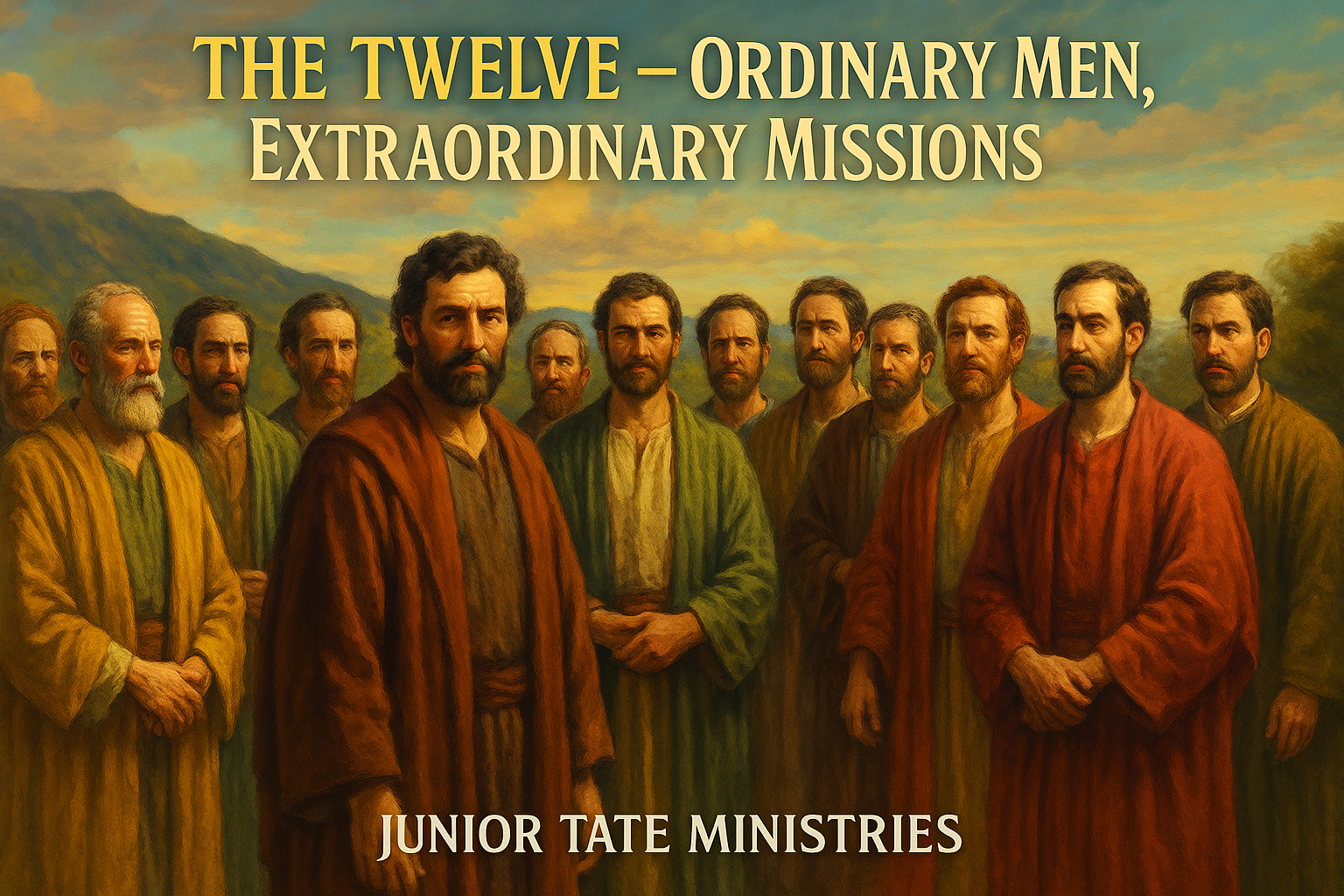
By: Junior Tate Ministries
God’s Pattern – Ordinary People, Extraordinary Work
From Genesis to Revelation, God delights in using ordinary people to accomplish extraordinary things. The twelve men whom Jesus chose as His apostles were not famous scholars, political leaders, or wealthy influencers. They were fishermen, a tax collector, a former zealot, and men with weaknesses, fears, and failures—just like us.
Yet under the hand of Christ and in the power of the Holy Ghost, these ordinary men were sent on an extraordinary mission: to take the gospel from a small region in Israel to the “uttermost part of the earth.”
The Bible describes God’s method plainly:
“For ye see your calling, brethren, how that not many wise men after the flesh, not many mighty, not many noble, are called: But God hath chosen the foolish things of the world to confound the wise; and God hath chosen the weak things of the world to confound the things which are mighty; And base things of the world, and things which are despised, hath God chosen, yea, and things which are not, to bring to nought things that are, that no flesh should glory in his presence.” (1 Corinthians 1:26–29, KJV)
The story of the Twelve is a living example of this truth.
Jesus Chooses the Twelve
The choosing of the Twelve was not random, rushed, or accidental. It was done in perfect obedience to the Father’s will, bathed in prayer.
“And it came to pass in those days, that he went out into a mountain to pray, and continued all night in prayer to God. And when it was day, he called unto him his disciples: and of them he chose twelve, whom also he named apostles.” (Luke 6:12–13, KJV)
Mark tells us more about their purpose:
“And he ordained twelve, that they should be with him, and that he might send them forth to preach, And to have power to heal sicknesses, and to cast out devils.” (Mark 3:14–15, KJV)
Notice three key things:
- “He ordained twelve” – Jesus chose them; they did not choose themselves.
- “That they should be with him” – before they were sent out, they were called to be with Him. Relationship comes before ministry.
- “That he might send them forth to preach” – they were chosen for a mission, not merely for a position.
They were ordinary men—but chosen and ordained by an extraordinary Lord.
Their Ordinary Backgrounds
Fishermen: Peter, Andrew, James, and John
Several of the Twelve were fishermen—hard-working, common men with calloused hands and simple lives.
“And Jesus, walking by the sea of Galilee, saw two brethren, Simon called Peter, and Andrew his brother, casting a net into the sea: for they were fishers. And he saith unto them, Follow me, and I will make you fishers of men. And they straightway left their nets, and followed him. And going on from thence, he saw other two brethren, James the son of Zebedee, and John his brother, in a ship with Zebedee their father, mending their nets; and he called them. And they immediately left the ship and their father, and followed him.” (Matthew 4:18–22, KJV)
There was nothing remarkable in the world’s eyes about these men. Yet when Jesus called, they immediately left what was familiar to follow Him.
A Tax Collector: Matthew (Levi)
Tax collectors were despised in Israel as collaborators with Rome and sinners.
“And as he passed by, he saw Levi the son of Alphaeus sitting at the receipt of custom, and said unto him, Follow me. And he arose and followed him.” (Mark 2:14, KJV)
Matthew’s former life as a tax collector shows that Christ can redeem even a hated profession and turn a man into a Gospel writer and witness of grace.
A Zealot: Simon the Canaanite
Simon is called “Simon the Canaanite” in Matthew’s list of the apostles (Matthew 10:4, KJV). Luke identifies him as “Simon called Zelotes” (Luke 6:15, KJV). These titles refer to the same disciple and highlight the idea of zeal—an intensity of conviction and passion that, in that era, was often associated with strong resistance to Roman rule.
It’s important not to confuse Simon with Judas Iscariot. Matthew lists them one after the other: “Simon the Canaanite, and Judas Iscariot, who also betrayed him” (Matthew 10:4, KJV). Judas is a different man, and the phrase “who also betrayed him” is describing Judas, not Simon. Luke makes this distinction explicit by listing “Simon called Zelotes” and then separately naming “Judas Iscariot, which also was the traitor” (Luke 6:15–16, KJV).
Jesus took a man known for intensity and redirected that zeal toward the kingdom of God. Whatever Simon’s passions had been before, Christ formed him into a witness whose loyalty was no longer driven by politics, but by the Person of Christ and the mission of the gospel.
Their Weaknesses and Failures
These twelve were not spiritual super-heroes. The Scriptures honestly record their arguments, fears, doubts, and failures.
Peter: Bold and Broken
Peter is often the spokesman of the group, quick to speak and quick to stumble. After Peter confessed Jesus as the Christ (Matthew 16:16), he later denied Him three times.
Before this failure, Jesus warned him:
“And the Lord said, Simon, Simon, behold, Satan hath desired to have you, that he may sift you as wheat:
But I have prayed for thee, that thy faith fail not: and when thou art converted, strengthen thy brethren.” (Luke 22:31–32, KJV)
When Peter did deny Christ, the Bible describes his deep sorrow:
“And the Lord turned, and looked upon Peter. And Peter remembered the word of the Lord, how he had said unto him, Before the cock crow, thou shalt deny me thrice. And Peter went out, and wept bitterly.” (Luke 22:61–62, KJV)
Peter was an ordinary man prone to fear, yet Jesus prayed for him and later used him mightily.
Thomas: Doubting Then Declaring
Thomas is often remembered as “doubting Thomas,” but Scripture gives us a fuller picture. When Jesus was going back toward danger in Judea:
“Then said Thomas, which is called Didymus, unto his fellow disciples, Let us also go, that we may die with him.” (John 11:16, KJV)
Later, after the resurrection, Thomas struggled to believe:
“Then saith he to Thomas, reach hither thy finger, and behold my hands; and reach hither thy hand, and thrust it into my side: and be not faithless, but believing. And Thomas answered and said unto him, My Lord and my God.” (John 20:27–28, KJV)
Thomas moved from doubt to one of the clearest confessions of Christ’s deity: “My Lord and my God.”
The Group as a Whole: Slow to Understand, Quick to Fear
The Gospels show the Twelve:
- Arguing over who would be greatest (Luke 22:24)
- Falling asleep in Gethsemane (Matthew 26:40–41)
- Forsaking Jesus and fleeing when He was arrested (Matthew 26:56)
They were not naturally brave, wise, or spiritually strong. They were ordinary—and often afraid.
Yet after the resurrection and the coming of the Holy Ghost, people saw a dramatic change.
“Now when they saw the boldness of Peter and John, and perceived that they were unlearned and ignorant men, they marveled; and they took knowledge of them, that they had been with Jesus.” (Acts 4:13, KJV)
What made the difference? They had “been with Jesus,” and they were filled with the Holy Ghost.
The Extraordinary Mission: The Great Commission
The Twelve were not simply saved and then left to live quiet lives. They were given a worldwide mission by the risen Lord.
“And Jesus came and spake unto them, saying, All power is given unto me in heaven and in earth. Go ye therefore, and teach all nations, baptizing them in the name of the Father, and of the Son, and of the Holy Ghost. Teaching them to observe all things whatsoever I have commanded you: and, lo, I am with you alway, even unto the end of the world. Amen.” (Matthew 28:18–20, KJV)
Key truths from this passage:
- Christ’s Authority – “All power is given unto Me in heaven and in earth.” The mission rests on His authority, not their strength.
- Global Scope – “…Teach all nations…” The message is for all people, not just Israel.
- Making Disciples – “Teaching them to observe all things whatsoever I have commanded you.” They were to make obedient followers of Christ, not just casual hearers.
- Christ’s Presence – “Lo, I am with you alway, even unto the end of the world.” The mission is carried out with His continual presence.
Before they went out, they were told to wait for the power of the Holy Ghost:
“But ye shall receive power, after that the Holy Ghost is come upon you: and ye shall be witnesses unto me both in Jerusalem, and in all Judaea, and in Samaria, and unto the uttermost part of the earth.” (Acts 1:8, KJV)
This verse outlines their mission field:
- Jerusalem – where they were
- Judaea – their surrounding region
- Samaria – the despised neighbors
- Uttermost part of the earth – everywhere else
Ordinary men, global mission.
Empowered at Pentecost
Jesus did not send the Twelve out in their own strength. He promised the Holy Ghost, and that promise was fulfilled at Pentecost.
“And when the day of Pentecost was fully come, they were all with one accord in one place. And suddenly there came a sound from heaven as of a rushing mighty wind, and it filled all the house where they were sitting. And there appeared unto them cloven tongues like as of fire, and it sat upon each of them. And they were all filled with the Holy Ghost, and began to speak with other tongues, as the Spirit gave them utterance.” (Acts 2:1–4, KJV)
After this, Peter—who had earlier denied Christ—stood up and preached to the crowd (Acts 2:14–36). When the people were convicted:
“Now when they heard this, they were pricked in their heart, and said unto Peter and to the rest of the apostles, Men and brethren, what shall we do?” (Acts 2:37, KJV)
Peter’s answer:
“Then Peter said unto them, Repent, and be baptized every one of you in the name of Jesus Christ for the remission of sins, and ye shall receive the gift of the Holy Ghost.” (Acts 2:38, KJV)
The result:
“Then they that gladly received his word were baptized: and the same day there were added unto them about three thousand souls.” (Acts 2:41, KJV)
Three thousand people saved and baptized in one day—through the preaching of men who had once fled in fear. This is the power of God working through ordinary vessels.
Individual Snapshots of the Twelve
Scripture does not give equal detail about each apostle, but what it does reveal shows God’s variety in His servants.
Peter (Simon Peter)
- Fisherman by trade (Matthew 4:18)
- Confessed, “Thou art the Christ, the Son of the living God.” (Matthew 16:16)
- Denied Christ, then restored and used mightily in Acts.
- Preached at Pentecost and opened the door of the gospel to Jews (Acts 2), Samaritans (Acts 8), and Gentiles (Acts 10).
James and John (Sons of Zebedee)
- Called while mending nets with their father (Matthew 4:21–22).
- Nicknamed “Boanerges…sons of thunder” (Mark 3:17).
- James was the first apostle martyred (Acts 12:1–2).
- John is called “the disciple whom Jesus loved” (John 13:23), and by Scripture he later wrote the Gospel of John, three epistles, and Revelation.
Andrew
Andrew is often seen bringing others to Jesus.
“One of the two which heard John speak, and followed him, was Andrew, Simon Peter’s brother.” (John 1:40, KJV)
He brought his own brother Peter to Christ (John 1:41–42) and later pointed out the lad with five loaves and two fishes (John 6:8–9). Quiet, but faithful in leading individuals to the Lord.
Philip and Nathanael (Bartholomew)
“Philip findeth Nathanael, and saith unto him, We have found him, of whom Moses in the law, and the prophets, did write, Jesus of Nazareth, the son of Joseph. And Nathanael said unto him, Can there any good thing come out of Nazareth? Philip saith unto him, Come and see.” (John 1:45–46, KJV)
Philip simply says, “Come and see.” Nathanael moves from skepticism to faith when Jesus reveals His knowledge of him (John 1:47–51).
Matthew (Levi)
We saw earlier his call from the tax office:
“And he arose and followed him.” (Mark 2:14, KJV)
He left a life of collecting money to record, under the Spirit’s inspiration, the Gospel that presents Christ as the promised King.
Thomas, James the son of Alphaeus, Simon Zelotes, Judas (not Iscariot)
The Bible records less about some of the Twelve, but that does not mean they were less important to God’s plan. Their names are still written in Scripture as chosen apostles.
“Philip, and Bartholomew; Thomas, and Matthew the publican; James the son of Alphaeus, and Lebbaeus, whose surname was Thaddaeus;
Simon the Canaanite, and Judas Iscariot, who also betrayed him.” (Matthew 10:3–4, KJV)
God knows their labors perfectly, even when man does not.
Judas Iscariot: A Solemn Warning
Judas was counted among the Twelve, saw the miracles, heard the teaching, and walked with Jesus—yet his heart was not truly surrendered. He betrayed Christ for thirty pieces of silver (Matthew 26:14–16) and later died in his sin (Matthew 27:3–5; Acts 1:16–20).
His life shows that outward position does not guarantee inward conversion. Being close to the things of God is not the same as being truly born again.
After his fall, another was chosen to take his place (Acts 1:23–26).
The Foundation Laid by the Apostles
Though these men were ordinary, Christ used them to lay the very foundation of the church’s witness.
“Now therefore ye are no more strangers and foreigners, but fellow citizens with the saints, and of the household of God;
And are built upon the foundation of the apostles and prophets, Jesus Christ himself being the chief corner stone.” (Ephesians 2:19–20, KJV)
Christ is the Chief Corner Stone. The apostles and prophets form the foundation upon which the rest of the church is built. Their doctrine, preaching, and Spirit-led writings (inspired Scripture) are still the standard for the church today.
As the gospel spread, enemies of the faith said of the early believers:
“These that have turned the world upside down are come hither also.” (Acts 17:6, KJV)
The Lord used these men so powerfully that an unbelieving world testified: they have “turned the world upside down.”
The story of the Twelve is not merely a piece of church history. It is a living testimony to what God can do with any believer fully yielded to Christ.
God Uses the Ordinary
The Twelve were fishermen, tax collectors, and ordinary laborers. The Bible says:
“For ye see your calling, brethren, how that not many wise men after the flesh, not many mighty, not many noble, are called.” (1 Corinthians 1:26, KJV)
God is still calling ordinary people—men and women, young and old—to follow Christ and be His witnesses where they live.
Being with Jesus Comes Before Working for Jesus
“And he ordained twelve, that they should be with him, and that he might send them forth to preach…” (Mark 3:14, KJV)
Before they went out to preach, they were called to be with Him. The power of their mission flowed from their relationship with Christ. The same is true today. Our ministry must flow from a close walk with the Lord.
God Can Redeem Failures
Peter denied Christ, Thomas doubted, the others fled—but Christ restored them and used them. God does not excuse sin, but He forgives and restores repentant hearts.
“And Peter went out, and wept bitterly.” (Luke 22:62, KJV). Later, this same Peter stood up boldly to preach in Acts 2.
Your past failures do not disqualify you from future usefulness if you repent and return to Christ.
The Same Gospel, the Same Mission
The Twelve were given the Great Commission. That Commission still belongs to the church today.
“Go ye therefore, and teach all nations…Teaching them to observe all things whatsoever I have commanded you…” (Matthew 28:19–20, KJV)
We are not apostles in the foundational sense, but we are witnesses of Christ in our generation. The same Lord, the same gospel, the same need—and the same promise of His presence.
The Same Power: The Holy Ghost
The apostles could not fulfill their mission without the power of the Holy Ghost, and neither can we.
“But ye shall receive power, after that the Holy Ghost is come upon you: and ye shall be witnesses unto Me…” (Acts 1:8, KJV)
The Spirit who filled and empowered them is the same Spirit who indwells on every true believer today. In our weakness, He is strong.
Twelve Men, One Lord, One Mission
The Twelve were not chosen because they were the most talented, the most educated, or the most impressive in the eyes of the world. They were chosen because it pleased God to take ordinary men and, through the Lord Jesus Christ and the power of the Holy Ghost, send them on an extraordinary mission that still shapes history.
They left their nets, their tax tables, their former lives, and followed Him. They stumbled, failed, and were restored. They preached, suffered, and many of them died for the name of Jesus. Through them, God laid a foundation for the gospel to reach the nations—even to us today.
Their story calls each of us to ask:
- Am I willing, as an ordinary person, to be fully surrendered to an extraordinary God?
- Will I be “with Him” first, so that I can be “sent forth” in His power?
- Will I take up my part in the same great mission—to make Christ known to the ends of the earth?
These twelve ordinary men with extraordinary missions remind us: it is never about the greatness of the servant, but the greatness of the Savior who calls, equips, and sends.
If the Holy Spirit is convicting and pulling at your heart strings today, give in to Him and follow the prayer below for your salvation in Jesus Christ! You may not ever get another chance to except Christ as your personal Savior and Lord! Your next breath is not promised!
Come! He’s Waiting on You!
Prayer for Salvation
Heavenly Father,
I come before You today admitting that I am a sinner in need of Your mercy and grace. Your Word says in Romans 10:9–10 that if I confess with my mouth the Lord Jesus and believe in my heart that God hath raised Him from the dead, I shall be saved. Today, I confess Jesus Christ as my Lord and my Savior. I believe with all my heart that He died for my sins, was buried, and rose again the third day.
Lord Jesus, I ask You to forgive me of all my sins. Wash me clean in Your precious blood. I turn from my old life and surrender fully to You. Come into my heart, make me a new creature, and fill me with the Holy Spirit. From this day forward, I choose to follow You, live by Your Word, and walk in the new life You have given me.
Thank You, Lord, for saving me, for forgiving me, and for writing my name in the Lamb’s Book of Life. I give You all the glory, honor, and praise.
In Jesus’ name I pray, Amen.