
By: Junior Tate
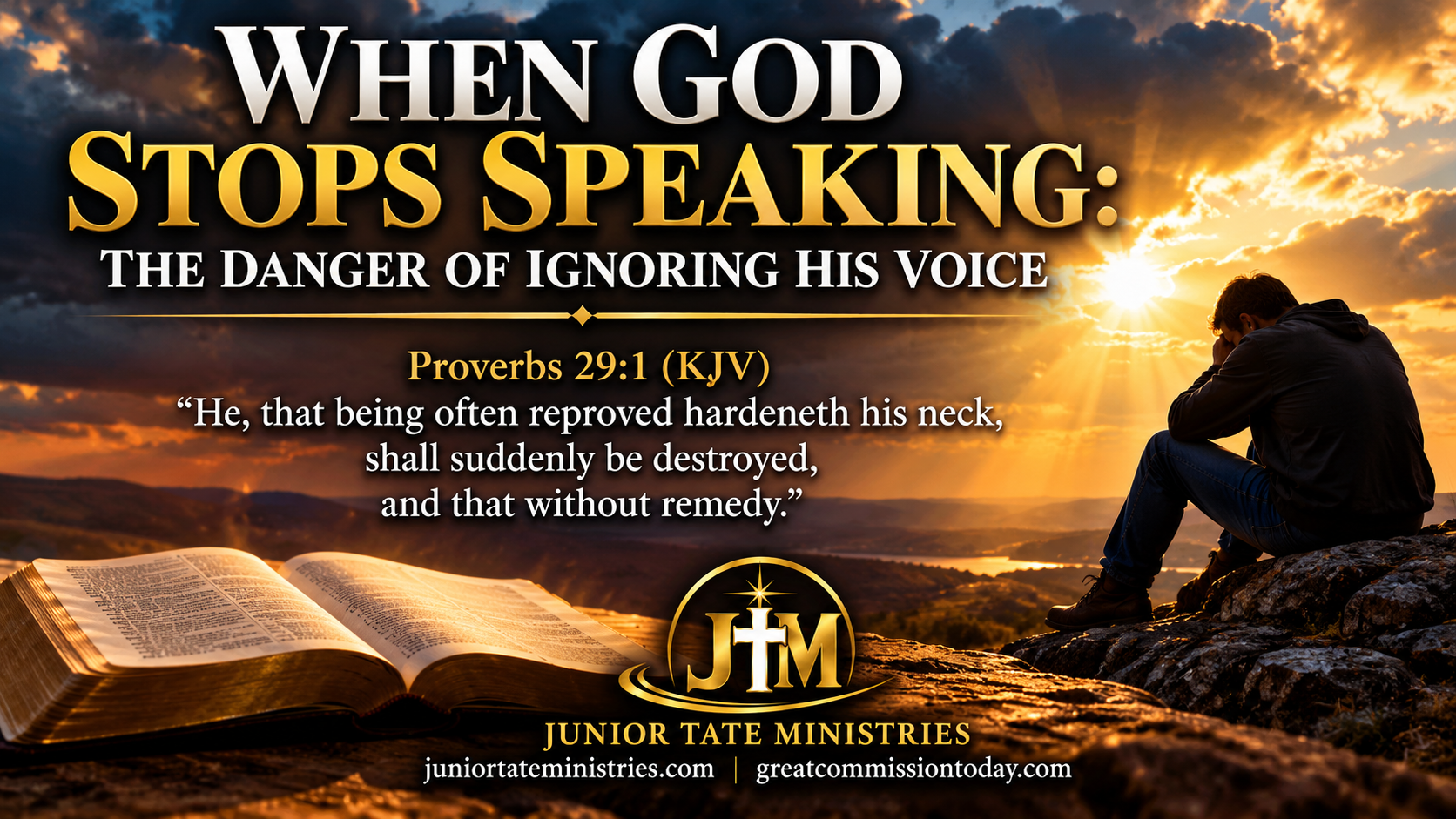
Main Scripture (KJV) – Proverbs 29:1
“He, that being often reproved hardeneth his neck, shall suddenly be destroyed, and that without remedy.”
What Happens When We Stop Listening?
There is something that has concerned me for many years as I have studied and taught the Word of God. It is the way a person can hear the truth of Scripture, feel the conviction of the Holy Spirit, and recognize that something in their life needs to change, yet continue walking in the same direction.
Sometimes that person may even acknowledge that God is dealing with their heart. They know what Scripture teaches. They understand what is right and what is wrong. They may even promise themselves that one day they will make things right with the Lord. But that day keeps getting pushed further into the future.
What concerns me is not simply that people reject God’s warnings. It is that they can become so accustomed to ignoring those warnings that eventually they no longer seem to bother them.
Think about that for a moment.
What happens when the very things that once troubled our conscience no longer concern us? What happens when the Scriptures that once brought conviction are heard without any desire to change?
The Bible gives us some serious warnings about this condition.
In Proverbs 29:1, Solomon describes a person who has been corrected repeatedly but continues to resist. This is not someone who made one mistake or struggled with a particular temptation. This is someone who has developed a pattern of rejecting correction.
Notice that the verse does not say the person was never warned. Quite the opposite. The person was often reproved.
God had given opportunities to listen, but those opportunities were repeatedly rejected.
I believe there is a lesson here that every one of us needs to consider. God’s patience is wonderful, His mercy is greater than we can comprehend, and His desire is that sinners come to repentance. But we must never confuse His patience with permission to continue in sin.
There is a difference between struggling against sin and becoming comfortable living in it.
And there is a difference between not understanding God’s Word and deliberately refusing to obey what we already know.
Pharaoh: A Heart That Continued to Harden
One of the clearest examples of resisting God’s warnings is found in the life of Pharaoh during the time of Moses.
God sent Moses to Egypt with a clear command.
Exodus 5:1 (KJV)
“And afterward Moses and Aaron went in, and told Pharaoh, Thus saith the LORD God of Israel, Let my people go, that they may hold a feast unto me in the wilderness.”
Pharaoh’s response revealed his attitude toward the Lord.
Exodus 5:2 (KJV)
“And Pharaoh said, Who is the LORD, that I should obey his voice to let Israel go? I know not the LORD, neither will I let Israel go.”
Pharaoh was not interested in submitting to God’s authority. He was the ruler of Egypt, accustomed to giving commands rather than receiving them.
Yet God continued to confront him.
Through Moses and Aaron, Pharaoh witnessed signs and judgments that demonstrated the power of the living God. The waters of Egypt were turned to blood. Frogs covered the land. Other plagues followed, bringing suffering and destruction upon Egypt.
Still, Pharaoh resisted.
At times he appeared willing to give in, especially when the consequences became unbearable. But when relief came, his resistance returned.
Exodus 8:15 (KJV)
“But when Pharaoh saw that there was respite, he hardened his heart, and hearkened not unto them; as the LORD had said.”
This verse reveals something important about the human heart.
Sometimes people become interested in God when they are experiencing trouble. They pray for relief, promise to change, and acknowledge that they need His help. But once the immediate danger has passed, they return to their former ways.
That is not genuine repentance.
Genuine repentance involves a change of heart that leads us to turn away from sin and toward God.
As the account continues, Scripture describes both Pharaoh hardening his own heart and God hardening Pharaoh’s heart. We should not overlook either truth. Pharaoh was responsible for his rebellion, and God was sovereign in the judgment that followed.
Eventually, Egypt experienced the devastating judgment of the death of the firstborn, and Pharaoh finally allowed Israel to leave. Even then, he pursued the Israelites toward the Red Sea.
The account ends with the destruction of Pharaoh’s pursuing army.
Pharaoh had witnessed God’s power repeatedly, yet his heart remained resistant.
His story reminds us that seeing the consequences of sin does not automatically produce repentance. A person can experience warning after warning and still refuse to surrender.
King Saul: When God No Longer Answered
Another example that should cause us to examine our hearts is found in the life of King Saul.
Saul began his reign with tremendous opportunity. God had chosen him to become Israel’s first king, and the prophet Samuel provided instruction concerning the Lord’s commands.
But Saul developed a pattern of disobedience.
In 1 Samuel 15, God commanded Saul to carry out judgment against the Amalekites. Saul did not fully obey. He spared Agag and preserved the best of the livestock.
When Samuel confronted him, Saul attempted to justify what he had done.
He claimed that the animals had been spared for sacrifice to the Lord.
Samuel’s response remains one of the most important lessons in Scripture concerning obedience.
1 Samuel 15:22 (KJV)
“And Samuel said, Hath the LORD as great delight in burnt offerings and sacrifices, as in obeying the voice of the LORD? Behold, to obey is better than sacrifice, and to hearken than the fat of rams.”
God was not impressed by Saul’s religious explanation.
Saul had been given a command, and he had chosen to disregard part of it.
This is something we need to remember today. Religious activity is never a substitute for obedience.
A person may attend church regularly, give generously, participate in ministry, and speak openly about God. Those things can be good, but none of them gives us permission to knowingly disregard His Word.
Saul’s disobedience eventually cost him the kingdom.
Later, as Saul faced the Philistine army, he became desperate for guidance.
1 Samuel 28:6 (KJV)
“And when Saul enquired of the LORD, the LORD answered him not, neither by dreams, nor by Urim, nor by prophets.”
Consider how tragic this moment was.
The man who had repeatedly disregarded God’s instructions was now desperate to hear from Him.
But the Lord did not answer.
Instead of humbling himself and responding rightly to his condition, Saul sought out a woman with a familiar spirit at Endor, something the law of God had expressly forbidden.
His desperation led him into further disobedience.
I want to be careful here because this passage is sometimes applied in ways that Scripture does not support.
Not every season when a believer feels that God is silent is evidence of divine judgment. There are times when faithful people pray and do not immediately receive the answers they desire. Job experienced tremendous suffering, and David sometimes cried out because God seemed distant.
Saul’s situation was different.
The biblical account connects his downfall to his persistent rebellion against God’s commands.
1 Chronicles 10:13–14 (KJV)
“So Saul died for his transgression which he committed against the LORD, even against the word of the LORD, which he kept not, and also for asking counsel of one that had a familiar spirit, to enquire of it;
And enquired not of the LORD: therefore he slew him, and turned the kingdom unto David the son of Jesse.”
These verses explain the spiritual condition behind Saul’s downfall. Although Saul sought an answer from God in his final crisis, his life had been characterized by disregarding the Lord’s instruction, and he ultimately turned to a forbidden source for guidance.
Saul’s story teaches us that we cannot expect obedience to become important only when we need something from God.
Our relationship with the Lord should be built upon daily faithfulness, not merely desperation during difficult circumstances.
Noah’s Generation: When God’s Patience Came to an End
As we have been studying Genesis, one of the things that stands out to me is the condition of mankind before the Flood.
The world had become deeply corrupted by wickedness.
Genesis 6:5 (KJV)
“And GOD saw that the wickedness of man was great in the earth, and that every imagination of the thoughts of his heart was only evil continually.”
This was not a society occasionally struggling with wrongdoing. Wickedness had become deeply rooted in the thoughts and desires of mankind.
Yet God did not bring the Flood without first revealing His purpose to Noah and providing instructions for the ark.
Noah responded in obedience.
Genesis 6:22 (KJV)
“Thus did Noah; according to all that God commanded him, so did he.”
The New Testament also describes Noah as a preacher of righteousness.
2 Peter 2:5 (KJV)
“And spared not the old world, but saved Noah the eighth person, a preacher of righteousness, bringing in the flood upon the world of the ungodly;”
Although Scripture does not record the individual messages Noah preached, it identifies him as a preacher of righteousness living in a world filled with ungodliness.
I can only imagine what people may have thought as Noah continued building the ark.
The Bible does not tell us every conversation that took place or every warning Noah may have delivered, so we should be careful not to invent details. What Scripture does reveal is that Noah obeyed God while the surrounding world continued in wickedness.
Then came the day when preparation ended.
Genesis 7:16 (KJV)
“And they that went in, went in male and female of all flesh, as God had commanded him: and the LORD shut him in.”
I have always found those final words especially significant.
The Lord shut him in.
The same God who provided a means of deliverance also determined when the door would close.
Once the Flood began, the opportunity to enter the ark had passed.
Jesus later used the days of Noah to warn about the unexpected arrival of judgment.
Matthew 24:38–39 (KJV)
“For as in the days that were before the flood they were eating and drinking, marrying and giving in marriage, until the day that Noe entered into the ark,
And knew not until the flood came, and took them all away; so shall also the coming of the Son of man be.”
Notice that Jesus described ordinary activities continuing until judgment arrived.
People were eating, drinking, marrying, and making plans for their lives.
Those activities were not inherently sinful. The warning concerns people carrying on with life without recognizing the judgment that was approaching.
That should make us consider our own generation.
How many people today are so occupied with careers, possessions, entertainment, and future plans that they give little thought to eternity?
There is nothing wrong with working, raising families, or planning for tomorrow. But there is something terribly wrong with living as though tomorrow is guaranteed and God’s warnings can be ignored indefinitely.
The Rich Fool: Planning for Everything Except Eternity
Jesus gave another powerful warning in the parable of the rich fool.
In Luke 12, He described a wealthy man whose land produced an abundant harvest.
The man faced what appeared to be a wonderful problem. He had more produce than his existing barns could hold.
So he decided to tear down his barns and build larger ones.
His plan was to store his abundance and enjoy many years of comfort.
Luke 12:19 (KJV)
“And I will say to my soul, Soul, thou hast much goods laid up for many years; take thine ease, eat, drink, and be merry.”
From a worldly perspective, the man seemed successful.
He had wealth, possessions, and plans for the future.
But he had overlooked something far more important.
He had made provision for his earthly comfort without considering the condition of his soul.
Then Jesus revealed God’s response.
Luke 12:20 (KJV)
“But God said unto him, Thou fool, this night thy soul shall be required of thee: then whose shall those things be, which thou hast provided?”
The man believed he had many years remaining.
God declared that his life would end that very night.
There is a lesson here that I believe our world desperately needs to hear.
We can plan for retirement, purchase insurance, save money, and prepare for almost every imaginable earthly circumstance. Yet none of those preparations can guarantee another day of life.
The rich man’s mistake was not simply that he possessed wealth.
His mistake was that he placed his confidence in earthly possessions while neglecting what mattered most before God.
Jesus concluded the parable with this warning.
Luke 12:21 (KJV)
“So is he that layeth up treasure for himself, and is not rich toward God.”
I wonder how many people are doing the same thing today.
They have prepared for everything they can imagine, except the day they will stand before the Lord.
When the Heart Becomes Hardened
There is another passage that brings these examples together.
Hebrews 3:13 (KJV)
“But exhort one another daily, while it is called To day; lest any of you be hardened through the deceitfulness of sin.”
Notice the expression, “the deceitfulness of sin.”
Sin does not always present itself as something obviously destructive.
Sometimes it begins with a small compromise, a neglected responsibility, or an excuse that seems reasonable at the time.
A person may tell themselves that one act of disobedience will not matter.
Then comes another compromise.
Before long, what once brought conviction begins to seem normal.
This is one of the great dangers of allowing sin to remain unchallenged in our lives.
The more comfortable we become with disobedience, the easier it becomes to justify it.
Eventually, a person may begin defending the very behavior that once troubled their conscience.
Paul describes a serious condition in his first letter to Timothy.
1 Timothy 4:2 (KJV)
“Speaking lies in hypocrisy; having their conscience seared with a hot iron;”
Paul was speaking about those who promoted false teaching through hypocrisy and deception. The description of a seared conscience illustrates the spiritual danger of becoming insensitive to truth.
We should not assume that every person struggling with sin has reached such a condition. The believer who is grieved by wrongdoing and desires to repent is not the same as someone who deliberately embraces deception and refuses correction.
But the warning remains serious.
A conscience repeatedly ignored can become less responsive to the truth.
This is why we should never treat conviction lightly.
When Scripture exposes something wrong in our lives, the proper response is not to argue with God’s Word or search for an excuse.
It is to humble ourselves before Him.
God’s Silence Does Not Always Mean His Absence
Before going further, I want to address something important.
There may be someone reading this article who has been praying faithfully but feels that God has been silent.
Perhaps you are facing illness, financial difficulty, family problems, or a decision that weighs heavily upon your heart.
You have prayed, searched the Scriptures, and asked God for direction, but the answer has not come in the way or at the time you expected.
Please do not automatically assume that God is displeased with you.
The Bible gives us many examples of faithful people who experienced seasons of waiting.
David cried out in Psalm 13 because he felt forgotten.
Psalm 13:1 (KJV)
“How long wilt thou forget me, O LORD? for ever? how long wilt thou hide thy face from me?”
David’s words reveal the anguish of someone who was struggling to understand God’s timing.
Yet the same psalm ends with an expression of trust.
Psalm 13:5 (KJV)
“But I have trusted in thy mercy; my heart shall rejoice in thy salvation.”
David did not allow his unanswered questions to destroy his confidence in the Lord.
That is an important distinction.
There is a difference between waiting upon God in faith and deliberately resisting what God has already revealed.
Sometimes we are waiting for an answer.
Other times, we already know what God has commanded, but we do not want to obey.
We must be honest enough with ourselves to recognize the difference.
God’s Word remains our trustworthy guide even when we do not receive the personal reassurance or immediate answer we desire.
God’s Mercy Is an Invitation to Repentance
After considering these warnings, someone might ask whether there is still hope for a person who has repeatedly ignored God.
The answer is that Scripture calls sinners to repentance and reveals God’s willingness to show mercy.
One of my favorite passages concerning God’s desire for people to turn from sin is found in Ezekiel.
Ezekiel 33:11 (KJV)
“Say unto them, As I live, saith the Lord GOD, I have no pleasure in the death of the wicked; but that the wicked turn from his way and live: turn ye, turn ye from your evil ways; for why will ye die, O house of Israel?”
What a remarkable statement.
God was speaking to a rebellious people, yet He called them to turn from their wickedness and live.
The repetition of the words “turn ye, turn ye” reveals the urgency of the appeal.
God’s warnings are not something we should dismiss as expressions of cruelty. They reveal the seriousness of sin and the necessity of repentance.
The New Testament reinforces this truth.
Romans 2:4 (KJV)
“Or despisest thou the riches of his goodness and forbearance and longsuffering; not knowing that the goodness of God leadeth thee to repentance?”
God’s patience is intended to lead us toward repentance.
It is not permission to continue in rebellion.
When we recognize His goodness, we should respond with gratitude, humility, and obedience.
But there is another truth we must remember.
We are never promised unlimited opportunities to repent.
We do not know how many days remain in our earthly lives, and we cannot assume that we will always be as willing to respond tomorrow as we are today.
That is why Scripture places such importance upon the present moment.
2 Corinthians 6:2 (KJV)
“(For he saith, I have heard thee in a time accepted, and in the day of salvation have I succoured thee: behold, now is the accepted time; behold, now is the day of salvation.)”
Now is the time to respond.
Not when life becomes easier.
Not when we have accomplished everything we want to accomplish.
Not when we are older or when circumstances seem more convenient.
Today is the day to take God’s Word seriously.
What Should We Do When God Convicts Our Hearts?
I believe the answer begins with humility.
We must be willing to admit that God’s Word is right, even when it exposes something in our lives that we would rather ignore.
The psalmist David understood the importance of inviting God to examine his heart.
Psalm 139:23–24 (KJV)
“Search me, O God, and know my heart: try me, and know my thoughts:
And see if there be any wicked way in me, and lead me in the way everlasting.”
That is a prayer every believer should be willing to pray.
It is not always comfortable to examine ourselves in the light of Scripture.
Sometimes God reveals attitudes that need correcting, habits that need changing, or relationships that require forgiveness and reconciliation.
At other times, He may convict us concerning things we have neglected, such as prayer, studying His Word, sharing the Gospel, or showing compassion toward others.
James reminds us that knowing what is right brings responsibility.
James 4:17 (KJV)
“Therefore to him that knoweth to do good, and doeth it not, to him it is sin.”
We cannot measure our relationship with God simply by what we know about the Bible.
Knowledge must lead to obedience.
That does not mean we earn salvation through good works. Salvation is God’s gift of grace through faith in Jesus Christ.
But a genuine relationship with the Lord should produce a growing desire to follow Him.
When we fall short, we should confess our sins, seek His forgiveness, and return to walking in obedience.
We should never become so comfortable with wrongdoing that repentance seems unnecessary.
A Final Warning: Do Not Ignore Him Today
As I bring this article to a close, I want to return to the question we began with.
What happens when someone continues ignoring the voice of God?
The examples of Pharaoh, Saul, Noah’s generation, and the rich fool remind us that persistent rebellion carries serious consequences.
They also teach us that God’s patience should never be mistaken for indifference toward sin.
Perhaps the most frightening condition a person can reach is not the moment they first recognize that something is wrong, but the point where they no longer care.
When conviction is continually dismissed, the heart can become hardened.
And when the heart becomes hardened, a person may begin treating God’s warnings as though they have no importance.
But I do not want anyone to finish reading this article with the impression that God is unwilling to forgive those who sincerely turn to Him.
The message of the Gospel is one of grace, mercy, repentance, and redemption through Jesus Christ.
Jesus came into this world to save sinners.
He willingly gave His life upon the cross, shedding His blood for our sins, and rose again on the third day.
Through Him, forgiveness and eternal life are offered to those who repent and believe.
If you recognize that you have been ignoring God’s Word, do not make another excuse.
If there is something in your life that you know is wrong, do not continue justifying it.
If you have never surrendered your life to Jesus Christ, do not assume there will always be another opportunity.
And if you are a believer who has allowed your relationship with the Lord to grow cold, return to Him with a humble and repentant heart.
I want to leave you with one final passage.
Hebrews 3:15 (KJV)
“While it is said, To day if ye will hear his voice, harden not your hearts, as in the provocation.”
There is something especially meaningful about those words.
Today, if you will hear His voice.
Not tomorrow.
Not next week.
Today.
The greatest danger is not that God has failed to warn us, but that we have become unwilling to listen.
May we never become so accustomed to hearing God’s Word that we lose our willingness to obey it.
And may we always remember that when God corrects us through His Word, His purpose is not merely to expose what is wrong, but to lead us toward what is right.
The question is not simply whether we have heard the truth.
The question is whether we are willing to respond.
Closing Prayer
Heavenly Father, I come before You with a humble heart, asking that You help me never become comfortable ignoring Your Word. Search my heart and reveal anything in my life that is displeasing to You. Give me the courage to repent when I am wrong, the wisdom to recognize Your correction, and the strength to walk faithfully in obedience. Lord, I pray for those who have turned away from You and for those who have heard Your warnings but continue to resist. May Your Word reach their hearts before it is too late. Help us never to take Your patience and mercy for granted, but to live each day with a sincere desire to honor You. In the precious name of Jesus Christ, Amen.
Junior Tate Ministries
JuniorTateMinistries.com
GreatCommissionToday.com