
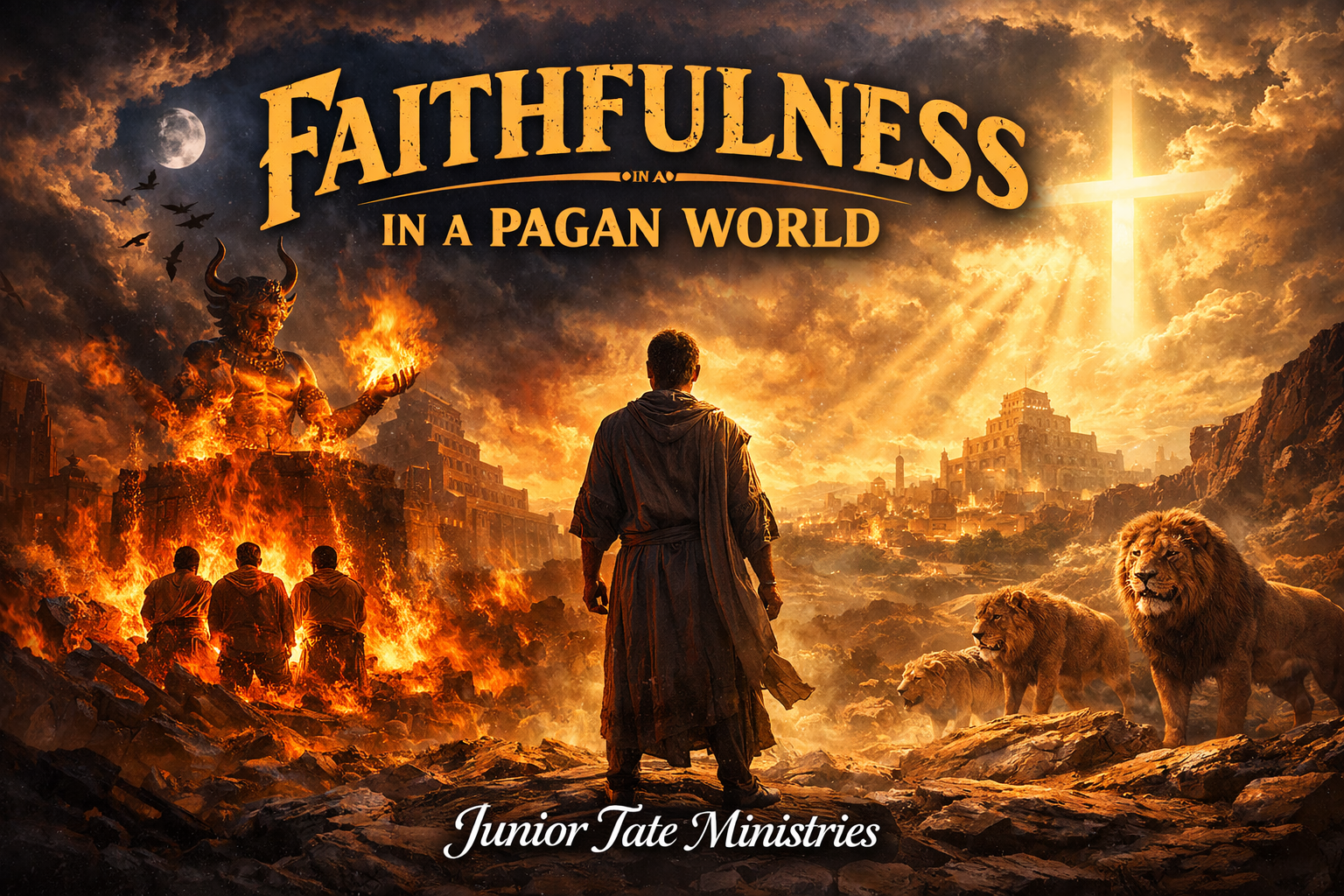
A Scripture-Centered Study Using the King James Version
By: Junior Tate Ministries
INTRODUCTION: FAITHFUL IN HOSTILE TIMES
From Genesis to Revelation, Scripture reveals a consistent truth: God’s people have always lived in cultures opposed to Him.
Paganism in the Bible is not merely idol worship—it includes moral corruption, rejection of God’s authority, self-exaltation, and hostility toward righteousness.
God never instructs His people to blend in with such systems. Instead, He commands faithfulness—unwavering loyalty to Him regardless of cost.
This article presents a purely Scripture-based examination of faithfulness in a pagan world.
Every passage is quoted in full from the King James Version (KJV), followed by clear commentary grounded directly in the text.
GOD IS THE SOURCE AND STANDARD OF FAITHFULNESS
Deuteronomy 7:9 (KJV)
“Know therefore that the LORD thy God, he is God, the faithful God, which keepeth covenant and mercy with them that love him and keep his commandments to a thousand generations;”
- Faithfulness originates in God’s nature, not human effort.
- God’s covenant faithfulness spans generations, proving His reliability.
- Human faithfulness is a response to God’s faithfulness, not the cause of it.
- Obedience and love are inseparable from faithfulness.
FAITHFULNESS BEFORE THE FLOOD
Genesis 5:24 (KJV)
“And Enoch walked with God: and he was not; for God took him.”
- “Walked with God” describes daily agreement and obedience.
- Enoch lived during increasing corruption yet remained aligned with God.
- Faithfulness is shown as relationship, not public acclaim.
- God honored Enoch’s faithfulness by removing him from death.
Genesis 6:5–9 (KJV)
“And GOD saw that the wickedness of man was great in the earth, and that every imagination of the thoughts of his heart was only evil continually.
And it repented the LORD that he had made man on the earth, and it grieved him at his heart.
And the LORD said, I will destroy man whom I have created from the face of the earth; both man, and beast, and the creeping thing, and the fowls of the air; for it repenteth me that I have made them.
But Noah found grace in the eyes of the LORD.
These are the generations of Noah: Noah was a just man and perfect in his generations, and Noah walked with God.”
- God’s judgment is based on universal corruption, not isolated sin.
- Noah stands in contrast to his generation.
- “Perfect in his generations” means morally distinct, not sinless.
- Faithfulness required obedience before visible rescue.
- Grace preserved Noah through judgment, not from responsibility.
FAITHFULNESS IN A PAGAN EMPIRE: BABYLON
Daniel 1:8 (KJV)
“But Daniel purposed in his heart that he would not defile himself with the portion of the king’s meat, nor with the wine which he drank: therefore he requested of the prince of the eunuchs that he might not defile himself.”
- Faithfulness begins with internal conviction.
- Daniel resisted assimilation without rebellion.
- Defilement was spiritual, not merely dietary.
- Obedience was chosen before consequences were known.
Daniel 1:17–20 (KJV)
“As for these four children, God gave them knowledge and skill in all learning and wisdom: and Daniel had understanding in all visions and dreams.
Now at the end of the days that the king had said he should bring them in, then the prince of the eunuchs brought them in before Nebuchadnezzar.
And the king communed with them; and among them all was found none like Daniel, Hananiah, Mishael, and Azariah: therefore stood they before the king.
And in all matters of wisdom and understanding, that the king enquired of them, he found them ten times better than all the magicians and astrologers that were in all his realm.”
- God is the giver of wisdom, not Babylon.
- Faithfulness did not hinder success—it produced excellence.
- God used faithful servants as a testimony in a pagan court.
- Obedience positioned them for influence without compromise.
FAITHFULNESS UNDER THREAT OF DEATH
Daniel 3:16–18 (KJV)
“Shadrach, Meshach, and Abednego, answered and said to the king, O Nebuchadnezzar, we are not careful to answer thee in this matter.
If it be so, our God whom we serve is able to deliver us from the burning fiery furnace, and he will deliver us out of thine hand, O king.
But if not, be it known unto thee, O king, that we will not serve thy gods, nor worship the golden image which thou hast set up.”
- Faith acknowledges God’s power without demanding deliverance.
- Loyalty to God is unconditional.
- Fear of death did not override obedience.
- Faithfulness refuses idolatry regardless of outcome.
Daniel 6:10 (KJV)
“Now when Daniel knew that the writing was signed, he went into his house; and his windows being open in his chamber toward Jerusalem, he kneeled upon his knees three times a day, and prayed, and gave thanks before his God, as he did aforetime.”
- Faithfulness remains consistent under legal threat.
- Daniel altered nothing about his devotion.
- Prayer and thanksgiving continued despite danger.
- Obedience to God outweighed obedience to man.
FAITHFULNESS FOR A DIVINE MOMENT
Esther 4:14 (KJV)
“For if thou altogether holdest thy peace at this time, then shall there enlargement and deliverance arise to the Jews from another place; but thou and thy father’s house shall be destroyed: and who knoweth whether thou art come to the kingdom for such a time as this?”
- God’s purpose is certain, participation is optional.
- Faithfulness requires courage and action.
- Silence in crisis equals unfaithfulness.
- God positions His people strategically within pagan systems.
FAITHFULNESS DEFINED BY SEPARATION
Psalm 1:1–3 (KJV)
“Blessed is the man that walketh not in the counsel of the ungodly, nor standeth in the way of sinners, nor sitteth in the seat of the scornful.
But his delight is in the law of the LORD; and in his law doth he meditate day and night.
And he shall be like a tree planted by the rivers of water, that bringeth forth his fruit in his season; his leaf also shall not wither; and whatsoever he doeth shall prosper.”
- Faithfulness rejects ungodly influence.
- Stability comes from delight in God’s Word.
- Fruitfulness is the result of rooted obedience.
- Prosperity is spiritual endurance, not cultural approval.
FAITHFULNESS IN THE NEW TESTAMENT
Romans 12:1–2 (KJV)
“I beseech you therefore, brethren, by the mercies of God, that ye present your bodies a living sacrifice, holy, acceptable unto God, which is your reasonable service.
And be not conformed to this world: but be ye transformed by the renewing of your mind, that ye may prove what is that good, and acceptable, and perfect, will of God.”
- Faithfulness is active worship.
- Conformity is rejected; transformation is commanded.
- Renewal of the mind guards against pagan thinking.
- God’s will is discerned through obedience.
1 Peter 1:15–16 (KJV)
“But as he which hath called you is holy, so be ye holy in all manner of conversation;
Because it is written, Be ye holy; for I am holy.”
- Holiness reflects God’s character.
- Faithfulness governs every area of life.
- God’s standard does not change with culture.
- Obedience proves identity as God’s people.
FAITHFULNESS IN THE LAST DAYS
2 Timothy 3:1–5 (KJV)
“This know also, that in the last days perilous times shall come.
For men shall be lovers of their own selves, covetous, boasters, proud, blasphemers, disobedient to parents, unthankful, unholy,
Without natural affection, trucebreakers, false accusers, incontinent, fierce, despisers of those that are good,
Traitors, heady, highminded, lovers of pleasures more than lovers of God;
Having a form of godliness, but denying the power thereof: from such turn away.”
- Paganism can exist alongside religious appearance.
- Faithfulness requires discernment and separation.
- God warns believers ahead of time.
- Obedience includes avoiding corrupt influence.
CHRIST’S PROMISE TO THE FAITHFUL
Revelation 2:10 (KJV)
“Fear none of those things which thou shalt suffer: behold, the devil shall cast some of you into prison, that ye may be tried; and ye shall have tribulation ten days: be thou faithful unto death, and I will give thee a crown of life.”
Commentary
- Suffering is acknowledged, not denied.
- Faithfulness is endurance, not escape.
- Eternal reward follows earthly faithfulness.
- Death is not defeat for the faithful.
CONCLUSION: STAND FAST
1 Corinthians 15:58 (KJV)
“Therefore, my beloved brethren, be ye stedfast, unmoveable, always abounding in the work of the Lord, forasmuch as ye know that your labour is not in vain in the Lord.”
Faithfulness in a pagan world is biblical obedience lived out daily.
God does not promise ease—but He promises His presence, approval, and eternal reward.
If the Holy Spirit is convicting and pulling at your heart strings today, give in to Him and follow the prayer below for your salvation in Jesus Christ!
You may not ever get another chance to except Christ as your personal Savior and Lord! Your next breath is not promised!
Come! He’s Waiting on You!
Prayer to Salvation
Heavenly Father,
I come before You today admitting that I am a sinner in need of Your mercy and grace.
Your Word says in Romans 10:9–10 that if I confess with my mouth the Lord Jesus and believe in my heart that God hath raised Him from the dead, I shall be saved.
Today, I confess Jesus Christ as my Lord and my Savior. I believe with all my heart that He died for my sins, was buried, and rose again the third day.
Lord Jesus, I ask You to forgive me of all my sins. Wash me clean in Your precious blood. I turn from my old life and surrender fully to You.
Come into my heart, make me a new creature, and fill me with the Holy Spirit. From this day forward, I choose to follow You, live by Your Word, and walk in the new life You have given me.
Thank You, Lord, for saving me, for forgiving me, and for writing my name in the Lamb’s Book of Life. I give You all the glory, honor, and praise.
In Jesus’ name I pray, Amen.
juniortateministires.com
greatcommissiontoday.com