
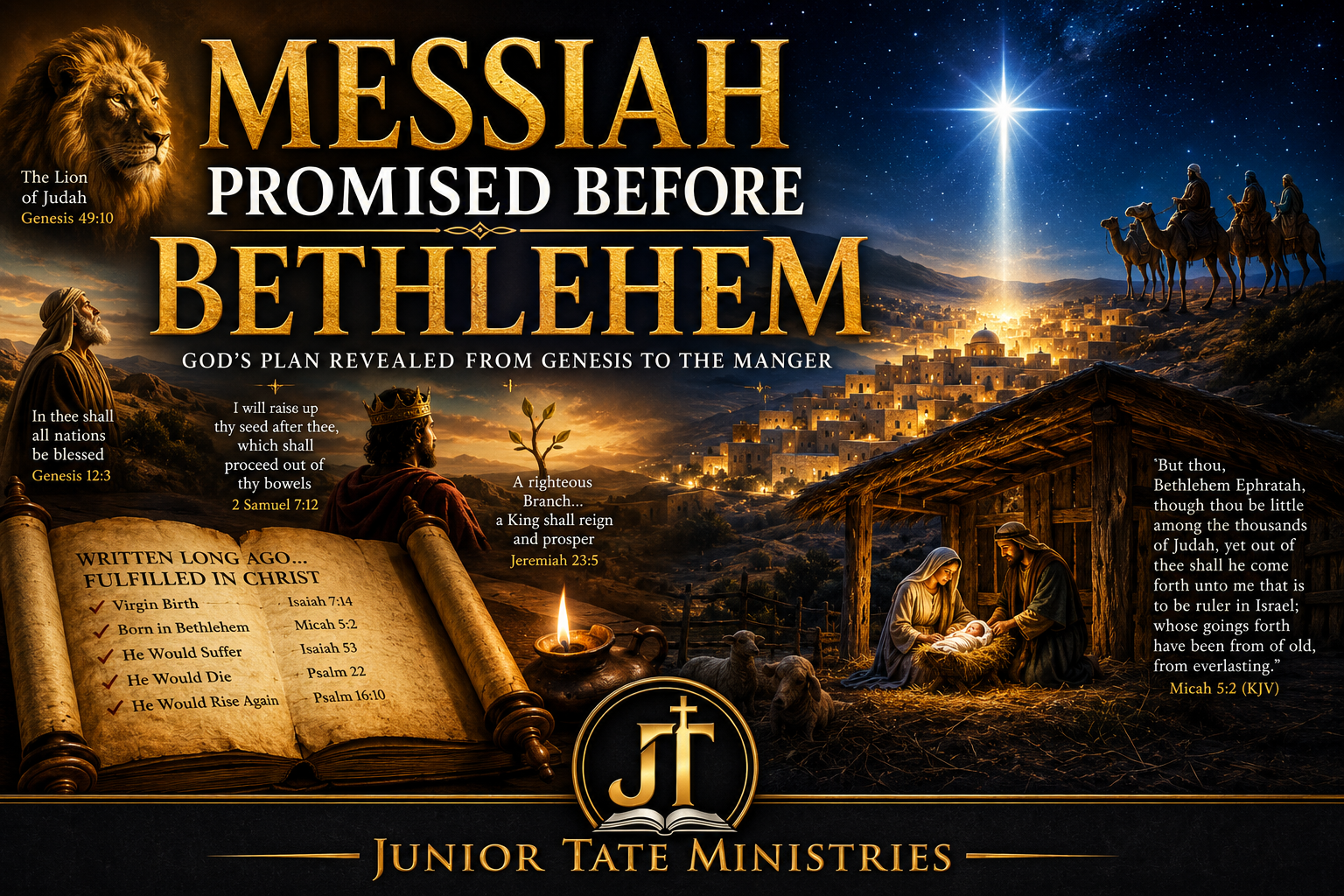
How the Old Testament Revealed the Coming of Jesus Christ
By: Junior Tate
The birth of Jesus Christ in Bethlehem was not the beginning of God’s plan of redemption. Bethlehem was the place where the promised Messiah entered the world in human flesh, but the promise of His coming had been revealed throughout the Old Testament for centuries.
The Messiah was not an unexpected figure who suddenly appeared in the New Testament. God had already declared that a Redeemer would come. He revealed the family line through which the Messiah would be born, the tribe from which He would come, the royal throne He would inherit, the place of His birth, the nature of His ministry, the rejection He would experience, the suffering He would endure, the death He would die, and the victory He would accomplish.
The Scriptures progressively revealed the identity and mission of the coming Christ. The first promise was given in the Garden of Eden. Later promises were given to Abraham, Isaac, Jacob, Moses, David, and the prophets. As the centuries passed, God provided more detail, narrowing the line of promise until the Messiah was born in Bethlehem.
The New Testament does not separate Jesus from these promises. It repeatedly declares that the life, ministry, death, and resurrection of Jesus fulfilled what had been written in the law, the prophets, and the Psalms.
After His resurrection, Jesus spoke to two disciples on the road to Emmaus.
Luke 24:25-27 (KJV)
“Then he said unto them, O fools, and slow of heart to believe all that the prophets have spoken:
Ought not Christ to have suffered these things, and to enter into his glory?
And beginning at Moses and all the prophets, he expounded unto them in all the scriptures the things concerning himself.”
Jesus declared that Moses and the prophets had written concerning Him. The Old Testament was preparing the way for the Messiah long before the shepherds heard the angels announce His birth near Bethlehem.
The message of Scripture is clear: Jesus Christ was promised before Bethlehem.
The Meaning of Messiah
The word “Messiah” refers to the Anointed One. In the Old Testament, kings, priests, and sometimes prophets were anointed for service. But the Scriptures also looked forward to one particular Anointed One who would fulfill God’s redemptive purpose.
The New Testament word “Christ” carries the same meaning. Jesus is the Christ, the Anointed One promised in the Scriptures.
When Andrew found his brother Simon Peter, he made a powerful declaration.
John 1:40-42 (KJV)
“One of the two which heard John speak, and followed him, was Andrew, Simon Peter’s brother.
He first findeth his own brother Simon, and saith unto him, We have found the Messias, which is, being interpreted, the Christ.
And he brought him to Jesus. And when Jesus beheld him, he said, Thou art Simon the son of Jona: thou shalt be called Cephas, which is by interpretation, A stone.”
Andrew understood that the Messiah and the Christ were the same promised Person. The disciples did not invent this expectation. They had learned from the Scriptures that God would send His Anointed One.
The First Promise of the Redeemer
The first promise of the Messiah appears in the Garden of Eden immediately after mankind fell into sin.
Adam and Eve had disobeyed God by eating from the tree of the knowledge of good and evil. Sin entered the human experience, and death followed. Yet during judgment, God spoke a promise concerning the future defeat of the serpent.
Genesis 3:14-15 (KJV)
“And the LORD God said unto the serpent, Because thou hast done this, thou art cursed above all cattle, and above every beast of the field; upon thy belly shalt thou go, and dust shalt thou eat all the days of thy life:
And I will put enmity between thee and the woman, and between thy seed and her seed; it shall bruise thy head, and thou shalt bruise his heel.”
This prophecy speaks of conflict between the serpent and the seed of the woman. The serpent would bruise His heel, but the seed of the woman would bruise the serpent’s head.
A wound to the heel is painful, but a crushed head represents decisive defeat. This passage pointed forward to the suffering and victory of Christ. Jesus would suffer, but through His death and resurrection He would defeat Satan’s claim over fallen humanity.
The phrase “her seed” is also significant. Throughout Scripture, descendants are normally connected to the father’s line, yet this promise speaks specifically of the seed of the woman. This prepared the way for the later revelation that the Messiah would be born of a virgin.
The New Testament explains that Jesus came to destroy the works of the devil.
1 John 3:8 (KJV)
“He that committeth sin is of the devil; for the devil sinneth from the beginning. For this purpose the Son of God was manifested, that he might destroy the works of the devil.”
The cross appeared to be Satan’s victory, but it became the place of his defeat. Through death, Christ destroyed the power of death.
Hebrews 2:14-15 (KJV)
“Forasmuch then as the children are partakers of flesh and blood, he also himself likewise took part of the same; that through death he might destroy him that had the power of death, that is, the devil;
And deliver them who through fear of death were all their lifetime subject to bondage.”
Before there was Bethlehem, before there was Israel, before Abraham was called, and before the law was given, God had already promised the coming of the victorious Redeemer.
The Promise Through Abraham
God later called Abraham and made a covenant with him. Through Abraham, God began to reveal more concerning the family line of the Messiah.
Genesis 12:1-3 (KJV)
“Now the LORD had said unto Abram, Get thee out of thy country, and from thy kindred, and from thy father’s house, unto a land that I will shew thee:
And I will make of thee a great nation, and I will bless thee, and make thy name great; and thou shalt be a blessing:
And I will bless them that bless thee, and curse him that curseth thee: and in thee shall all families of the earth be blessed.”
God promised that all families of the earth would be blessed through Abraham. This promise reached far beyond earthly prosperity or the establishment of Israel. The ultimate blessing would come through Jesus Christ.
The New Testament directly connects the promise to Christ.
Galatians 3:8 (KJV)
“And the scripture, foreseeing that God would justify the heathen through faith, preached before the gospel unto Abraham, saying, In thee shall all nations be blessed.”
The Gospel was announced beforehand in the promise to Abraham. Through Abraham’s line, the Saviour would come, and salvation would be offered to people from every nation.
Paul later explained that the promise centered on Christ.
Galatians 3:16 (KJV)
“Now to Abraham and his seed were the promises made. He saith not, And to seeds, as of many; but as of one, And to thy seed, which is Christ.”
The Messiah would come through Abraham. This was one more step in God’s unfolding promise.
The Promised Son and the Line of Isaac
Abraham had more than one son, but God made clear that the covenant line would continue through Isaac.
Genesis 17:19 (KJV)
“And God said, Sarah thy wife shall bear thee a son indeed; and thou shalt call his name Isaac: and I will establish my covenant with him for an everlasting covenant, and with his seed after him.”
The promise was narrowed. The Messiah would not merely come through Abraham generally. He would come through Isaac.
This truth is repeated in Genesis 21.
Genesis 21:12 (KJV)
“And God said unto Abraham, Let it not be grievous in thy sight because of the lad, and because of thy bondwoman; in all that Sarah hath said unto thee, hearken unto her voice; for in Isaac shall thy seed be called.”
God’s plan was moving through a particular promised line.
Isaac’s birth itself demonstrated that God could bring life where human strength had failed. Abraham and Sarah were beyond the natural expectation of having a child, yet God fulfilled His promise. This did not make Isaac the Messiah, but it showed that the Messianic line rested on God’s faithfulness rather than human ability.
Isaac on Mount Moriah: A Picture of the Coming Sacrifice
Genesis 22 records Abraham being commanded to offer Isaac. Although God did not allow Isaac to die, the event provides a powerful biblical picture of substitution and sacrifice.
Genesis 22:1-8 (KJV)
“And it came to pass after these things, that God did tempt Abraham, and said unto him, Abraham: and he said, Behold, here I am.
And he said, Take now thy son, thine only son Isaac, whom thou lovest, and get thee into the land of Moriah; and offer him there for a burnt offering upon one of the mountains which I will tell thee of.
And Abraham rose up early in the morning, and saddled his ass, and took two of his young men with him, and Isaac his son, and clave the wood for the burnt offering, and rose up, and went unto the place of which God had told him.
Then on the third day Abraham lifted up his eyes, and saw the place afar off.
And Abraham said unto his young men, Abide ye here with the ass; and I and the lad will go yonder and worship, and come again to you.
And Abraham took the wood of the burnt offering, and laid it upon Isaac his son; and he took the fire in his hand, and a knife; and they went both of them together.
And Isaac spake unto Abraham his father, and said, My father: and he said, Here am I, my son. And he said, Behold the fire and the wood: but where is the lamb for a burnt offering?
And Abraham said, My son, God will provide himself a lamb for a burnt offering: so they went both of them together.”
Isaac carried the wood upon which he was to be offered. In a greater fulfillment, Jesus carried His cross toward the place of execution.
Abraham said, “God will provide himself a lamb.” God did provide a ram caught in the thicket for Isaac, but the fuller fulfillment came in Jesus Christ, the Lamb of God.
John 1:29 (KJV)
“The next day John seeth Jesus coming unto him, and saith, Behold the Lamb of God, which taketh away the sin of the world.”
Jesus was not spared from death as Isaac was. He became the sacrifice that God provided for sinners.
The Promise Continues Through Jacob
Isaac had two sons, Esau and Jacob. God chose Jacob as the one through whom the covenant line would continue.
God spoke to Jacob in a dream at Bethel.
Genesis 28:13-14 (KJV)
“And, behold, the LORD stood above it, and said, I am the LORD God of Abraham thy father, and the God of Isaac: the land whereon thou liest, to thee will I give it, and to thy seed;
And thy seed shall be as the dust of the earth, and thou shalt spread abroad to the west, and to the east, and to the north, and to the south: and in thee and in thy seed shall all the families of the earth be blessed.”
The blessing promised to Abraham was repeated to Jacob. Through Jacob’s seed, all families of the earth would be blessed.
Jacob’s name was later changed to Israel. His twelve sons became the fathers of the twelve tribes of Israel. From those tribes, God identified one particular tribe through which the King would come.
The Messiah Would Come from Judah
Before Jacob died, he blessed his sons. In his words concerning Judah, he declared that royal authority would remain with that tribe until Shiloh came.
Genesis 49:8-10 (KJV)
“Judah, thou art he whom thy brethren shall praise: thy hand shall be in the neck of thine enemies; thy father’s children shall bow down before thee.
Judah is a lion’s whelp: from the prey, my son, thou art gone up: he stooped down, he couched as a lion, and as an old lion; who shall rouse him up?
The sceptre shall not depart from Judah, nor a lawgiver from between his feet, until Shiloh come;and unto him shall the gathering of the people be.”
The sceptre represents royal authority. The Messiah would be connected with Judah, and the people would be gathered unto Him.
Jesus was born from the tribe of Judah. The book of Hebrews states this plainly.
Hebrews 7:14 (KJV)
“For it is evident that our Lord sprang out of Juda; of which tribe Moses spake nothing concerning priesthood.”
Revelation identifies Jesus with the royal and victorious imagery first connected to Judah.
Revelation 5:5 (KJV)
“And one of the elders saith unto me, Weep not: behold, the Lion of the tribe of Juda, the Root of David, hath prevailed to open the book, and to loose the seven seals thereof.”
Long before Bethlehem, God had identified Judah as the tribe of the coming King.
A Star Out of Jacob and a Sceptre Out of Israel
During Israel’s journey toward the Promised Land, Balaam was hired by Balak to curse Israel. Instead, God caused Balaam to speak blessing and prophecy.
Numbers 24:15-17 (KJV)
“And he took up his parable, and said, Balaam the son of Beor hath said, and the man whose eyes are open hath said:
He hath said, which heard the words of God, and knew the knowledge of the most High, which saw the vision of the Almighty, falling into a trance, but having his eyes open:
I shall see him, but not now: I shall behold him, but not nigh: there shall come a Star out of Jacob, and a Sceptre shall rise out of Israel, and shall smite the corners of Moab, and destroy all the children of Sheth.”
Balaam spoke of a future ruler. He would come as a Star out of Jacob and a Sceptre out of Israel.
The prophecy looked beyond Balaam’s day. “I shall see him, but not now.” The coming One would arise in God’s appointed time.
The image of a star became closely connected with the birth of Jesus. Wise men from the east came to Jerusalem after seeing His star.
Matthew 2:1-2 (KJV)
“Now when Jesus was born in Bethlehem of Judaea in the days of Herod the king, behold, there came wise men from the east to Jerusalem,
Saying, Where is he that is born King of the Jews? for we have seen his star in the east, and are come to worship him.”
The One born in Bethlehem was the promised King of the Jews.
The Prophet Like Moses
Moses told Israel that God would raise up another Prophet like him. The people would be responsible to hear Him.
Deuteronomy 18:15-19 (KJV)
“The LORD thy God will raise up unto thee a Prophet from the midst of thee, of thy brethren, like unto me; unto him ye shall hearken;
According to all that thou desiredst of the LORD thy God in Horeb in the day of the assembly, saying, Let me not hear again the voice of the LORD my God, neither let me see this great fire any more, that I die not.
And the LORD said unto me, They have well spoken that which they have spoken.
I will raise them up a Prophet from among their brethren, like unto thee, and will put my words in his mouth; and he shall speak unto them all that I shall command him.
And it shall come to pass, that whosoever will not hearken unto my words which he shall speak in my name, I will require it of him.”
This was more than a promise that ordinary prophets would continue to appear. The New Testament applies this prophecy to Jesus Christ.
After healing the lame man at the temple, Peter preached Christ to the people.
Acts 3:20-23 (KJV)
“And he shall send Jesus Christ, which before was preached unto you:
Whom the heaven must receive until the times of restitution of all things, which God hath spoken by the mouth of all his holy prophets since the world began.
For Moses truly said unto the fathers, A prophet shall the Lord your God raise up unto you of your brethren, like unto me; him shall ye hear in all things whatsoever he shall say unto you.
And it shall come to pass, that every soul, which will not hear that prophet, shall be destroyed from among the people.”
Jesus is the Prophet like Moses, but He is greater than Moses. Moses served faithfully in God’s house, but Christ is the Son over His own house.
The Passover Lamb Pointed to Christ
When God delivered Israel from Egypt, He commanded each household to kill a lamb and place its blood upon the doorposts.
Exodus 12:3-7 (KJV)
“Speak ye unto all the congregation of Israel, saying, In the tenth day of this month they shall take to them every man a lamb, according to the house of their fathers, a lamb for an house:
And if the household be too little for the lamb, let him and his neighbour next unto his house take it according to the number of the souls; every man according to his eating shall make your count for the lamb.
Your lamb shall be without blemish, a male of the first year: ye shall take it out from the sheep, or from the goats:
And ye shall keep it up until the fourteenth day of the same month: and the whole assembly of the congregation of Israel shall kill it in the evening.
And they shall take of the blood, and strike it on the two side posts and on the upper door post of the houses, wherein they shall eat it.”
The lamb had to be without blemish. Its blood stood between the household and judgment.
Exodus 12:12-13 (KJV)
“For I will pass through the land of Egypt this night, and will smite all the firstborn in the land of Egypt, both man and beast; and against all the gods of Egypt I will execute judgment: I am the LORD.
And the blood shall be to you for a token upon the houses where ye are: and when I see the blood, I will pass over you, and the plague shall not be upon you to destroy you, when I smite the land of Egypt.”
The Passover pointed forward to Christ. Paul wrote:
1 Corinthians 5:7 (KJV)
“Purge out therefore the old leaven, that ye may be a new lump, as ye are unleavened. For even Christ our passover is sacrificed for us:”
Jesus is the true Passover sacrifice. His blood delivers those who trust in Him from condemnation.
The Bronze Serpent Pointed to Christ
When Israel sinned in the wilderness, fiery serpents came among the people. God provided a way of deliverance.
Numbers 21:8-9 (KJV)
“And the LORD said unto Moses, Make thee a fiery serpent, and set it upon a pole: and it shall come to pass, that every one that is bitten, when he looketh upon it, shall live.
And Moses made a serpent of brass, and put it upon a pole, and it came to pass, that if a serpent had bitten any man, when he beheld the serpent of brass, he lived.”
Jesus applied this event to His own crucifixion.
John 3:14-16 (KJV)
“And as Moses lifted up the serpent in the wilderness, even so must the Son of man be lifted up:
That whosoever believeth in him should not perish, but have eternal life.
For God so loved the world, that he gave his only begotten Son, that whosoever believeth in him should not perish, but have everlasting life.”
Before Bethlehem, the Scriptures were already preparing people to understand that salvation would come through faith in the One who would be lifted up.
The Promise of the Throne of David
The Messianic promise became even more specific during the reign of David. God made a covenant with David and promised that his throne would be established forever.
2 Samuel 7:12-16 (KJV)
“And when thy days be fulfilled, and thou shalt sleep with thy fathers, I will set up thy seed after thee, which shall proceed out of thy bowels, and I will establish his kingdom.
He shall build an house for my name, and I will stablish the throne of his kingdom for ever.
I will be his father, and he shall be my son. If he commit iniquity, I will chasten him with the rod of men, and with the stripes of the children of men:
But my mercy shall not depart away from him, as I took it from Saul, whom I put away before thee.
And thine house and thy kingdom shall be established for ever before thee: thy throne shall be established for ever.”
This prophecy had an immediate connection to Solomon, who built the temple. But the promise of an everlasting throne extended beyond Solomon. No ordinary earthly king could fulfill it completely.
The Messiah would be the Son of David and the everlasting King.
The angel Gabriel repeated this promise when announcing the birth of Jesus to Mary.
Luke 1:30-33 (KJV)
“And the angel said unto her, Fear not, Mary: for thou hast found favour with God.
And, behold, thou shalt conceive in thy womb, and bring forth a son, and shalt call his name JESUS.
He shall be great, and shall be called the Son of the Highest: and the Lord God shall give unto him the throne of his father David:
And he shall reign over the house of Jacob for ever;and of his kingdom there shall be no end.”
Jesus was the promised Son of David. Bethlehem was connected to David, but the promise of David’s greater Son had been given centuries earlier.
The Messiah as God’s Anointed King
Psalm 2 speaks of the nations raging against the LORD and His Anointed.
Psalm 2:1-7 (KJV)
“Why do the heathen rage, and the people imagine a vain thing?
The kings of the earth set themselves, and the rulers take counsel together, against the LORD, and against his anointed, saying,
Let us break their bands asunder, and cast away their cords from us.
He that sitteth in the heavens shall laugh: the Lord shall have them in derision.
Then shall he speak unto them in his wrath, and vex them in his sore displeasure.
Yet have I set my king upon my holy hill of Zion.
I will declare the decree: the LORD hath said unto me, Thou art my Son; this day have I begotten thee.”
This Psalm presents the Messiah as God’s King and Son. The nations may resist Him, but God has appointed Him to rule.
The New Testament applies this Psalm to Jesus.
Acts 4:25-28 (KJV)
“Who by the mouth of thy servant David hast said, Why did the heathen rage, and the people imagine vain things?
The kings of the earth stood up, and the rulers were gathered together against the Lord, and against his Christ.
For of a truth against thy holy child Jesus, whom thou hast anointed, both Herod, and Pontius Pilate, with the Gentiles, and the people of Israel, were gathered together,
For to do whatsoever thy hand and thy counsel determined before to be done.”
Jesus is the Anointed King against whom rulers gathered. Yet their opposition could not overturn God’s purpose.
The Messiah Would Be Both David’s Son and David’s Lord
Psalm 110 records David speaking of a coming Lord greater than himself.
Psalm 110:1-4 (KJV)
“The LORD said unto my Lord, Sit thou at my right hand, until I make thine enemies thy footstool.
The LORD shall send the rod of thy strength out of Zion: rule thou in the midst of thine enemies.
Thy people shall be willing in the day of thy power, in the beauties of holiness from the womb of the morning: thou hast the dew of thy youth.
The LORD hath sworn, and will not repent, Thou art a priest for ever after the order of Melchizedek.”
The Messiah would be David’s descendant, but He would also be David’s Lord. He would be both King and eternal Priest.
Jesus used this Psalm to challenge the religious leaders.
Matthew 22:41-46 (KJV)
“While the Pharisees were gathered together, Jesus asked them,
Saying, What think ye of Christ? Whose son is he? They say unto him, The Son of David.
He saith unto them, How then doth David in spirit call him Lord, saying,
The LORD said unto my Lord, Sit thou on my right hand, till I make thine enemies thy footstool?
If David then call him Lord, how is he his son?
And no man was able to answer him a word, neither durst any man from that day forth ask him any more questions.”
The answer is found in the identity of Jesus. As man, He came through David’s line. As the eternal Son of God, He is David’s Lord.
The Messiah Would Be Born of a Virgin
The prophet Isaiah gave one of the clearest signs concerning the birth of the Messiah.
Isaiah 7:14 (KJV)
“Therefore the Lord himself shall give you a sign; Behold, a virgin shall conceive, and bear a son, and shall call his name Immanuel.”
The Messiah would be born of a virgin and called Immanuel, meaning God with us.
Matthew declares that the birth of Jesus fulfilled this prophecy.
Matthew 1:18-23 (KJV)
“Now the birth of Jesus Christ was on this wise: When as his mother Mary was espoused to Joseph, before they came together, she was found with child of the Holy Ghost.
Then Joseph her husband, being a just man, and not willing to make her a publick example, was minded to put her away privily.
But while he thought on these things, behold, the angel of the Lord appeared unto him in a dream, saying, Joseph, thou son of David, fear not to take unto thee Mary thy wife: for that which is conceived in her is of the Holy Ghost.
And she shall bring forth a son, and thou shalt call his name JESUS: for he shall save his people from their sins.
Now all this was done, that it might be fulfilled which was spoken of the Lord by the prophet, saying,
Behold, a virgin shall be with child, and shall bring forth a son, and they shall call his name Emmanuel, which being interpreted is, God with us.”
Bethlehem was not the origin of this promise. Isaiah had spoken of the virgin birth centuries earlier.
The Child Would Be the Mighty God
Isaiah also revealed that the coming Child would possess divine titles and reign forever.
Isaiah 9:6-7 (KJV)
“For unto us a child is born, unto us a son is given: and the government shall be upon his shoulder: and his name shall be called Wonderful, Counsellor, The mighty God, The everlasting Father, The Prince of Peace.
Of the increase of his government and peace there shall be no end, upon the throne of David, and upon his kingdom, to order it, and to establish it with judgment and with justice from henceforth even for ever.The zeal of the LORD of hosts will perform this.”
The prophecy speaks of a child being born, showing true humanity. It also calls Him “The mighty God,” revealing His deity.
The Child would sit upon the throne of David, and His government would have no end. Jesus fulfilled the promise by entering the world as a true man while remaining the eternal Son of God.
John described this mystery in the opening of his Gospel.
John 1:1-3 (KJV)
“In the beginning was the Word, and the Word was with God, and the Word was God.
The same was in the beginning with God.
All things were made by him; and without him was not any thing made that was made.”
Then John wrote:
John 1:14 (KJV)
“And the Word was made flesh, and dwelt among us, and we beheld his glory, the glory as of the only begotten of the Father, full of grace and truth.”
Jesus did not begin to exist at Bethlehem. The eternal Word became flesh at Bethlehem.
The Branch from the Line of Jesse
Isaiah described the Messiah as a Branch rising from the family line of Jesse, the father of David.
Isaiah 11:1-5 (KJV)
“And there shall come forth a rod out of the stem of Jesse, and a Branch shall grow out of his roots:
And the spirit of the LORD shall rest upon him, the spirit of wisdom and understanding, the spirit of counsel and might, the spirit of knowledge and of the fear of the LORD;
And shall make him of quick understanding in the fear of the LORD: and he shall not judge after the sight of his eyes, neither reprove after the hearing of his ears:
But with righteousness shall he judge the poor, and reprove with equity for the meek of the earth: and he shall smite the earth with the rod of his mouth, and with the breath of his lips shall he slay the wicked.
And righteousness shall be the girdle of his loins, and faithfulness the girdle of his reins.”
The house of David would appear to be cut down like a tree, but a Branch would arise from its roots. The Spirit of the LORD would rest upon Him, and He would rule in righteousness.
Jesus was born into the house and lineage of David. Though David’s royal family no longer sat visibly upon the throne when Jesus was born, God had not forgotten His promise.
The Righteous Branch
Jeremiah also spoke of the Messiah as a righteous Branch from David.
Jeremiah 23:5-6 (KJV)
“Behold, the days come, saith the LORD, that I will raise unto David a righteous Branch, and a King shall reign and prosper, and shall execute judgment and justice in the earth.
In his days Judah shall be saved, and Israel shall dwell safely: and this is his name whereby he shall be called, THE LORD OUR RIGHTEOUSNESS.”
The coming King would be righteous. His name would be called “THE LORD OUR RIGHTEOUSNESS.”
This title reveals that the Messiah would not merely teach righteousness. He would become the righteousness of His people.
The New Testament explains that righteousness is found in Christ.
1 Corinthians 1:30 (KJV)
“But of him are ye in Christ Jesus, who of God is made unto us wisdom, and righteousness, and sanctification, and redemption:”
Jesus is the righteous Branch and the source of righteousness for those who trust in Him.
The Forerunner Would Prepare His Way
The prophets not only foretold the Messiah; they also foretold that a messenger would prepare His way.
Isaiah 40:3-5 (KJV)
“The voice of him that crieth in the wilderness, Prepare ye the way of the LORD, make straight in the desert a highway for our God.
Every valley shall be exalted, and every mountain and hill shall be made low: and the crooked shall be made straight, and the rough places plain:
And the glory of the LORD shall be revealed, and all flesh shall see it together: for the mouth of the LORD hath spoken it.”
Malachi also announced a coming messenger.
Malachi 3:1 (KJV)
“Behold, I will send my messenger, and he shall prepare the way before me: and the Lord, whom ye seek, shall suddenly come to his temple, even the messenger of the covenant, whom ye delight in: behold, he shall come, saith the LORD of hosts.”
John the Baptist fulfilled the role of the forerunner.
Matthew 3:1-3 (KJV)
“In those days came John the Baptist, preaching in the wilderness of Judaea,
And saying, Repent ye: for the kingdom of heaven is at hand.
For this is he that was spoken of by the prophet Esaias, saying, The voice of one crying in the wilderness, Prepare ye the way of the Lord, make his paths straight.”
Before Jesus began His public ministry, John prepared the people and pointed them to the Lamb of God.
The Messiah’s Ministry Would Bring Light
Isaiah foretold that a great light would shine in Galilee.
Isaiah 9:1-2 (KJV)
“Nevertheless the dimness shall not be such as was in her vexation, when at the first he lightly afflicted the land of Zebulun and the land of Naphtali, and afterward did more grievously afflict her by the way of the sea, beyond Jordan, in Galilee of the nations.
The people that walked in darkness have seen a great light: they that dwell in the land of the shadow of death, upon them hath the light shined.”
Matthew connects this prophecy with the ministry of Jesus.
Matthew 4:12-17 (KJV)
“Now when Jesus had heard that John was cast into prison, he departed into Galilee;
And leaving Nazareth, he came and dwelt in Capernaum, which is upon the sea coast, in the borders of Zabulon and Nephthalim:
That it might be fulfilled which was spoken by Esaias the prophet, saying,
The land of Zabulon, and the land of Nephthalim, by the way of the sea, beyond Jordan, Galilee of the Gentiles;
The people which sat in darkness saw great light; and to them which sat in the region and shadow of death light is sprung up.
From that time Jesus began to preach, and to say, Repent: for the kingdom of heaven is at hand.”
The Messiah would bring light to those dwelling in spiritual darkness.
The Messiah Would Heal and Preach Good Tidings
Isaiah described the works that would mark the Messianic age.
Isaiah 35:4-6 (KJV)
“Say to them that are of a fearful heart, Be strong, fear not: behold, your God will come with vengeance, even God with a recompence; he will come and save you.
Then the eyes of the blind shall be opened, and the ears of the deaf shall be unstopped.
Then shall the lame man leap as an hart, and the tongue of the dumb sing: for in the wilderness shall waters break out, and streams in the desert.”
During His earthly ministry, Jesus opened blind eyes, unstopped deaf ears, healed the lame, cleansed lepers, and raised the dead.
When John the Baptist sent messengers to ask Jesus whether He was the One who should come, Jesus answered by pointing to His works.
Matthew 11:4-6 (KJV)
“Jesus answered and said unto them, Go and shew John again those things which ye do hear and see:
The blind receive their sight, and the lame walk, the lepers are cleansed, and the deaf hear, the dead are raised up, and the poor have the gospel preached to them.
And blessed is he, whosoever shall not be offended in me.”
His works matched the prophetic description of the Messiah.
The Messiah Would Be Rejected
The Old Testament did not only promise a triumphant King. It also revealed that the Messiah would be rejected.
Psalm 118:22-23 (KJV)
“The stone which the builders refused is become the head stone of the corner.
This is the LORD’S doing; it is marvellous in our eyes.”
Jesus applied this passage to Himself.
Matthew 21:42 (KJV)
“Jesus saith unto them, Did ye never read in the scriptures, The stone which the builders rejected, the same is become the head of the corner: this is the Lord’s doing, and it is marvellous in our eyes?”
The religious leaders rejected Jesus, but God made Him the chief cornerstone.
Isaiah also foretold that the Servant of the LORD would be despised.
Isaiah 53:1-3 (KJV)
“Who hath believed our report? And to whom is the arm of the LORD revealed?
For he shall grow up before him as a tender plant, and as a root out of a dry ground: he hath no form nor comeliness; and when we shall see him, there is no beauty that we should desire him.
He is despised and rejected of men; a man of sorrows, and acquainted with grief: and we hid as it were our faces from him; he was despised, and we esteemed him not.”
Jesus was not received by the nation as its King. Yet even this rejection had been written beforehand.
The Messiah Would Enter Jerusalem on a Donkey
Zechariah foretold the manner in which the King would enter Jerusalem.
Zechariah 9:9 (KJV)
“Rejoice greatly, O daughter of Zion; shout, O daughter of Jerusalem: behold, thy King cometh unto thee: he is just, and having salvation; lowly, and riding upon an ass, and upon a colt the foal of an ass.”
Jesus fulfilled this prophecy during His triumphal entry.
Matthew 21:6-9 (KJV)
“And the disciples went, and did as Jesus commanded them,
And brought the ass, and the colt, and put on them their clothes, and they set him thereon.
And a very great multitude spread their garments in the way; others cut down branches from the trees, and strawed them in the way.
And the multitudes that went before, and that followed, cried, saying, Hosanna to the Son of David: Blessed is he that cometh in the name of the Lord; Hosanna in the highest.”
The King came exactly as the prophet had written.
The Messiah Would Be Betrayed
Zechariah also foretold the price connected with the betrayal of the Messiah.
Zechariah 11:12-13 (KJV)
“And I said unto them, If ye think good, give me my price; and if not, forbear. So they weighed for my price thirty pieces of silver.
And the LORD said unto me, Cast it unto the potter: a goodly price that I was prised at of them. And I took the thirty pieces of silver, and cast them to the potter in the house of the LORD.”
Judas betrayed Jesus for thirty pieces of silver.
Matthew 26:14-16 (KJV)
“Then one of the twelve, called Judas Iscariot, went unto the chief priests,
And said unto them, What will ye give me, and I will deliver him unto you? And they covenanted with him for thirty pieces of silver.
And from that time he sought opportunity to betray him.”
After Judas returned the money, the chief priests used it to buy the potter’s field.
Matthew 27:5-8 (KJV)
“And he cast down the pieces of silver in the temple, and departed, and went and hanged himself.
And the chief priests took the silver pieces, and said, It is not lawful for to put them into the treasury, because it is the price of blood.
And they took counsel, and bought with them the potter’s field, to bury strangers in.
Wherefore that field was called, The field of blood, unto this day.”
The betrayal of Jesus did not take God by surprise. Scripture had already spoken of it.
The Messiah Would Suffer in Silence
Isaiah described the Messiah’s submission before those who condemned Him.
Isaiah 53:7 (KJV)
“He was oppressed, and he was afflicted, yet he opened not his mouth: he is brought as a lamb to the slaughter, and as a sheep before her shearers is dumb, so he openeth not his mouth.”
During His trial before Pilate, Jesus did not defend Himself in the ordinary manner.
Matthew 27:12-14 (KJV)
“And when he was accused of the chief priests and elders, he answered nothing.
Then said Pilate unto him, Hearest thou not how many things they witness against thee?
And he answered him to never a word; insomuch that the governor marvelled greatly.”
Jesus willingly submitted to the Father’s redemptive plan.
The Messiah Would Bear Our Sins
Isaiah 53 gives one of the clearest Old Testament explanations of the Messiah’s substitutionary suffering.
Isaiah 53:4-6 (KJV)
“Surely he hath borne our griefs, and carried our sorrows: yet we did esteem him stricken, smitten of God, and afflicted.
But he was wounded for our transgressions, he was bruised for our iniquities: the chastisement of our peace was upon him; and with his stripes we are healed.
All we like sheep have gone astray; we have turned every one to his own way; and the LORD hath laid on him the iniquity of us all.”
The Messiah would not die for His own sins. He would be wounded for our transgressions and bruised for our iniquities.
The New Testament applies this directly to Christ.
1 Peter 2:22-24 (KJV)
“Who did no sin, neither was guile found in his mouth:
Who, when he was reviled, reviled not again; when he suffered, he threatened not; but committed himself to him that judgeth righteously:
Who his own self bare our sins in his own body on the tree, that we, being dead to sins, should live unto righteousness: by whose stripes ye were healed.”
The suffering of Jesus was not meaningless tragedy. He bore our sins as the promised suffering Servant.
Psalm 22 Described the Crucifixion
Psalm 22 contains details that closely match the crucifixion of Jesus.
Psalm 22:1 (KJV)
“My God, my God, why hast thou forsaken me? Why art thou so far from helping me, and from the words of my roaring?”
Jesus spoke these words from the cross.
Matthew 27:46 (KJV)
“And about the ninth hour Jesus cried with a loud voice, saying, Eli, Eli, lama sabachthani? that is to say, My God, my God, why hast thou forsaken me?”
Psalm 22 also describes mockery.
Psalm 22:7-8 (KJV)
“All they that see me laugh me to scorn: they shoot out the lip, they shake the head, saying,
He trusted on the LORD that he would deliver him: let him deliver him, seeing he delighted in him.”
Matthew records similar words at the cross.
Matthew 27:39-43 (KJV)
“And they that passed by reviled him, wagging their heads,
And saying, Thou that destroyest the temple, and buildest it in three days, save thyself. If thou be the Son of God, come down from the cross.
Likewise also the chief priests mocking him, with the scribes and elders, said,
He saved others; himself he cannot save. If he be the King of Israel, let him now come down from the cross, and we will believe him.
He trusted in God; let him deliver him now, if he will have him: for he said, I am the Son of God.”
Psalm 22 further speaks of pierced hands and feet and divided garments.
Psalm 22:16-18 (KJV)
“For dogs have compassed me: the assembly of the wicked have inclosed me: they pierced my hands and my feet.
I may tell all my bones: they look and stare upon me.
They part my garments among them, and cast lots upon my vesture.”
The Gospel of John records the soldiers dividing His garments.
John 19:23-24 (KJV)
“Then the soldiers, when they had crucified Jesus, took his garments, and made four parts, to every soldier a part; and also his coat: now the coat was without seam, woven from the top throughout.
They said therefore among themselves, Let us not rend it, but cast lots for it, whose it shall be: that the scripture might be fulfilled, which saith, They parted my raiment among them, and for my vesture they did cast lots. These things therefore the soldiers did.”
These details had been written long before Roman crucifixion was used against Jesus.
The Messiah’s Bones Would Not Be Broken
The Passover lamb was not to have its bones broken.
Exodus 12:46 (KJV)
“In one house shall it be eaten; thou shalt not carry forth ought of the flesh abroad out of the house; neither shall ye break a bone thereof.”
Psalm 34 also states:
Psalm 34:20 (KJV)
“He keepeth all his bones: not one of them is broken.”
When the soldiers came to Jesus, they did not break His legs because He was already dead.
John 19:32-36 (KJV)
“Then came the soldiers, and brake the legs of the first, and of the other which was crucified with him.
But when they came to Jesus, and saw that he was dead already, they brake not his legs:
But one of the soldiers with a spear pierced his side, and forthwith came there out blood and water.
And he that saw it bare record, and his record is true: and he knoweth that he saith true, that ye might believe.
For these things were done, that the scripture should be fulfilled, A bone of him shall not be broken.”
Even the treatment of His body at the cross fulfilled Scripture.
The Messiah Would Be Buried with the Rich
Isaiah prophesied that the suffering Servant would be associated with the rich in His death.
Isaiah 53:9 (KJV)
“And he made his grave with the wicked, and with the rich in his death; because he had done no violence, neither was any deceit in his mouth.”
Jesus was crucified between criminals, yet He was buried in the tomb of a rich man named Joseph of Arimathaea.
Matthew 27:57-60 (KJV)
“When the even was come, there came a rich man of Arimathaea, named Joseph, who also himself was Jesus’ disciple:
He went to Pilate, and begged the body of Jesus. Then Pilate commanded the body to be delivered.
And when Joseph had taken the body, he wrapped it in a clean linen cloth,
And laid it in his own new tomb, which he had hewn out in the rock: and he rolled a great stone to the door of the sepulchre, and departed.”
The burial of Jesus matched the prophecy of Isaiah.
The Messiah Would Rise from the Dead
The Old Testament also pointed to the resurrection.
David wrote:
Psalm 16:8-11 (KJV)
“I have set the LORD always before me: because he is at my right hand, I shall not be moved.
Therefore my heart is glad, and my glory rejoiceth: my flesh also shall rest in hope.
For thou wilt not leave my soul in hell; neither wilt thou suffer thine Holy One to see corruption.
Thou wilt shew me the path of life: in thy presence is fulness of joy; at thy right hand there are pleasures for evermore.”
Peter explained that David was speaking prophetically of Christ.
Acts 2:29-32 (KJV)
“Men and brethren, let me freely speak unto you of the patriarch David, that he is both dead and buried, and his sepulchre is with us unto this day.
Therefore being a prophet, and knowing that God had sworn with an oath to him, that of the fruit of his loins, according to the flesh, he would raise up Christ to sit on his throne;
He seeing this before spake of the resurrection of Christ, that his soul was not left in hell, neither his flesh did see corruption.
This Jesus hath God raised up, whereof we all are witnesses.”
The promised Messiah would suffer and die, but death would not hold Him.
The Messiah Would Be Born in Bethlehem
Finally, the prophet Micah identified the place where the Messiah would be born.
Micah 5:2 (KJV)
“But thou, Bethlehem Ephratah, though thou be little among the thousands of Judah, yet out of thee shall he come forth unto me that is to be ruler in Israel; whose goings forth have been from of old, from everlasting.”
Bethlehem was a small town, but from it would come the Ruler of Israel. The verse also declares that His “goings forth have been from of old, from everlasting.” The Messiah would be born in Bethlehem, but His existence did not begin there.
When the wise men came to Jerusalem, the chief priests and scribes knew this prophecy.
Matthew 2:3-6 (KJV)
“When Herod the king had heard these things, he was troubled, and all Jerusalem with him.
And when he had gathered all the chief priests and scribes of the people together, he demanded of them where Christ should be born.
And they said unto him, In Bethlehem of Judaea: for thus it is written by the prophet,
And thou Bethlehem, in the land of Juda, art not the least among the princes of Juda: for out of thee shall come a Governor, that shall rule my people Israel.”
Bethlehem did not prove that God had formed a new plan. It proved that God had fulfilled an old promise.
The Fullness of Time Had Come
God’s promises were fulfilled according to His timing.
Galatians 4:4-5 (KJV)
“But when the fulness of the time was come, God sent forth his Son, made of a woman, made under the law,
To redeem them that were under the law, that we might receive the adoption of sons.”
God sent forth His Son. This language shows that the Son existed before He was born. He was made of a woman, fulfilling the promise of the seed of the woman. He was born under the law and came to redeem.
Every promise was moving toward that appointed moment.
Jesus Fulfilled the Law and the Prophets
Jesus repeatedly declared that the Scriptures testified of Him.
John 5:39 (KJV)
“Search the scriptures; for in them ye think ye have eternal life: and they are they which testify of me.”
After His resurrection, He reminded His disciples that everything written concerning Him had to be fulfilled.
Luke 24:44-47 (KJV)
“And he said unto them, These are the words which I spake unto you, while I was yet with you, that all things must be fulfilled, which were written in the law of Moses, and in the prophets, and in the psalms, concerning me.
Then opened he their understanding, that they might understand the scriptures,
And said unto them, Thus it is written, and thus it behoved Christ to suffer, and to rise from the dead the third day:
And that repentance and remission of sins should be preached in his name among all nations, beginning at Jerusalem.”
The law, the prophets, and the Psalms all pointed toward Christ.
Why These Prophecies Matter
The prophecies concerning the Messiah demonstrate the unity of Scripture. The Bible was written over many centuries through different human writers, yet it presents one connected message of redemption.
These promises also show that God is faithful. He did not forget what He had spoken. Generations passed, kingdoms rose and fell, and centuries went by, but every promise remained certain.
The Messiah came through the line God identified. He came through Abraham, Isaac, Jacob, Judah, and David. He was born of a virgin. He was born in Bethlehem. His way was prepared by a messenger. He ministered in Galilee. He opened blind eyes, healed the sick, and preached good tidings. He entered Jerusalem on a donkey. He was betrayed for thirty pieces of silver. He was rejected, mocked, pierced, and crucified. His garments were divided. His bones were not broken. He was buried with the rich. He rose from the dead.
These were not opinions developed after the fact. They were truths written in Scripture before the events occurred.
The prophecies also reveal that the cross was always part of God’s redemptive plan. Jesus was not merely a teacher whose life ended tragically. He was the Lamb of God, the suffering Servant, the rejected Stone, and the promised Redeemer who bore the sins of others.
The Messiah Came to Save Sinners
The purpose of the Messiah’s coming is stated plainly in the New Testament.
Matthew 1:21 (KJV)
“And she shall bring forth a son, and thou shalt call his name JESUS: for he shall save his people from their sins.”
Jesus came to save people from their sins, not merely from difficult circumstances. Humanity’s greatest problem is sin. Sin separates people from God, brings condemnation, and ends in death.
The Messiah came to deal with that problem by offering Himself as the sacrifice.
1 Timothy 1:15 (KJV)
“This is a faithful saying, and worthy of all acceptation, that Christ Jesus came into the world to save sinners; of whom I am chief.”
The promised Messiah came for sinners. His salvation is offered through faith.
Salvation Through the Promised Christ
The Gospel is the good news that Christ died for our sins, was buried, and rose again.
1 Corinthians 15:1-4 (KJV)
“Moreover, brethren, I declare unto you the gospel which I preached unto you, which also ye have received, and wherein ye stand;
By which also ye are saved, if ye keep in memory what I preached unto you, unless ye have believed in vain.
For I delivered unto you first of all that which I also received, how that Christ died for our sins according to the scriptures;
And that he was buried, and that he rose again the third day according to the scriptures:”
Notice the repeated phrase “according to the scriptures.” The death and resurrection of Christ fulfilled what God had already revealed.
Salvation is not received through religious heritage, human merit, or good works. It is received through faith in Jesus Christ.
Romans 10:9-13 (KJV)
“That if thou shalt confess with thy mouth the Lord Jesus, and shalt believe in thine heart that God hath raised him from the dead, thou shalt be saved.
For with the heart man believeth unto righteousness; and with the mouth confession is made unto salvation.
For the scripture saith, Whosoever believeth on him shall not be ashamed.
For there is no difference between the Jew and the Greek: for the same Lord over all is rich unto all that call upon him.
For whosoever shall call upon the name of the Lord shall be saved.”
The Messiah promised before Bethlehem is the Saviour offered to the whole world.
Conclusion: The Promise Was Fulfilled
Bethlehem was not the beginning of the story. It was the fulfillment of promises spoken across centuries.
The promise began in Eden with the seed of the woman who would crush the serpent’s head. It continued through Abraham, Isaac, and Jacob. It was narrowed to Judah and then to the house of David. The prophets revealed that the Messiah would be born of a virgin, possess divine titles, minister in Galilee, heal the broken, be rejected, suffer for sins, die, be buried, and rise again.
Micah identified Bethlehem as the place of His birth, but also declared that His goings forth were from everlasting.
Jesus Christ entered the world exactly as God had promised. He was the child born, the Son given, the righteous Branch, the Son of David, the Prophet like Moses, the Lamb of God, the suffering Servant, and the everlasting King.
The manger cannot be separated from the cross. The Child born in Bethlehem came to become the sacrifice for sin. The One wrapped in swaddling clothes would one day be wrapped in grave clothes. But the grave could not hold Him. He rose from the dead and now lives forever.
The promises before Bethlehem reveal the faithfulness of God. What God speaks, He fulfills.
They also confront every person with a decision. Jesus is not merely one religious teacher among many. He is the promised Messiah. He fulfilled the Scriptures. He died for sinners. He rose from the dead. Salvation is found in Him alone.
The Messiah was promised before Bethlehem.
The Messiah was born in Bethlehem.
The Messiah died at Calvary.
The Messiah rose from the grave.
The Messiah is coming again.
If the Holy Spirit is convicting and pulling at your heart strings today, give in to Him and follow the prayer below for your salvation in Jesus Christ!
You may not ever get another chance to except Christ as your personal Savior and Lord! Your next breath is not promised!
Come! He’s Waiting on You!
Prayer to Salvation
Heavenly Father,
I come before You today admitting that I am a sinner in need of Your mercy and grace.
Your Word says in Romans 10:9–10 that if I confess with my mouth the Lord Jesus and believe in my heart that God hath raised Him from the dead, I shall be saved.
Today, I confess Jesus Christ as my Lord and my Savior. I believe with all my heart that He died for my sins, was buried, and rose again the third day.
Lord Jesus, I ask You to forgive me of all my sins. Wash me clean in Your precious blood. I turn from my old life and surrender fully to You.
Come into my heart, make me a new creature, and fill me with the Holy Spirit. From this day forward, I choose to follow You, live by Your Word, and walk in the new life You have given me.
Thank You, Lord, for saving me, for forgiving me, and for writing my name in the Lamb’s Book of Life. I give You all the glory, honor, and praise.
In Jesus’ name I pray, Amen.