February 9 – Remembering the Wilderness Way

Scripture (KJV) — Deuteronomy 8:2“And thou shalt remember all the way which the LORD thy God led thee these forty years in the wilderness, to humble thee, and to prove thee, to know what was in thine heart, whether thou wouldest keep his commandments, or no.” ReflectionGod never wastes a season—not even the wilderness ones. Israel’s long journey wasn’t just about getting from Egypt to the Promised Land; it was about shaping hearts along the way. The Lord allowed hardship to humble them, testing their obedience and revealing what truly lived within them. In the same way, our difficult seasons often uncover where our trust really lies. God uses waiting, uncertainty, and struggle to teach us dependence, obedience, and faithfulness. When we look back, we can see that the wilderness was not punishment—it was preparation. PrayerLord, help me to remember the paths You have led me through, even the hard ones. Teach me humility in every season and faithfulness when I am tested. Reveal what is in my heart, and shape me to walk in obedience to Your Word. Thank You for using every step of the journey to prepare me for what lies ahead. In Jesus’ name, Amen. 🌐 juniortateministries.com🌐 greatcommissiontoday.com

February 8 – Pleasing God by Faith

Scripture (KJV) — Hebrews 11:6“But without faith it is impossible to please him: for he that cometh to God must believe that he is, and that he is a rewarder of them that diligently seek him.” ReflectionFaith is not optional in the life of a believer—it is essential. This verse makes it clear that pleasing God begins with believing who He is and trusting what He promises. Faith acknowledges God’s existence, His character, and His willingness to respond to those who earnestly seek Him. God honors sincere faith. When we come to Him, we are invited to trust not only in His power but also in His goodness. Faith grows as we seek Him daily—through prayer, Scripture, and obedience—believing that our pursuit of God is never in vain. If you feel weary or uncertain today, remember this truth: God sees your faith, even when it feels small. He rewards those who seek Him, not with empty promises, but with His presence, peace, and purpose. PrayerHeavenly Father,I come before You in faith, believing that You are and that You are good. Strengthen my trust in You and help me to seek You with my whole heart. When doubts arise, remind me of Your faithfulness and Your promises. I desire a life that pleases You, grounded firmly in faith.In Jesus’ name, Amen. 🌐 juniortateministries.com🌐 greatcommissiontoday.com

February 7 – Saved by Grace Alone

Scripture (KJV) — Ephesians 2:8–9“For by grace are ye saved through faith; and that not of yourselves: it is the gift of God:Not of works, lest any man should boast.” ReflectionSalvation is one of the greatest gifts God has ever given, and this passage makes it unmistakably clear: it is by grace alone. We are not saved because of our goodness, our effort, or our religious works. We are saved because of God’s mercy and love, received through faith in Jesus Christ. Grace humbles us because it removes all boasting. There is no room for pride at the foot of the cross. At the same time, grace comforts us, because it assures us that our salvation does not rest on our performance but on God’s faithfulness. When we stumble, grace reminds us that God’s gift is secure, not fragile. Today, rest in the truth that salvation is a gift—not a reward. Let gratitude replace striving, and let faith deepen your trust in the finished work of Christ. PrayerGracious Father,Thank You for saving me by Your grace and not by my works. Help me to never take Your gift for granted or try to earn what You freely gave.  Teach me to live with humility, gratitude, and faith, trusting fully in what Christ has done for me. May my life reflect thankfulness for Your amazing grace.In Jesus’ name, Amen. 🌐 juniortateministries.com🌐 greatcommissiontoday.com

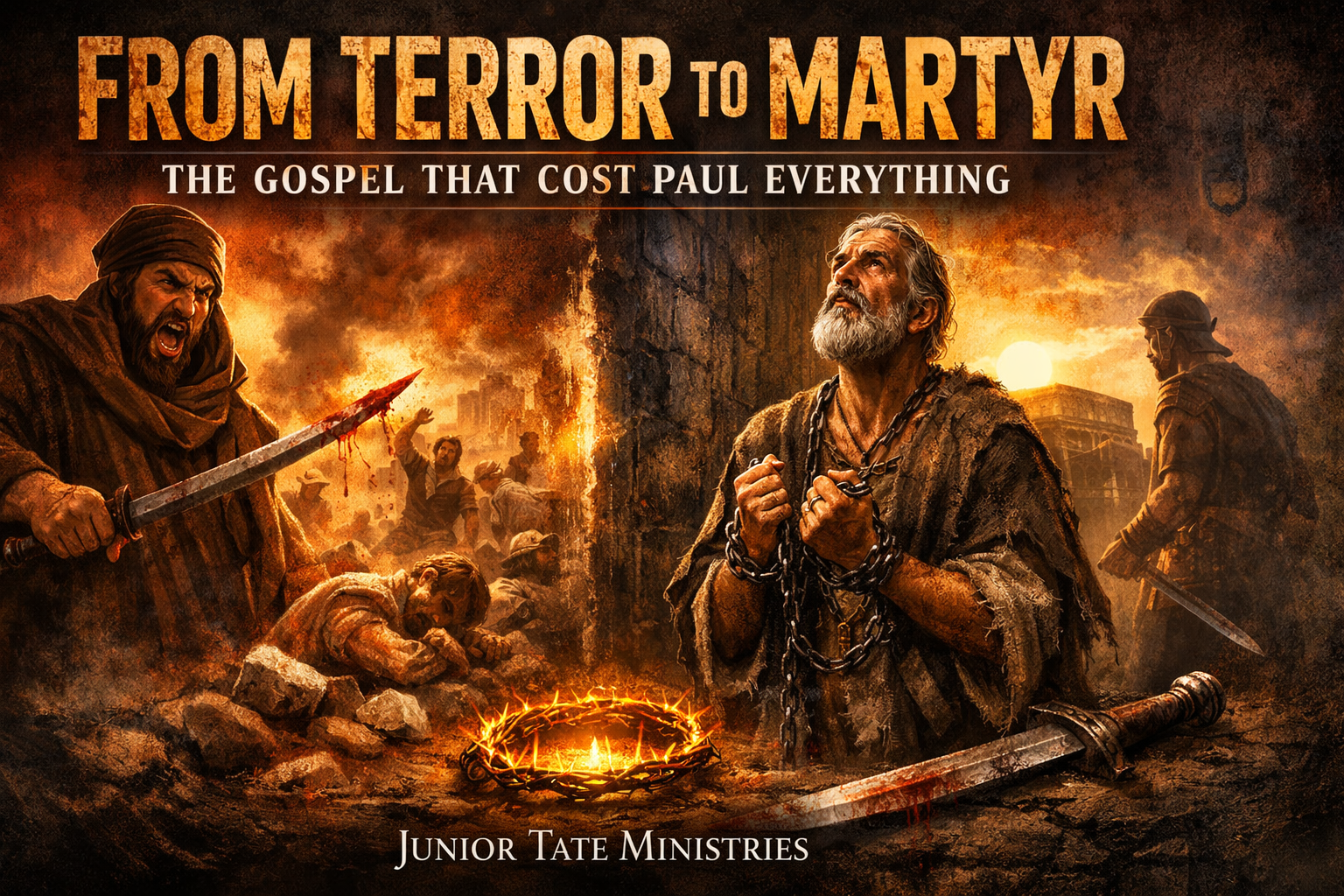
FROM TERROR TO MARTYR — THE GOSPEL THAT COST PAUL EVERYTHING

Before he became the apostle whose letters shape much of the New Testament, Paul the Apostle was known as Saul of Tarsus—a man feared by the early church. Scripture does not soften Saul’s past.  It presents him as a relentless persecutor whose mission was to silence the followers of Jesus Christ through imprisonment, violence, and death. Paul’s later endurance cannot be separated from this transformation. The man who once terrorized the church would become its most persecuted messenger. His life demonstrates that the gospel does not merely change behavior—it reassigns allegiance, even when obedience leads to suffering. Saul: A Terror to the Early Church Saul first appears in Scripture during the execution of Stephen, the first Christian martyr. His presence there marks the beginning of widespread persecution. Acts 7:58 (KJV) “And cast him out of the city, and stoned him: and the witnesses laid down their clothes at a young man’s feet, whose name was Saul.” This detail is intentional. Saul stood as an approving authority figure while Stephen was murdered for his testimony of Christ. Acts 8:1 (KJV) “And Saul was consenting unto his death. And at that time there was a great persecution against the church which was at Jerusalem…” Saul’s consent was not passive agreement—it was active endorsement. His presence emboldened violence against believers. Acts 8:3 (KJV) “As for Saul, he made havock of the church, entering into every house, and haling men and women committed them to prison.” The phrase “made havock” describes violent destruction. Saul did not target leaders alone; he targeted families. Men and women were dragged from their homes. Fear followed his name wherever it was spoken. Later, Paul himself would confess the extent of his actions: Acts 22:4 (KJV) “And I persecuted this way unto the death, binding and delivering into prisons both men and women.” In modern terms, Saul functioned as a religious terrorist—using intimidation, force, and violence to eradicate a movement he believed threatened God. Zeal Without Truth: Religious Blindness Saul’s actions were fueled by religious confidence, not moral indifference. Philippians 3:5–6 (KJV) “Circumcised the eighth day, of the stock of Israel…Concerning zeal, persecuting the church; touching the righteousness which is in the law, blameless.” Saul believed he was righteous. He believed he was defending God. Scripture reveals a sobering truth: zeal without Christ becomes hostility toward Christ.  Saul’s sincerity did not make him right—it made him dangerous. The Road to Damascus: Christ Stops the Terror Saul’s campaign of persecution ended abruptly—not through debate, but through divine confrontation. Acts 9:1–2 (KJV) “And Saul, yet breathing out threatenings and slaughter against the disciples of the Lord…” Saul was actively hunting Christians when Christ intervened. Acts 9:3–6 (KJV) “And suddenly there shined round about him a light from heaven…Saul, Saul, why persecutest thou me?…I am Jesus whom thou persecutest…” Jesus did not say, “Why do you persecute My followers?” He said, “Why persecutest thou me?” Christ identified Himself fully with His church. This encounter shattered Saul’s theology, identity, and authority in a single moment. Broken Before Being Sent Acts 9:8–9 (KJV) “And when his eyes were opened, he saw no man… and he was three days without sight…” Blindness humbled Saul physically and spiritually. The man who once led others now had to be led by the hand. God stripped Saul of self-reliance before granting him new purpose. Acts 9:15–16 (KJV) “He is a chosen vessel unto me…For I will shew him how great things he must suffer for my name’s sake.” Paul’s calling included suffering from the beginning. Grace did not remove cost—it redefined obedience. Acts 13:9 (KJV) “Then Saul, (who also is called Paul,) filled with the Holy Ghost…” From persecutor to preacher, Saul became Paul—not by reform, but by surrender. Obedience That Invited Opposition Paul’s obedience immediately placed him in danger. Acts 13:50 (KJV) “But the Jews stirred up… persecution against Paul…” Acts 16:22–23 (KJV) “And when they had laid many stripes upon them, they cast them into prison…” Paul did not soften his message to avoid suffering. Obedience brought conflict because truth confronts darkness. A Life Marked by Suffering Paul openly listed his sufferings to expose false teachers who equated success with comfort. 2 Corinthians 11:23–28 (KJV) “In stripes above measure… in prisons more frequent… once was I stoned… thrice I suffered shipwreck…” Paul’s endurance proved that faithfulness is measured by perseverance, not applause. Stoned and Still Faithful Acts 14:19–20 (KJV) “Having stoned Paul… supposing he had been dead… he rose up, and came into the city.” Paul did not retreat. Obedience resumed immediately. Preserved Through Shipwreck 2 Corinthians 11:25 (KJV) “Thrice I suffered shipwreck…” Acts 27:44 (KJV) “And so it came to pass, that they escaped all safe to land.” God preserved Paul for continued service, not comfort. Chains That Advanced the Gospel Philippians 1:12–13 (KJV) “The things which happened unto me have fallen out rather unto the furtherance of the gospel…” Paul’s imprisonment became a platform for Christ. Strength Through Surrender Galatians 2:20 (KJV) “I am crucified with Christ…” 2 Corinthians 12:9 (KJV) “My grace is sufficient for thee…” Paul endured because he had already died to self. The Marks of a Faithful Servant Galatians 6:17 (KJV) “I bear in my body the marks of the Lord Jesus.” Paul’s scars were evidence of obedience. The Modern Crisis: Discipleship Without Cost Matthew 16:24 (KJV) “Let him deny himself, and take up his cross, and follow me.” Christianity without a cross produces faith without endurance. Conclusion: From Terror to Testimony The gospel transformed a man who terrorized the church into a servant who suffered for it. Philippians 3:8 (KJV) “I count all things but loss for the excellency of the knowledge of Christ Jesus my Lord…” Paul’s life leaves one unavoidable question: If the true gospel turned a terrorist into a faithful servant—why does ours demand so little sacrifice? Paul’s Final Testimony: Faithful Unto Death Scripture does not record Paul’s execution scene in narrative form as it does with Stephen or James. Instead, the Holy Spirit gives … Read more

February 6 – Honoring God With the Heart

Scripture (KJV) — Malachi 2:2“If ye will not hear, and if ye will not lay it to heart, to give glory unto my name, saith the LORD of hosts, I will even send a curse upon you, and I will curse your blessings: yea, I have cursed them already, because ye do not lay it to heart.” ReflectionGod speaks plainly in this verse, calling His people not just to listen—but to take His words to heart. Hearing God without honoring Him leads to empty worship and misplaced priorities. The issue is not outward activity, but inward devotion. God desires hearts that truly revere His name. When God is not given first place, even blessings can lose their purpose. This passage is a sobering reminder that obedience, reverence, and humility matter deeply to the Lord. He calls us to reflect on our motives and ensure that our lives bring Him glory, not just words or routines. Today is an opportunity to examine the heart. Are we merely hearing, or are we truly honoring God? When we give Him the glory He deserves, our lives align with His purpose and our blessings remain fruitful. PrayerLord of Hosts,Search my heart and reveal anything that does not honor You. Help me not only to hear Your Word, but to lay it deeply within my heart. Teach me to glorify Your name in my thoughts, actions, and decisions. I desire a life that honors You fully and walks in reverence before You.In Jesus’ name, Amen. 🌐 juniortateministries.com🌐 greatcommissiontoday.com

February 5 – Blessings That Follow Obedience

Scripture (KJV) — Deuteronomy 28:2“And all these blessings shall come on thee, and overtake thee, if thou shalt hearken unto the voice of the LORD thy God.” ReflectionGod’s blessings are not random—they are connected to relationship and obedience. This verse reminds us that when we listen to God’s voice and walk in His ways, His blessings do not merely arrive quietly; they overtake us. They pursue us as we pursue Him. Obedience is not about earning God’s favor, but aligning our lives with His will. When we choose to follow His Word, we place ourselves in the flow of His promises. God delights in blessing His people—not only materially, but spiritually, emotionally, and eternally. Today is an invitation to listen closely to the Lord. As you walk in obedience, trust that God sees your faithfulness and that His blessings will come in His perfect timing and way. PrayerHeavenly Father,Thank You for Your promises and for Your desire to bless Your people. Help me to listen carefully to Your voice and to walk in obedience to Your Word. Align my heart with Your will and strengthen me to follow You daily. I trust that as I obey You, Your blessings will follow according to Your perfect plan.In Jesus’ name, Amen. 🌐 juniortateministries.com🌐 greatcommissiontoday.com

The Church of Pergamos & Thyatira — Compromise and Corruption

Introduction: When the Church Is Tested from Within By: Junior Tate Ministries In Revelation 2, the Lord Jesus Christ speaks directly to real churches that existed in Asia Minor. Each message contains praise where faithfulness is present, correction where sin is tolerated, and a call to overcome. Two churches stand out for what happens when God’s people live too close to the world and tolerate sin inside the fellowship: Pergamos and Thyatira. Pergamos is warned about compromise—dwelling where Satan’s influence is strong, yet allowing false teaching to remain in the church. Thyatira is warned about corruption—a deeper tolerance of immorality and spiritual deception that spreads like poison when it is not confronted. These are not merely ancient warnings. The same spiritual dangers appear wherever believers loosen their grip on truth, excuse sin, or protect false teachers for the sake of comfort, culture, or convenience. Christ’s words are not guesses or human opinions. They are the holy assessment of the One whose eyes see everything and whose judgment is always righteous. Pergamos: A Church in a Dangerous Place The Name and Setting The Lord begins: Revelation 2:12 (KJV)“And to the angel of the church in Pergamos write; These things saith he which hath the sharp sword with two edges;” Pergamos was a city known for strong pagan worship and imperial cult devotion. Yet the first thing Christ emphasizes is who He is: the One “which hath the sharp sword with two edges.” That sword represents His authority to judge and His Word that cuts through lies and compromise. Christ confronts compromise with truth, not with flattery. Christ Knows Where They Live Revelation 2:13 (KJV)“I know thy works, and where thou dwellest, even where Satan’s seat is: and thou holdest fast my name, and hast not denied my faith, even in those days wherein Antipas was my faithful martyr, who was slain among you, where Satan dwelleth.” Christ says twice, “where Satan dwelleth.” That is not symbolic exaggeration—it is spiritual reality. Pergamos was surrounded by idolatry, false religion, and pressure to conform. Yet Christ praises them for two things: And there was a costly example of faithfulness: This shows something crucial: a church can be courageous under persecution and still be vulnerable to compromise from within. Sometimes the enemy fails to destroy the church through outward pressure, so he attempts to corrupt it through inward deception. Pergamos: The Problem of Compromise “A Few Things Against Thee” Revelation 2:14 (KJV)“But I have a few things against thee, because thou hast there them that hold the doctrine of Balaam, who taught Balac to cast a stumblingblock before the children of Israel, to eat things sacrificed unto idols, and to commit fornication.” Christ’s complaint is not that everyone is corrupt, but that they tolerate people who “hold the doctrine of Balaam.” This doctrine is rooted in the Old Testament event where Balaam, though unable to curse Israel directly, counseled Balak to seduce Israel into sin—leading them into idolatry and immorality. Christ defines the stumbling block in two ways: This is compromise: mixing worship of God with practices God condemns. It is spiritual unfaithfulness that often expresses itself in moral unfaithfulness. The Nicolaitans Again Revelation 2:15 (KJV)“So hast thou also them that hold the doctrine of the Nicolaitans, which thing I hate.” Notice the seriousness: “which thing I hate.” Christ does not treat false doctrine as a harmless difference of opinion.  He hates teachings that excuse sin, corrupt worship, or twist grace into license. Pergamos had people in their midst teaching things Christ hates—yet they were still there. The church may have been strong in public identity, but weak in internal discipline. Pergamos: Christ’s Command and Warning Repent or Face the Sword Revelation 2:16 (KJV)“Repent; or else I will come unto thee quickly, and will fight against them with the sword of my mouth.” This is sobering. Christ does not say He will fight for the church; He says He will fight against “them” (the corrupting teachers) with the sword of His mouth—His Word, His verdict, His judgment. And the church is responsible because it tolerated them. If the church will not confront compromise, Christ Himself will. The Call to Hear Revelation 2:17 (KJV)“He that hath an ear, let him hear what the Spirit saith unto the churches; To him that overcometh will I give to eat of the hidden manna, and will give him a white stone, and in the stone a new name written, which no man knoweth saving he that receiveth it.” Christ offers a promise to the overcomer: Pergamos was tempted with the food of idols; Christ offers better food. Pergamos was tempted to seek acceptance from the culture; Christ offers true acceptance and a new name. Thyatira: A Church With Works, Love, and Growth—But Also Corruption The Lord Who Sees All Revelation 2:18 (KJV)“And unto the angel of the church in Thyatira write; These things saith the Son of God, who hath his eyes like unto a flame of fire, and his feet are like fine brass;” Jesus identifies Himself as: Where Pergamos is addressed with the sword, Thyatira is addressed with piercing eyes—because the problem here is deeper, more entrenched, more hidden. A Strong Beginning: Love and Service Revelation 2:19 (KJV)“I know thy works, and charity, and service, and faith, and thy patience, and thy works; and the last to be more than the first.” Thyatira is praised for: This church was active and increasing in good works. Yet activity does not guarantee purity. A church may appear alive on the outside while tolerating deadly corruption within. Thyatira: The Problem of Corruption Tolerating “That Woman Jezebel” Revelation 2:20 (KJV)“Notwithstanding I have a few things against thee, because thou sufferest that woman Jezebel, which calleth herself a prophetess, to teach and to seduce my servants to commit fornication, and to eat things sacrificed unto idols.” Key word: “thou sufferest” — you allow it; you tolerate it. Jesus calls her “Jezebel,” connecting her to the Old Testament figure who promoted idolatry, … Read more

February 4 – Overcoming With Good

Scripture (KJV) — Romans 12:21“Be not overcome of evil, but overcome evil with good.” ReflectionEvil seeks to pull us down to its level—through bitterness, revenge, anger, and retaliation. But God calls His people to a higher way. To overcome evil with good is not weakness; it is spiritual strength. It means refusing to let darkness dictate our responses. When we respond with good, we break the cycle of harm and reflect the heart of Christ. Jesus overcame the greatest evil not with force, but with sacrificial love.  Every time we choose grace over resentment, kindness over cruelty, and forgiveness over vengeance, we testify to the power of God working within us. Today’s challenge is clear: do not allow evil to shape your heart. Let the goodness of God flow through you, turning opposition into an opportunity for His glory to be revealed. PrayerFather God,Help me to stand firm when evil confronts me. Guard my heart from bitterness and teach me to respond with the goodness that comes from You. Fill me with Your love so that my actions reflect Christ, even in difficult moments. Give me the strength to overcome evil—not by my power, but by Your grace working in me.In Jesus’ name, Amen. 🌐 juniortateministries.com🌐 greatcommissiontoday.com

February 3 – Refined Through the Fire

Scripture (KJV) — Psalm 66:10“For thou, O God, hast proved us: thou hast tried us, as silver is tried.” ReflectionGod’s testing is never meant to destroy us—it is meant to refine us. Just as silver is heated to remove impurities, God allows seasons of testing to purify our faith, strengthen our character, and draw us closer to Him. These moments may feel uncomfortable, even painful, but they serve a holy purpose. When trials come, it is easy to question why. Yet Scripture reminds us that God is intentional. He sees what we cannot. He knows what must be removed and what must remain. The fire does not mean God has abandoned us; it means He is at work within us. If you are in a refining season today, take heart. God is shaping you for greater faith, deeper trust, and stronger endurance. When the refining is complete, what remains will be more precious than before. PrayerLord God,Thank You for Your refining work in my life. Even when I do not understand the trials I face, help me to trust Your purpose. Give me patience in the fire and faith in Your plan. Remove anything in me that does not honor You, and let my life reflect Your glory more clearly each day.  I place myself in Your hands, knowing You are faithful in all You do.In Jesus’ name, Amen. 🌐 juniortateministries.com🌐 greatcommissiontoday.com

February 2 – Faith That Trusts God

Scripture (KJV) — Mark 11:22“And Jesus answering saith unto them, Have faith in God.” ReflectionThese few words from Jesus carry immense weight: Have faith in God. Not faith in circumstances. Not faith in outcomes.  Not even faith in our own strength—but faith in God Himself. The disciples had just witnessed something impossible with their natural eyes, and Jesus redirected their focus away from amazement and toward trust. Faith is not about how strong we feel; it’s about who we are trusting. God does not ask us to manufacture belief—He asks us to rest in His character. When life feels uncertain, faith anchors us to the One who never changes. Trusting God means believing that His power, wisdom, and timing are sufficient, even when answers seem delayed or unclear. Today’s call is simple but profound: shift your confidence fully onto God. He is able. He is faithful. And He is worthy of your trust. PrayerHeavenly Father,Thank You for reminding me that faith begins and ends with You. Help me to place my trust not in what I see, but in who You are. Strengthen my faith when doubts arise and teach me to rely on Your promises instead of my fears. I surrender my worries, my plans, and my future into Your hands. I choose today to have faith in You alone.In Jesus’ name, Amen. 🌐 juniortateministries.com🌐 greatcommissiontoday.com