
The Fall of Man and Angels: The True Beginning of Sin According to Scripture

Introduction: Why the Fall Matters The Bible does not treat sin as a minor flaw or a simple mistake. Scripture presents sin as a real rebellion against God that brought death, separation, and corruption into the human experience.  To understand redemption, we must first understand the Fall. The Fall of Man is not merely an ancient story—it is the true beginning of sin entering first with God’s Holy Angels and the human race, and it explains why every person is born into a world broken by disobedience. This article will follow the biblical record carefully, especially Genesis 1–3 and the rest of Scripture that interprets those events. We will avoid speculation and keep our foundation in what God has revealed. We will also address a key question: How was Satan already a fallen angel before he appeared in the garden as a serpent? Scripture gives enough information to establish that Satan’s rebellion occurred prior to Eden, even if it does not give every detail in chronological order. Sin Began Before the Garden: Satan’s Rebellion Against God According to Scripture, sin did not originate in the Garden of Eden, but with the rebellion of Satan against God in heaven. Satan, originally created as a glorious angelic being, became lifted up in pride and sought to exalt himself above God’s authority. His rebellion resulted in his fall and the corruption of a portion of the angelic host. The Bible indicates that Satan drew a significant number of angels into his revolt, commonly understood as a “third part” of the angels, who fell with him and are now identified as fallen angels or demons. Jesus Himself affirmed the historical reality of Satan’s fall when He told His disciples that He personally witnessed Satan being cast out of heaven. This angelic rebellion marks the true beginning of sin—occurring before Satan ever appeared in the Garden of Eden to deceive mankind—demonstrating that evil entered God’s creation through willful disobedience against divine authority. Scriptural Support (KJV) Isaiah 14:12–15 (KJV) “How art thou fallen from heaven, O Lucifer, son of the morning! how art thou cut down to the ground, which didst weaken the nations!For thou hast said in thine heart, I will ascend into heaven, I will exalt my throne above the stars of God: I will sit also upon the mount of the congregation, in the sides of the north:I will ascend above the heights of the clouds; I will be like the most High.Yet thou shalt be brought down to hell, to the sides of the pit.” Ezekiel 28:15–17 (KJV) “Thou wast perfect in thy ways from the day that thou wast created, till iniquity was found in thee.By the multitude of thy merchandise they have filled the midst of thee with violence, and thou hast sinned: therefore I will cast thee as profane out of the mountain of God: and I will destroy thee, O covering cherub, from the midst of the stones of fire.Thine heart was lifted up because of thy beauty, thou hast corrupted thy wisdom by reason of thy brightness: I will cast thee to the ground, I will lay thee before kings, that they may behold thee.” Revelation 12:3–4 (KJV) “And there appeared another wonder in heaven; and behold a great red dragon, having seven heads and ten horns, and seven crowns upon his heads.And his tail drew the third part of the stars of heaven, and did cast them to the earth…” (Note: Scripture frequently uses “stars” symbolically for angels; see Job 38:7.) Luke 10:18 (KJV) “And he said unto them, I beheld Satan as lightning fall from heaven.” This is Jesus speaking to His Disciples. Why This Matters Theologically This biblical foundation clarifies that Satan was already a fallen being when he entered the Garden of Eden. He did not create sin within mankind but introduced sin to humanity after originating it through his own rebellion against God. Adam and Eve fell by deception, but Satan fell by pride and willful defiance. Understanding this sequence preserves the biblical order of events and reinforces the truth that evil did not originate with God, but through created beings who chose rebellion over obedience. God’s Good Creation Before Sin Entered Man Before the Fall, God’s creation was declared “very good.” Man and woman were made in God’s image, given dominion, and placed in a garden that God Himself prepared. Sin did not begin with God—sin began with the creature turning away from the Creator. Genesis 1:26–31 (KJV)“And God said, Let us make man in our image, after our likeness: and let them have dominion over the fish of the sea, and over the fowl of the air, and over the cattle, and over all the earth, and over every creeping thing that creepeth upon the earth.So God created man in his own image, in the image of God created he him; male and female created he them.And God blessed them, and God said unto them, Be fruitful, and multiply, and replenish the earth, and subdue it: and have dominion over the fish of the sea, and over the fowl of the air, and over every living thing that moveth upon the earth.And God said, Behold, I have given you every herb bearing seed, which is upon the face of all the earth, and every tree, in the which is the fruit of a tree yielding seed; to you it shall be for meat.And to every beast of the earth, and to every fowl of the air, and to every thing that creepeth upon the earth, wherein there is life, I have given every green herb for meat: and it was so.And God saw every thing that he had made, and, behold, it was very good. And the evening and the morning were the sixth day.” Man was not created sinful. Man was created upright, blessed, and placed under God’s authority with purpose and provision. The Garden, the Command, and the Test of Obedience God placed the man in Eden … Read more

January 23 – Tested, Yet Faithful

Scripture (KJV): Genesis 22:1“And it came to pass after these things, that God did tempt Abraham, and said unto him, Abraham: and he said, Behold, here I am. Reflection Genesis 22 opens one of the most profound moments of faith in Scripture. God tests Abraham—not to harm him, but to reveal and refine his trust.  The word tempt here speaks of testing, not enticing to sin. God was drawing Abraham into deeper obedience and dependence, asking him to trust God’s character even when the command would be difficult to understand. Abraham’s response is striking: “Behold, here I am.” There is no hesitation, no argument, only availability. This moment teaches us that true faith is not proven in comfort, but in surrender. God often tests His people after seasons of blessing, not to take away, but to strengthen faith and align hearts fully with Him. Believers today may face tests of obedience, patience, or trust. These moments reveal what we truly believe about God. Like Abraham, we are called to respond with a willing heart, trusting that the God who tests us is the same God who provides and remains faithful to His promises. Prayer Father, help me to trust You even when I do not understand the path You place before me. Give me a heart that responds, “Here I am,” in obedience and faith. Strengthen me in times of testing and remind me that You are always faithful, just, and good.  I place my life fully in Your hands. In Jesus’ name, Amen. juniortateministries.comgreatcommissiontoday.com

January 22 – Victory Through Faith

Scripture (KJV): 1 John 5:4“For whatsoever is born of God overcometh the world: and this is the victory that overcometh the world, even our faith.” Reflection This verse declares a powerful truth about the believer’s identity. Victory over the world is not achieved through strength, influence, or determination—it flows from being born of God. When a person belongs to Christ, they are given a new nature that is no longer ruled by the world’s systems, values, or fears. Faith is the means by which this victory is lived out daily. It is not blind optimism, but confident trust in who God is and what He has done through Jesus Christ. Faith anchors us to truth when circumstances press in, when temptation calls, and when opposition arises. Though believers still face trials, the outcome is already secured. Our victory does not depend on how we feel or how strong we are in the moment, but on the faithfulness of God. Walking by faith allows us to overcome fear, discouragement, and the pull of the world, reminding us that we belong to Him. Prayer Lord, thank You that through Christ I am an overcomer. Strengthen my faith when I feel weak and help me trust You beyond what I see. Teach me to walk daily in the victory You have already secured for me. May my life reflect confidence in You and obedience to Your truth. In Jesus’ name, Amen. juniortateministries.comgreatcommissiontoday.com

EPHESUS: THE CHURCH THAT LEFT ITS FIRST LOVE

A Scripture-Centered, In-Depth Study from the King James Version By: Junior Tate Ministries Why Ephesus Matters: The First Church Addressed by Christ When Jesus Christ speaks to the seven churches in Revelation 2–3, He begins with Ephesus. That is not accidental. Ephesus was a well-established church with a strong history, sound doctrine, endurance through opposition, and discernment against false teachers. Yet the Lord’s chief charge against them is sobering: they had left their first love. The message to Ephesus teaches every believer and every church a vital truth: it is possible to be orthodox, active, and enduring—yet spiritually drifting in love for Christ. The Lord does not merely evaluate outward performance; He searches the inner spiritual condition: the heart’s love, devotion, and priority. Ephesus becomes a warning to churches that work hard, resist error, and remain busy—yet lose the warmth of affection, delight, and devotion to Jesus Himself. The Full Message to Ephesus (KJV) To study Ephesus faithfully, we must begin with Christ’s own words. Revelation 2:1–7 (KJV)“Unto the angel of the church of Ephesus write; These things saith he that holdeth the seven stars in his right hand, who walketh in the midst of the seven golden candlesticks;I know thy works, and thy labour, and thy patience, and how thou canst not bear them which are evil: and thou hast tried them which say they are apostles, and are not, and hast found them liars:And hast borne, and hast patience, and for my name’s sake hast laboured, and hast not fainted.Nevertheless I have somewhat against thee, because thou hast left thy first love.Remember therefore from whence thou art fallen, and repent, and do the first works; or else I will come unto thee quickly, and will remove thy candlestick out of his place, except thou repent.But this thou hast, that thou hatest the deeds of the Nicolaitans, which I also hate.He that hath an ear, let him hear what the Spirit saith unto the churches; To him that overcometh will I give to eat of the tree of life, which is in the midst of the paradise of God.” This passage provides everything needed to understand Ephesus biblically: The Identity of the Speaker: Christ in the Midst Christ introduces Himself as the One “that holdeth the seven stars” and “walketh in the midst of the seven golden candlesticks.” Those symbols are explained just one chapter earlier. Revelation 1:20 (KJV)“The mystery of the seven stars which thou sawest in my right hand, and the seven golden candlesticks. The seven stars are the angels of the seven churches: and the seven candlesticks which thou sawest are the seven churches.” The point is clear: the churches belong to Christ, and Christ is present among them. The Lord’s message is not distant or theoretical—He is in the midst, seeing truly, evaluating rightly, and calling His people back to spiritual reality. Ephesus therefore is measured not by reputation or activity but by the Lord who walks among His churches. Christ’s Commendation: Works, Labour, Patience, and Discernment Jesus begins with praise: Revelation 2:2–3 (KJV)“I know thy works, and thy labour, and thy patience… And hast borne, and hast patience, and for my name’s sake hast laboured, and hast not fainted.” What Ephesus Was Doing Right (Scripturally) Ephesus was not lazy. Ephesus was not doctrinally careless. Ephesus was not tolerant of spiritual deception. Christ openly acknowledges and honors these things. This matters: leaving first love is not always the failure of a “bad” church. Sometimes it happens in a church that is busy, faithful, and enduring—yet becomes spiritually cold. “Thou Hast Tried Them”: Testing Teachers and Exposing Liars Ephesus is praised because they tested claims. Revelation 2:2 (KJV)“…and how thou canst not bear them which are evil: and thou hast tried them which say they are apostles, and are not, and hast found them liars:” Scripture supports the responsibility to test teaching, doctrine, and spiritual claims. 1 John 4:1 (KJV)“Beloved, believe not every spirit, but try the spirits whether they are of God: because many false prophets are gone out into the world.” Acts 17:11 (KJV)“These were more noble than those in Thessalonica, in that they received the word with all readiness of mind, and searched the scriptures daily, whether those things were so.” Ephesus had a Berean-like discipline. They did not accept spiritual titles as proof. They measured teaching by truth and exposed those who lied. Yet here is the warning: even correct discernment can become dry if love for Christ is not guarded. The Lord’s Charge: “Thou Hast Left Thy First Love” Then comes the turning point: Revelation 2:4 (KJV)“Nevertheless I have somewhat against thee, because thou hast left thy first love.” Notice what Christ does not say. He does not accuse them of abandoning doctrine or surrendering to immorality. He says they left their first love. That word indicates a departure—an intentional or gradual moving away from what was once central. What Is “First Love” (Biblically)? “First love” is not mere emotion. It is the primary place Christ holds in the heart, expressed through devotion, obedience, delight in Him, and fellowship with Him. Jesus defines true love as obedience flowing from the heart. John 14:15 (KJV)“If ye love me, keep my commandments.” But Ephesus still had works and labour—so the problem is not that they did nothing. The issue is that their works were no longer flowing from that first, foremost love and devotion to Jesus. Scripture warns of a form of godliness without spiritual life. 2 Timothy 3:5 (KJV)“Having a form of godliness, but denying the power thereof: from such turn away.” Ephesus had strong form—but Christ says something essential was missing: love that is first. How a Church Leaves First Love While Still Working Ephesus shows how spiritual decline can hide behind spiritual activity. A church can be: …and still be drifting in affection and devotion to Christ. Common Symptoms (Drawn From the Text) When love is not first, even good works can become mechanical, duty-driven, reputation-driven, or conflict-driven. The … Read more

January 21 – Blessed Beyond Measure

Scripture (KJV): Ephesians 1:3“Blessed be the God and Father of our Lord Jesus Christ, who hath blessed us with all spiritual blessings in heavenly places in Christ:” Reflection This verse lifts our eyes beyond the temporary and into the eternal. Paul reminds believers that our greatest blessings are not earthly possessions or circumstances, but spiritual riches already secured for us in Christ. These blessings come from God Himself and are rooted in heaven, untouched by loss, hardship, or change. In Christ, believers lack nothing that is necessary for salvation, growth, and godly living. Forgiveness, adoption, redemption, peace, hope, and eternal life are not future possibilities—they are present realities. Too often we measure God’s goodness by what we see around us, forgetting what has already been given to us through Jesus. Ephesians 1:3 calls us to live with gratitude and confidence. When we understand who we are in Christ and what we already possess through Him, our perspective shifts. We move from striving to resting, from worry to worship, and from scarcity to abundance. Prayer Heavenly Father, I praise You for the spiritual blessings You have freely given me in Christ. Help me to see beyond temporary struggles and fix my heart on eternal truth. Teach me to live each day with gratitude, faith, and confidence in what You have already provided. May my life reflect praise to You for Your goodness and grace. In Jesus’ name, Amen. juniortateministries.comgreatcommissiontoday.com

January 20 – The Deceptive Path

Scripture (KJV): Proverbs 14:12“There is a way which seemeth right unto a man, but the end thereof are the ways of death.” Reflection This proverb is a sobering reminder that human judgment, when separated from God’s truth, can be dangerously misleading. What feels right, logical, or culturally accepted is not always aligned with God’s will. Our hearts and minds, shaped by sin and limited understanding, can justify paths that ultimately lead to spiritual harm, brokenness, or separation from God. God is warning us that sincerity alone is not enough. A person can be confident, well-intentioned, and still be wrong. The only safe guide for life is God’s Word and His wisdom. When we lean solely on our own understanding, we risk choosing direction based on pride, emotion, or convenience rather than truth. This verse calls believers to humility and dependence. Instead of asking, “What feels right to me?” we must ask, “What does God say?” True life, peace, and righteousness are found when our paths are submitted to Him. Prayer Lord, help me to recognize that my understanding is limited, but Your wisdom is perfect. Guard my heart from trusting my own way above Your truth. Lead me by Your Word, correct me when I stray, and give me discernment to walk the path that honors You.  I surrender my plans, decisions, and direction to You today. In Jesus’ name, Amen. juniortateministries.comgreatcommissiontoday.com

January 19 – Nothing Can Separate

Scripture (KJV): Romans 8:39“Nor height, nor depth, nor any other creature, shall be able to separate us from the love of God, which is in Christ Jesus our Lord.” Reflection This verse is one of the greatest assurances given to believers. Paul closes his powerful argument by declaring that absolutely nothing in all creation has the power to separate us from God’s love. No circumstance, no fear, no spiritual force, no failure, and no future uncertainty can undo what God has secured in Christ. God’s love is not fragile. It does not weaken when life grows heavy or when faith feels small. It is rooted in Jesus Christ—His finished work, His victory over sin, death, and the grave. When the believer is in Christ, they are permanently held by a love that cannot be broken, shaken, or withdrawn. This truth brings deep comfort and confidence. When doubts arise or trials press in, Romans 8:39 reminds us that God’s love is constant, unchanging, and eternal. We are not kept by our strength, but by His faithfulness. Prayer Heavenly Father, thank You for the unbreakable love You have shown me through Christ Jesus. When fear, doubt, or hardship tries to convince me otherwise, help me stand firmly on Your truth. Remind my heart that nothing can separate me from Your love. Strengthen my faith, calm my spirit, and let me walk today in confidence and peace, knowing I am fully held by You. In Jesus’ name, Amen. juniortateministries.comgreatcommissiontoday.com

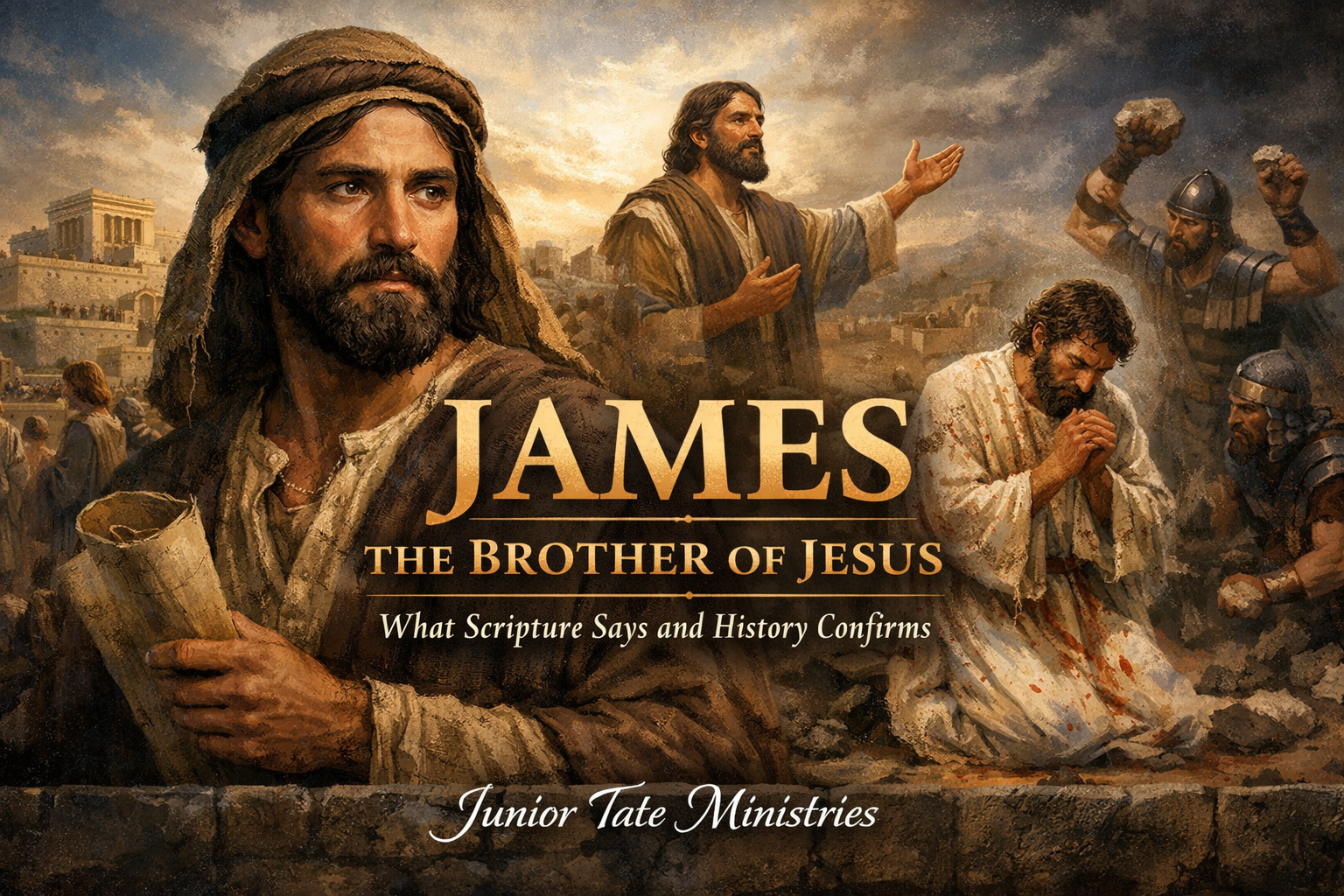
James the Brother of Jesus: What Scripture Says and History Confirms

Introduction Among the figures of the New Testament, few are as remarkable—and often overlooked—as James, the brother of Jesus.  He did not begin as a believer. He grew up in the same household as Jesus of Nazareth, witnessed His life firsthand, and yet initially rejected His messianic claims. Scripture is honest about this fact. But after the resurrection of Christ, James underwent a profound transformation. He would go on to become one of the most influential leaders in the early Church, particularly in Jerusalem, and ultimately lay down his life as a martyr. This article carefully examines everything Scripture explicitly says about James, quoting the full KJV verses, and then distinguishes that inspired record from what early history confirms about his life and death. The goal is not speculation, legend, or church tradition elevated to doctrine—but biblical clarity supported by historical testimony. James Identified as the Brother of Jesus (Scripture) The New Testament clearly identifies James as one of Jesus’ brothers. Jesus’ Family Named by the Gospels Matthew 13:55–56 (KJV) “Is not this the carpenter’s son? is not his mother called Mary? and his brethren, James, and Joses, and Simon, and Judas? And his sisters, are they not all with us? Whence then hath this man all these things?” Mark 6:3 (KJV) “Is not this the carpenter, the son of Mary, the brother of James, and Joses, and of Juda, and Simon? and are not his sisters here with us? And they were offended at him.” Scripture plainly names James as a brother of Jesus. The Bible does not attempt to soften or redefine the term. He is not introduced as an apostle at this stage, nor as a believer—but simply as a family member. James’ Initial Unbelief (Scripture) One of the most striking facts about James is that he did not believe in Jesus during His earthly ministry. John 7:5 (KJV) “For neither did his brethren believe in him.” This verse includes James among those who lived with Jesus yet did not accept His claims during that time. Scripture does not hide this reality. It emphasizes the authenticity of the later transformation. The Resurrection Appearance That Changed Everything (Scripture) After Jesus’ resurrection, something extraordinary occurred. 1 Corinthians 15:7 (KJV) “After that, he was seen of James; then of all the apostles.” The Bible does not record the conversation or the details of this meeting—but it records the fact. The risen Christ personally appeared to James. This moment marks the clear turning point in James’ life. James Among the Believers After the Ascension (Scripture) Following the resurrection and ascension, James is no longer listed among skeptics—but among praying believers. Acts 1:14 (KJV) “These all continued with one accord in prayer and supplication, with the women, and Mary the mother of Jesus, and with his brethren.” James, once an unbeliever, is now united with the Church in prayer. James Emerges as a Leader in Jerusalem (Scripture) Peter Recognizes James’ Authority Acts 12:17 (KJV) “But he, beckoning unto them with the hand to hold their peace, declared unto them how the Lord had brought him out of the prison. And he said, Go shew these things unto James, and to the brethren. And he departed, and went into another place.” Peter, one of the Twelve, instructs that news be taken directly to James—demonstrating James’ recognized authority within the Jerusalem church. James at the Jerusalem Council (Scripture) James plays a central role in resolving one of the most critical doctrinal issues of the early Church: whether Gentile believers must keep the Law of Moses. Acts 15:13–21 (KJV) “And after they had held their peace, James answered, saying, Men and brethren, hearken unto me:Simeon hath declared how God at the first did visit the Gentiles, to take out of them a people for his name.And to this agree the words of the prophets; as it is written,After this I will return, and will build again the tabernacle of David, which is fallen down; and I will build again the ruins thereof, and I will set it up:That the residue of men might seek after the Lord, and all the Gentiles, upon whom my name is called, saith the Lord, who doeth all these things.Known unto God are all his works from the beginning of the world.Wherefore my sentence is, that we trouble not them, which from among the Gentiles are turned to God:But that we write unto them, that they abstain from pollutions of idols, and from fornication, and from things strangled, and from blood.For Moses of old time hath in every city them that preach him, being read in the synagogues every sabbath day.” James does not contradict the apostles—he synthesizes Scripture and affirms salvation by grace while encouraging holiness. Paul Identifies James as “the Lord’s Brother” (Scripture) Paul explicitly confirms James’ identity. Galatians 1:18–19 (KJV) “Then after three years I went up to Jerusalem to see Peter, and abode with him fifteen days.But other of the apostles saw I none, save James the Lord’s brother.” James Named a Pillar of the Church Galatians 2:9 (KJV) “And when James, Cephas, and John, who seemed to be pillars, perceived the grace that was given unto me, they gave to me and Barnabas the right hands of fellowship; that we should go unto the heathen, and they unto the circumcision.” James stands alongside Peter and John as a foundational leader. James’ Continued Leadership Late in Acts (Scripture) Years later, James remains at the center of Jerusalem leadership. Acts 21:17–19 (KJV) “And when we were come to Jerusalem, the brethren received us gladly.And the day following Paul went in with us unto James; and all the elders were present.And when he had saluted them, he declared particularly what things God had wrought among the Gentiles by his ministry.” James presides among the elders—demonstrating long-term stability and leadership. James the Author of the Epistle of James (Scripture) James identifies himself not by family connection, but by submission to Christ. James 1:1 (KJV) “James, a servant of … Read more

January 18 – Saved by Mercy, Not Works

Scripture — Titus 3:5 (KJV) 5 Not by works of righteousness which we have done, but according to his mercy he saved us, by the washing of regeneration, and renewing of the Holy Ghost; Reflection This verse clearly reminds us that salvation is not something we earn—it is something we receive. No amount of good deeds, religious effort, or moral behavior can save a soul. Salvation is entirely the result of God’s mercy, poured out through Jesus Christ. God does more than forgive; He regenerates and renews. The Holy Spirit brings new life, cleanses the heart, and transforms us from the inside out. This truth humbles us, removes pride, and fills us with gratitude. When we understand that we are saved by mercy alone, we are moved to live lives marked by humility, obedience, and thankful service to God. Prayer Heavenly Father,Thank You for saving me by Your mercy and not by my own efforts. I praise You for the new life You have given me through the renewing work of the Holy Spirit. Help me to walk in gratitude, humility, and obedience, living each day as a testimony of Your grace. May my life honor You in all things.In Jesus’ name, Amen. juniortateministries.comgreatcommissiontoday.com

January 17 – Stay Alert, Stand Firm

Scripture — 1 Peter 5:8 (KJV) 8 Be sober, be vigilant; because your adversary the devil, as a roaring lion, walketh about, seeking whom he may devour: Reflection Scripture warns believers that the Christian life is not lived on neutral ground. We have an enemy who is real, active, and persistent. Peter’s call to be sober and vigilant is a reminder to stay spiritually alert—clear-minded, grounded in truth, and watchful in faith. The devil is described as a roaring lion, using fear, deception, and temptation to intimidate and weaken believers. Yet this warning is not meant to create fear, but readiness. When we remain anchored in God’s Word, clothed in humility, and dependent on Christ, we are able to stand firm. Awareness leads to vigilance, and vigilance strengthens our walk with God. Prayer Heavenly Father,Help me to walk each day with spiritual alertness and discernment. Keep my mind clear and my heart anchored in Your truth. Strengthen me to resist the enemy and to stand firm in faith, knowing that You are my protector and defender. Guide my steps and guard my life according to Your will.In Jesus’ name, Amen. juniortateministries.comgreatcommissiontoday.com