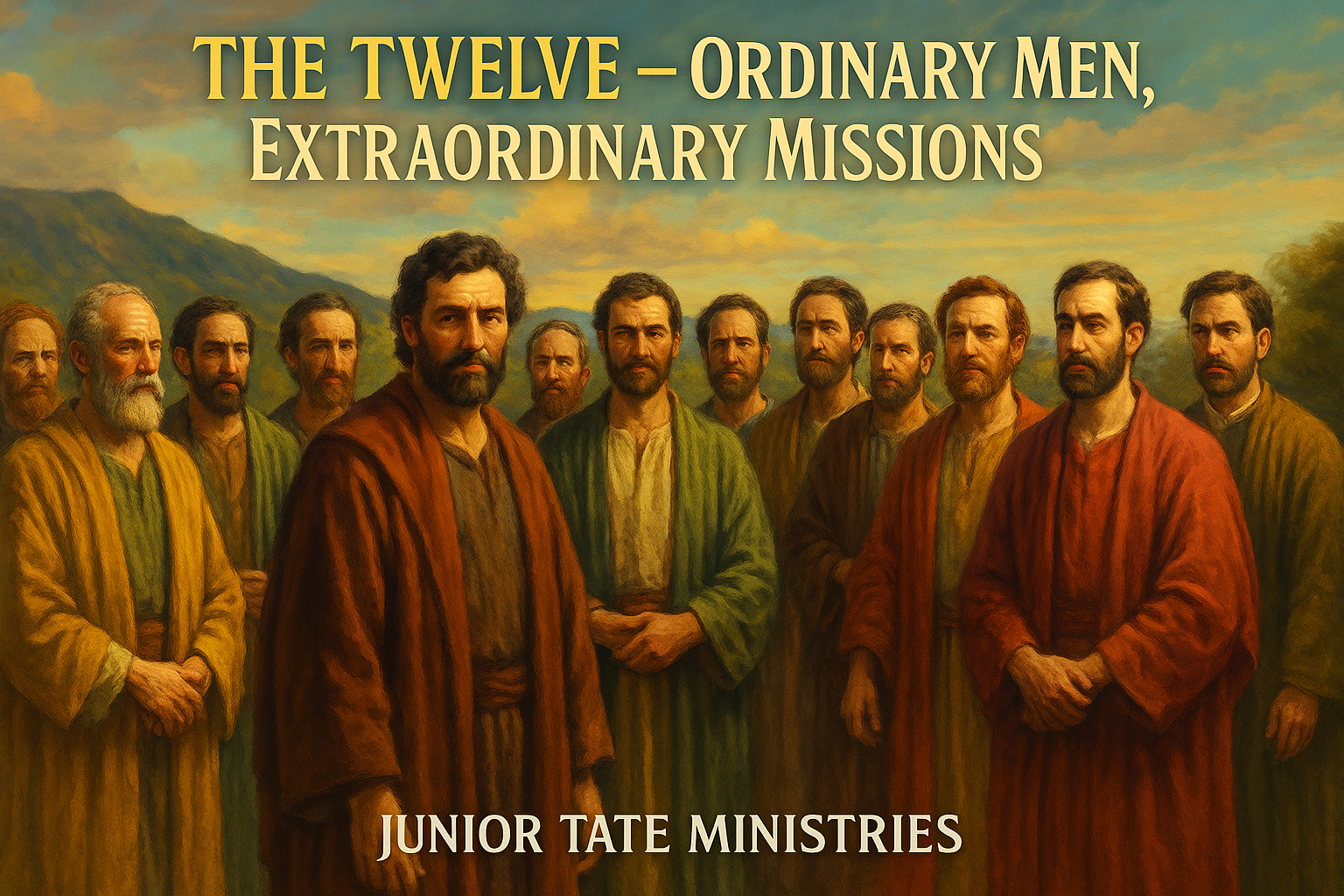
“The Twelve – Ordinary Men, Extraordinary Missions.” A Bible-Based Study Into the Lives of the Disciples.

By: Junior Tate Ministries God’s Pattern – Ordinary People, Extraordinary Work From Genesis to Revelation, God delights in using ordinary people to accomplish extraordinary things. The twelve men whom Jesus chose as His apostles were not famous scholars, political leaders, or wealthy influencers. They were fishermen, a tax collector, a former zealot, and men with weaknesses, fears, and failures—just like us. Yet under the hand of Christ and in the power of the Holy Ghost, these ordinary men were sent on an extraordinary mission: to take the gospel from a small region in Israel to the “uttermost part of the earth.” The Bible describes God’s method plainly: “For ye see your calling, brethren, how that not many wise men after the flesh, not many mighty, not many noble, are called:  But God hath chosen the foolish things of the world to confound the wise; and God hath chosen the weak things of the world to confound the things which are mighty; And base things of the world, and things which are despised, hath God chosen, yea, and things which are not, to bring to nought things that are, that no flesh should glory in his presence.”  (1 Corinthians 1:26–29, KJV) The story of the Twelve is a living example of this truth. Jesus Chooses the Twelve The choosing of the Twelve was not random, rushed, or accidental. It was done in perfect obedience to the Father’s will, bathed in prayer. “And it came to pass in those days, that he went out into a mountain to pray, and continued all night in prayer to God. And when it was day, he called unto him his disciples: and of them he chose twelve, whom also he named apostles.” (Luke 6:12–13, KJV) Mark tells us more about their purpose: “And he ordained twelve, that they should be with him, and that he might send them forth to preach, And to have power to heal sicknesses, and to cast out devils.” (Mark 3:14–15, KJV) Notice three key things: They were ordinary men—but chosen and ordained by an extraordinary Lord. Their Ordinary Backgrounds Fishermen: Peter, Andrew, James, and John Several of the Twelve were fishermen—hard-working, common men with calloused hands and simple lives. “And Jesus, walking by the sea of Galilee, saw two brethren, Simon called Peter, and Andrew his brother, casting a net into the sea: for they were fishers. And he saith unto them, Follow me, and I will make you fishers of men. And they straightway left their nets, and followed him. And going on from thence, he saw other two brethren, James the son of Zebedee, and John his brother, in a ship with Zebedee their father, mending their nets; and he called them. And they immediately left the ship and their father, and followed him.” (Matthew 4:18–22, KJV) There was nothing remarkable in the world’s eyes about these men. Yet when Jesus called, they immediately left what was familiar to follow Him. A Tax Collector: Matthew (Levi) Tax collectors were despised in Israel as collaborators with Rome and sinners.  “And as he passed by, he saw Levi the son of Alphaeus sitting at the receipt of custom, and said unto him, Follow me. And he arose and followed him.” (Mark 2:14, KJV) Matthew’s former life as a tax collector shows that Christ can redeem even a hated profession and turn a man into a Gospel writer and witness of grace. A Zealot: Simon the Canaanite Simon is called “Simon the Canaanite” in Matthew’s list of the apostles (Matthew 10:4, KJV). Luke identifies him as “Simon called Zelotes” (Luke 6:15, KJV). These titles refer to the same disciple and highlight the idea of zeal—an intensity of conviction and passion that, in that era, was often associated with strong resistance to Roman rule. It’s important not to confuse Simon with Judas Iscariot. Matthew lists them one after the other: “Simon the Canaanite, and Judas Iscariot, who also betrayed him” (Matthew 10:4, KJV). Judas is a different man, and the phrase “who also betrayed him” is describing Judas, not Simon. Luke makes this distinction explicit by listing “Simon called Zelotes” and then separately naming “Judas Iscariot, which also was the traitor” (Luke 6:15–16, KJV). Jesus took a man known for intensity and redirected that zeal toward the kingdom of God. Whatever Simon’s passions had been before, Christ formed him into a witness whose loyalty was no longer driven by politics, but by the Person of Christ and the mission of the gospel. Their Weaknesses and Failures These twelve were not spiritual super-heroes. The Scriptures honestly record their arguments, fears, doubts, and failures. Peter: Bold and Broken Peter is often the spokesman of the group, quick to speak and quick to stumble. After Peter confessed Jesus as the Christ (Matthew 16:16), he later denied Him three times. Before this failure, Jesus warned him: “And the Lord said, Simon, Simon, behold, Satan hath desired to have you, that he may sift you as wheat:But I have prayed for thee, that thy faith fail not: and when thou art converted, strengthen thy brethren.” (Luke 22:31–32, KJV) When Peter did deny Christ, the Bible describes his deep sorrow: “And the Lord turned, and looked upon Peter. And Peter remembered the word of the Lord, how he had said unto him, Before the cock crow, thou shalt deny me thrice. And Peter went out, and wept bitterly.” (Luke 22:61–62, KJV) Peter was an ordinary man prone to fear, yet Jesus prayed for him and later used him mightily. Thomas: Doubting Then Declaring Thomas is often remembered as “doubting Thomas,” but Scripture gives us a fuller picture. When Jesus was going back toward danger in Judea: “Then said Thomas, which is called Didymus, unto his fellow disciples, Let us also go, that we may die with him.” (John 11:16, KJV)  Later, after the resurrection, Thomas struggled to believe: “Then saith he to Thomas, reach hither thy finger, and behold my hands; and reach hither thy hand, and … Read more

THE DAYS OF NOAH AND THE RETURN OF CHRIST

A Biblical Examination of the Last Days Through Scripture alone (KJV) By Junior Tate Ministries Introduction The return of Jesus Christ is the blessed hope of every believer. Scripture teaches that the coming of the Lord will be sudden, visible, and global. Jesus Himself gives us one of the clearest indicators of the timing and character of His return when He says the last days will resemble “the days of Noah.” This is not a vague or mystical comparison. Jesus points us to a historical period filled with specific moral conditions, spiritual realities, and global events. In Matthew 24, Jesus does not direct us to speculation, philosophy, or human opinion, but to divine history recorded in the Word of God. By understanding the days of Noah, we gain insight into the world conditions leading up to Christ’s Second Coming. This article will examine: This study is rooted in complete KJV Scripture, carefully explained with Scripture interpreting Scripture. Jesus’ Own Warning: “As the Days of Noah Were” The foundation for this entire study is found in Jesus’ words: Matthew 24:37–39 (KJV) 37 But as the days of Noe were, so shall also the coming of the Son of man be.38 For as in the days that were before the flood they were eating and drinking, marrying and giving in marriage, until the day that Noe entered into the ark,39 And knew not until the flood came, and took them all away; so shall also the coming of the Son of man be. Jesus teaches four essential truths about the last days: This is not speculation. Jesus makes the comparison Himself. So we must ask: What exactly were the days of Noah like? To answer that, we go to Genesis 6. The Moral and Spiritual Condition of Noah’s Day Extreme Wickedness Filled the Earth Genesis 6:5 (KJV) 5 And GOD saw that the wickedness of man was great in the earth, and that every imagination of the thoughts of his heart was only evil continually. The wickedness of mankind was: When Jesus said the last days would be like this, He meant moral corruption would not be occasional or limited, but worldwide and constant. The Earth Was Filled With Violence Genesis 6:11–12 (KJV) 11 The earth also was corrupt before God, and the earth was filled with violence.12 And God looked upon the earth, and, behold, it was corrupt; for all flesh had corrupted his way upon the earth. Violence was not regional; it was global. Society had normalized it. Humanity had “corrupted his way,” meaning people rejected the ways of God and embraced their own ways. Jesus says the world before His coming will mirror this. The Fallen Angels and Their Offspring in the Days of Noah Another defining characteristic of the days of Noah was the unnatural corruption brought into humanity when fallen angels; referred to in Scripture as “sons of God” left their proper place and took human women as wives. This union produced a race of giants, contributing to the deep moral decay that filled the earth. The Bible states clearly: Genesis 6:1–4 (KJV) 1 And it came to pass, when men began to multiply on the face of the earth, and daughters of men were born unto them,2 That the sons of God saw the daughters of men that they were fair; and they took them wives of all which they chose.3 And the LORD said, My spirit shall not always strive with man, for that he also is flesh: yet his days shall be an hundred and twenty years.4 There were giants in the earth in those days; and also after that, when the sons of God came in unto the daughters of men, and they bare children to them, the same became mighty men which were of old, men of renown. These “sons of God” are understood in Scripture to be angels. Job uses the same term: Job 1:6 (KJV) 6 Now there was a day when the sons of God came to present themselves before the LORD, and Satan came also among them. Jude explains that certain angels left their original habitation—their God-given order—and committed great sin in the days before the Flood. These angels are now held in chains awaiting judgment. Jude 6 (KJV) 6 And the angels which kept not their first estate, but left their own habitation, he hath reserved in everlasting chains under darkness unto the judgment of the great day. Peter also refers to this same incident when he writes: 2 Peter 2:4 (KJV) 4 For if God spared not the angels that sinned, but cast them down to hell, and delivered them into chains of darkness, to be reserved unto judgment… This angelic rebellion, combined with human wickedness, filled the earth with corruption and violence, accelerating God’s judgment. Jesus’ comparison of His return to “the days of Noah” means that the world will again experience widespread spiritual rebellion, demonic deception, and intensified supernatural darkness, just as it was when fallen angels influenced humanity before the Flood. Humanity Rejected the Preaching of Righteousness Noah was not simply a builder; he was a preacher. 2 Peter 2:5 (KJV) 5 And spared not the old world, but saved Noah the eighth person, a preacher of righteousness, bringing in the flood upon the world of the ungodly. For over a hundred years, Noah warned the people of God’s judgment. The world ignored him. They dismissed his message. Likewise, in the last days: 2 Peter 3:3–4 (KJV) 3 Knowing this first, that there shall come in the last days scoffers, walking after their own lusts,4 And saying, Where is the promise of his coming? for since the fathers fell asleep, all things continue as they were from the beginning of the creation. Mockery and unbelief will fill the earth; just like in Noah’s day. Noah Found Grace, Not Because of Merit But Because of God’s Favor Genesis 6:8 (KJV) 8 But Noah found grace in the eyes of the LORD. Even in … Read more

Good People Don’t Go to Heaven — Forgiven People Do

(All Scripture quotations are from the King James Version) By Junior Tate Ministries A Common but Dangerous Misunderstanding Many people today believe that “good people” go to heaven. They measure goodness by human standards, being kind, honest most of the time, helping others, going to church occasionally, or simply “trying their best.” But the Word of God gives a very different picture. According to Scripture, heaven is not the reward of “good people,” but the gift of a holy God to forgiven sinners who have been saved by grace through faith in Jesus Christ. This article is not based on human opinion or religious tradition. It is built on the clear teaching of the Bible. When we simply let God speak through His Word, we quickly see that no one is good enough, everyone is guilty, and only those who are forgiven through Christ will enter heaven. God’s Standard Is Not “Good”: It Is Perfect Holiness Most people compare themselves to other people. “I’m not perfect,” they say, “but I’m better than a lot of folks.” The problem is, God does not compare us with other sinners. He measures us by His own perfect righteousness. Peter writes: 1 Peter 1:15–16 (KJV) “But as he which hath called you is holy, so be ye holy in all manner of conversation; Because it is written, Be ye holy; for I am holy.” God is holy; completely pure, without sin, spotless in His character and ways. His standard for entering His presence is not “overall goodness” but absolute holiness. Jesus set that same standard: Matthew 5:48 (KJV) “Be ye therefore perfect, even as your Father which is in heaven is perfect.” This is not a suggestion. It is a divine requirement. To stand before a holy God on our own merits would require perfection, not just being “better than most,” but completely sinless in thought, word, and deed. The Bible Declares That No One Is Truly Good Once we understand God’s standard, we quickly see the problem. The Bible clearly and repeatedly states that no one is righteous in themselves. Romans 3:10–12 (KJV) “As it is written, There is none righteous, no, not one:There is none that understandeth, there is none that seeketh after God.They are all gone out of the way, they are together become unprofitable;there is none that doeth good, no, not one.” This is God’s verdict on the entire human race. Not one person, in his or her natural condition, meets God’s righteous standard. Later in the same chapter, Paul writes: Romans 3:23 (KJV) “For all have sinned, and come short of the glory of God;” “All” means everyone; moral people, religious people, church members, preachers, and so-called “good people.” We have all sinned. We have all “come short” of God’s glory, His holy standard. Even what we think of as “righteousness” is corrupted by sin: Isaiah 64:6 (KJV) “But we are all as an unclean thing, and all our righteousnesses are as filthy rags; and we all do fade as a leaf; and our iniquities, like the wind, have taken us away.” Notice it says “our righteousnesses,” not our worst deeds, but our very best efforts are like “filthy rags” before a holy God. Good works cannot erase guilt. They cannot wash away sin. James adds: James 2:10 (KJV) “For whosoever shall keep the whole law, and yet offend in one point, he is guilty of all.” God’s law is like a chain. Break one link, and the whole chain is broken. One sin makes us a lawbreaker. One violation brings guilt. By this standard, every person stands condemned apart from God’s mercy. Even Jesus Denied the Idea of Human “Goodness” When a morally upright young man came to Jesus and called Him “good,” the Lord used that moment to correct his wrong view of goodness. Mark 10:17–18 (KJV) “And when he was gone forth into the way, there came one running, and kneeled to him, and asked him, Good Master, what shall I do that I may inherit eternal life?And Jesus said unto him, Why callest thou me good? there is none good but one, that is, God.” Jesus was not denying His own deity; He was exposing the young man’s shallow understanding of “good.” According to Jesus, only God is truly good. Any goodness we think we have is far below the perfect goodness of God. If “good people” went to heaven based on their own goodness, Jesus would have told this man what “good deed” to do to earn eternal life. Instead, the Lord exposed the man’s heart and showed him that he was not ready to submit to God (Mark 10:19–22). Human goodness will always fall short of saving faith. A Parable That Destroys the “Good Person” Illusion Jesus told a powerful parable to confront those who trusted in their own goodness: Luke 18:9–14 (KJV) “And he spake this parable unto certain which trusted in themselves that they were righteous, and despised others: Two men went up into the temple to pray; the one a Pharisee, and the other a publican. The Pharisee stood and prayed thus with himself, God, I thank thee, that I am not as other men are, extortioners, unjust, adulterers, or even as this publican.I fast twice in the week, I give tithes of all that I possess.And the publican, standing afar off, would not lift up so much as his eyes unto heaven,but smote upon his breast, saying, God be merciful to me a sinner.I tell you, this man went down to his house justified rather than the other:for every one that exalteth himself shall be abased; and he that humbleth himself shall be exalted.” The Pharisee represents the “good person” who measures himself against others. He boasts in his religious works and morality. The publican (tax collector) represents the sinner who knows he is unworthy and cries out for mercy. Jesus said the publican, not the Pharisee, went home “justified.” To be justified means to be declared righteous … Read more

THE MOST DANGEROUS LIE: “I’LL GET SAVED LATER.”

A Full Biblical Article Using Only the KJV Bible By Junior Tate Ministries There is a lie whispered into more ears than perhaps any other; a lie that feels harmless, comfortable, and reasonable. It is the lie Satan has used for centuries to keep multitudes from salvation until it is eternally too late: “I know I need to get right with God… but I’ll get saved later.” It sounds simple. It sounds safe. It even feels like a person is acknowledging truth; after all, they admit they will get saved at some point. But Scripture reveals that this is one of the most dangerous, deadly, and eternally destructive lies ever believed. This article will walk through the full biblical truth about salvation, urgency, spiritual deception, the reality of death, the certainty of judgment, and the peril of delaying repentance. Every Scripture is quoted in the complete King James Version, with no opinion added; only the Word of God speaking plainly. THE DEVIL’S FAVORITE LIE: “YOU HAVE MORE TIME.” Satan rarely tells people to reject God outright. Instead, he says: “Not today. You can do it later.” But the Word of God warns repeatedly that delaying repentance is spiritually deadly. Satan Blinds the Minds of the Lost 2 Corinthians 4:4 (KJV) – “In whom the god of this world hath blinded the minds of them which believe not, lest the light of the glorious gospel of Christ, who is the image of God, should shine unto them.” The devil’s strategy is not simply to deceive people into false religions or open rebellion; often, he just blinds them by convincing them that salvation can wait. A blinded mind thinks it has endless opportunity. A blinded mind believes death is far away. A blinded mind assumes conviction will come again later. But God warns that the longer a person delays responding to Him, the harder their heart becomes. The Danger of a Hardened Heart Hebrews 3:7–8 (KJV) – “Wherefore (as the Holy Ghost saith, To day if ye will hear his voice,Harden not your hearts…” Notice God does not say “Tomorrow if you will hear His voice.”He says TODAY. Every delay strengthens rebellion and weakens conviction. SALVATION IS ALWAYS PRESENTED IN SCRIPTURE AS URGENT When God speaks of salvation, He never points people to tomorrow.He always points them to this moment. Now Is the Accepted Time 2 Corinthians 6:2 (KJV) – “…behold, now is the accepted time; behold, now is the day of salvation.” Not next week.Not when life slows down.Not when they “get their life together.”Not after they “finish enjoying sin.” NOW! There is not a single verse in the Bible that says salvation can be safely postponed. God Commands All to Repent Immediately Acts 17:30 (KJV) – “And the times of this ignorance God winked at; but now commandeth all men every where to repent.” Repentance is not a suggestion.It is a command.And it is a command for now. THE LIE OF “ANOTHER CHANCE” IS NOT PROMISED BY GOD People assume they will have another church service.Another sermon.Another moment of conviction.Another breath. But the Bible says the opposite. Life Is a Vapor! James 4:14 (KJV) – “Whereas ye know not what shall be on the morrow. For what is your life? It is even a vapour, that appeareth for a little time, and then vanisheth away.” A vapor; brief, passing, unpredictable. Tomorrow Is Not Guaranteed Jesus preached a parable to destroy the false belief that people will have time later. Luke 12:19–20 (KJV) – “And I will say to my soul, Soul, thou hast much goods laid up for many years; take thine ease, eat, drink, and be merry.But God said unto him, Thou fool, this night thy soul shall be required of thee…” The man planned for many years.God required his soul that night. The lie of “later” cost him eternity. THE RICH MAN WHO WAITED UNTIL IT WAS TOO LATE Jesus gives a terrifying example of a man who waited until death to care about his soul. Luke 16:22–23 (KJV) – “The rich man also died, and was buried;And in hell he lift up his eyes, being in torments, and seeth Abraham afar off, and Lazarus in his bosom.” He undoubtedly believed he would make things right someday.But “someday” never came.Death came instead.And after death, his eternity was sealed. No Second Chances After Death Hebrews 9:27 (KJV) – “And as it is appointed unto men once to die, but after this the judgment.” There is no purgatory.There is no soul sleep.There is no opportunity after death. Once a person dies without Christ, the door of mercy is closed forever. THE DANGER OF RESISTING THE HOLY SPIRIT Conviction is not something a person can schedule.It is a gift; and a limited one. The Spirit Will Not Always Strive With Man Genesis 6:3 (KJV) – “And the Lord said, My spirit shall not always strive with man…” God does not promise He will call a person forever.Some people feel conviction once or twice in their entire life. To say “later” is to gamble with the voice of God. A Seared Conscience 1 Timothy 4:2 (KJV) – “…having their conscience seared with a hot iron.” The more a person says “no,” the more numb they become.Eventually the voice they once heard clearly becomes silent. That silence is the most frightening condition a soul can experience. DELAYING SALVATION IS DISOBEDIENCE When Felix heard Paul preach, he trembled, but delayed. Acts 24:25 (KJV) – “And as he reasoned of righteousness, temperance, and judgment to come, Felix trembled, and answered, Go thy way for this time; when I have a convenient season, I will call for thee.” There is no record that Felix ever found that “convenient season.” People are still repeating his tragic words: “Not today.”“When life settles down.”“When I’m older.”“When I’m done sowing my wild oats.” But delayed obedience is disobedience. THE UNCERTAINTY OF DEATH: A BIBLICAL WARNING Scripture shows again and again that death often comes suddenly. Sudden Destruction 1 Thessalonians … Read more

ONE MINUTE AFTER YOU DIE — WHERE WILL YOU BE?

By Junior Tate Ministries What the Bible Says About Your Eternal Destination Death is the single most certain appointment every human being will face. The Bible declares in Hebrews 9:27 (KJV): “And as it is appointed unto men once to die, but after this the judgment.” There are no exceptions. No delays. No rescheduling.Within one minute of your final breath, you will be more conscious, more aware, more alive than at any moment in your earthly life, because you will have stepped into eternity. This article explores exactly what the Bible teaches about what happens the moment after death. Not traditions. Not opinions. Scripture alone. The Word of God reveals with absolute clarity that every soul immediately enters one of two eternal destinations: There is no middle ground, no purgatory, no reincarnation, and no spiritual sleep of unconsciousness. The question is urgent and unavoidable: Where will YOU be — one minute after you die? DEATH IS NOT THE END: IT IS THE ENTRANCE TO ETERNITY The Bible teaches that humans are body, soul, and spirit, and while the body dies, the soul does not cease to exist. Jesus Himself proved this when He told the dying thief on the cross in Luke 23:43 (KJV): “And Jesus said unto him, Verily I say unto thee, To day shalt thou be with me in paradise.” The thief’s body died and was placed in the grave, but his soul was immediately alive in Paradise. There is no “soul sleep.” There is immediate conscious existence. Paul affirmed this same truth in 2 Corinthians 5:8 (KJV): “We are confident, I say, and willing rather to be absent from the body, and to be present with the Lord.” Notice the language:Absent from the body = present with the LordThere is no delay. No waiting room. No suspended existence. Death is instant transition into eternity. THE IMMEDIATE REALITY OF TWO ETERNAL DESTINATIONS Jesus Christ preached more about Hell than any other figure in the Bible. Why? Because He came to rescue sinners from it. According to Scripture, the moment after death: The saved enter the presence of the Lord. The lost enter Hell, a place of conscious torment. There is absolutely no scriptural support for the dead lingering on earth, becoming angels, or roaming as spirits. Hebrews 9:27 makes the sequence clear: There is no second chance after death. ONE MINUTE AFTER YOU DIE: IF YOU ARE SAVED If you have been born again (John 3:3), redeemed through the blood of Christ (1 Peter 1:18-19), and saved by faith (Ephesians 2:8-9), the Bible describes your first minute in eternity with breathtaking clarity. You Will Be Welcomed Into the Presence of Christ Jesus personally receives His people. John 14:2-3 (KJV): “In my Father’s house are many mansions… I go to prepare a place for you… I will come again, and receive you unto myself; that where I am, there ye may be also.” Your first breath in eternity will be in the presence of the Savior “Jesus Christ” Himself. You Will Be Immediately Conscious The Bible gives a picture of believers in Heaven in Revelation 6:9-10 (KJV): “I saw under the altar the souls of them that were slain for the word of God, And they cried with a loud voice” These believers are: There is no unconscious state. You Will Experience Joy Beyond Earthly Understanding Psalm 16:11 (KJV) describes the reality of God’s presence: “In thy presence is fulness of joy; at thy right hand there are pleasures for evermore.” This joy is: Your final earthly tears will never follow you into eternity. Revelation 21:4 (KJV): “And God shall wipe away all tears from their eyes; and there shall be no more death, neither sorrow, nor crying, neither shall there be any more pain…” The first minute after death is the beginning of everlasting comfort. Your Eternal Destiny Is Secure Jesus declared in John 10:28 (KJV): “And I give unto them eternal life; and they shall never perish, neither shall any man pluck them out of my hand.” Heaven is not a possible outcome; it is a guaranteed promise to the saved. 4. ONE MINUTE AFTER YOU DIE: IF YOU ARE LOST Scripture is equally clear about the destiny of those who reject Christ. Jesus gave the most detailed description of life after death in Luke 16:19-31, the account of the rich man and Lazarus. This is in my opinion not a parable! Jesus never used real names in parables. This is a historical account, revealing what happens to a lost soul instantly after death. Immediate Torment in Hell Luke 16:22-23 (KJV): “…the rich man also died, and was buried;And in hell he lift up his eyes, being in torments…” Notice several details: There is no unconscious state for the lost.There is no second chance after death. The Lost Retain Memory and Regret Luke 16:25 (KJV): “But Abraham said, Son, remember…” Every sermon ignored,every invitation rejected,every warning refusedwill be remembered forever. The Torment Is Real and Physical Luke 16:24 (KJV): “…for I am tormented in this flame.” Jesus affirms that Hell is: Hell is not symbolic.Hell is not temporary.Hell is not metaphorical. There Is No Escape After Death Luke 16:26 (KJV): “And beside all this, between us and you there is a great gulf fixed…” The word fixed means permanent and unmovable. Hell has no exits, no appeals, and no reversals. The Lost Instantly Understand the Truth Too Late The rich man suddenly became a believer: But it was too late. Luke 16:27-28 (KJV): “Then he said, I pray thee therefore, father, that thou wouldest send him to my father’s house: For I have five brethren; that he may testify unto them, lest they also come into this place of torment.” One minute into eternity; and he became an evangelist. But he could not leave Hell. WHAT JESUS TAUGHT ABOUT THE ETERNAL DESTINY OF THE LOST Jesus repeatedly emphasized the reality and eternity of Hell: Everlasting Fire Matthew 25:41 (KJV): “Depart from me, ye cursed, into … Read more

The Five Crowns of Glory: Rewards for the Faithful

A Comprehensive Biblical Study on Eternal Rewards for Believers By Junior Tate Ministries God Rewards Faithful Service Throughout Scripture, God reveals Himself as a rewarder of those who diligently seek Him. Hebrews 11:6 (KJV) declares: “But without faith it is impossible to please him: for he that cometh to God must believe that he is, and that he is a rewarder of them that diligently seek him.” The Bible teaches that salvation is by grace alone, through faith alone, in Christ alone (Ephesians 2:8–9). But while salvation is a free gift, rewards are earned through faithful obedience, endurance, and service to Christ after salvation. Every believer will stand before the Judgment Seat of Christ, not to determine salvation, but to have their works tested by fire. Paul writes in 2 Corinthians 5:10 (KJV): “For we must all appear before the judgment seat of Christ; that every one may receive the things done in his body, according to that he hath done, whether it be good or bad.” And again in 1 Corinthians 3:13–15 (KJV):“Every man’s work shall be made manifest: for the day shall declare it, because it shall be revealed by fire; and the fire shall try every man’s work of what sort it is.” “If any man’s work abide which he hath built thereupon, he shall receive a reward.” “If any man’s work shall be burned, he shall suffer loss: but he himself shall be saved; yet so as by fire.” This clearly teaches two truths: Among the rewards mentioned in Scripture, the most prominent are the Five Crowns, sometimes called “crowns of glory,” “victor’s crowns,” or “rewards for the faithful.” These are not literal golden headpieces for self-exaltation—these are symbols of honor, recognition, and responsibility given by Christ. Revelation 4:10–11 (KJV) shows how believers respond to these crowns: “The four and twenty elders fall down before him that sat on the throne. And cast their crowns before the throne, saying, Thou art worthy, O Lord” Believers will ultimately lay every reward at the feet of Jesus, acknowledging that all glory belongs to Him. This article will explore the five specific crowns mentioned in the New Testament, what each represents, who qualifies for them, and why they matter today. The Incorruptible Crown: The Victor’s Crown (1 Corinthians 9:24–27) This crown is awarded to believers who faithfully practice self-discipline, resist fleshly temptations, and run the Christian race with endurance. Paul writes in 1 Corinthians 9:24–27 (KJV): “Know ye not that they which run in a race run all, but one receiveth the prize? So run, that ye may obtain.” “And every man that striveth for the mastery is temperate in all things. Now they do it to obtain a corruptible crown; but we an incorruptible.” “I therefore so run, not as uncertainly; so fight I, not as one that beateth the air:” “But I keep under my body, and bring it into subjection: lest that by any means, when I have preached to others, I myself should be a castaway.” Meaning of the Crown This crown symbolizes: Paul uses athletic imagery familiar to the Corinthians. Just as athletes deny themselves, train, focus, and sacrifice to win a temporary crown, the believer must practice spiritual discipline for an eternal, incorruptible crown. Who Receives This Crown? Believers who: The Christian life is not a casual stroll: it is a race, and the Lord rewards those who run it with purpose, focus, and determination. The Crown of Rejoicing: The Soul-Winner’s Crown (1 Thessalonians 2:19–20; Philippians 4:1) This crown is given to believers who lead others to Christ or who faithfully sow the seeds of the Gospel. Paul says in 1 Thessalonians 2:19–20 (KJV): “For what is our hope, or joy, or crown of rejoicing? Are not even ye in the presence of our Lord Jesus Christ at his coming?” “For ye are our glory and joy.” And again in Philippians 4:1 (KJV): “Therefore, my brethren dearly beloved and longed for, my joy and crown…” Meaning of the Crown This crown is tied directly to evangelism: Every soul reached for Christ becomes part of the believer’s eternal joy and reward. Who Receives This Crown? Believers who: Jesus said in Matthew 28:19–20 (KJV): “Go ye therefore, and teach all nations… teaching them to observe all things whatsoever I have commanded you…” Those who obey the Great Commission receive eternal joy for every life influenced for Christ. The Crown of Righteousness: For Those Who Love His Appearing (2 Timothy 4:6–8) This crown is reserved for believers who live in eager expectation of the return of Jesus Christ. Paul writes near the end of his life in 2 Timothy 4:6–8 (KJV): “For I am now ready to be offered, and the time of my departure is at hand.” “I have fought a good fight, I have finished my course, I have kept the faith:” “Henceforth there is laid up for me a crown of righteousness, which the Lord, the righteous judge, shall give me at that day: and not to me only, but unto all them also that love his appearing.” Meaning of the Crown This crown represents: To “love His appearing” means to: Who Receives This Crown? Believers who: This crown is unique because it is awarded to believers based on their attitude toward Christ’s return. The Crown of Life: For Those Who Endure Trials and Persecution (James 1:12; Revelation 2:10) Often called the martyr’s crown, but Scripture shows it applies to all believers who endure temptation, suffering, and trials faithfully. James 1:12 (KJV) promises: “Blessed is the man that endureth temptation: for when he is tried, he shall receive the crown of life, which the Lord hath promised to them that love him.” Christ also said to the church at Smyrna in Revelation 2:10 (KJV): “Fear none of those things which thou shalt suffer: behold, the devil shall cast some of you into prison, that ye may be tried; and ye shall have tribulation ten days: be thou faithful unto death, and I … Read more

God’s Testing: Why the Lord Allows Trials!

By Junior Tate Ministries Introduction Every believer, no matter how committed, faithful, or mature, will walk through seasons of testing. Trials are not signs of God’s absence; they are evidence of His refining work. Scripture shows again that God uses hardship to purify His people, strengthen their faith, and prepare them for greater spiritual maturity. From Job’s unimaginable losses to Peter’s sifting, to Paul’s sufferings for the Gospel, the Bible makes one truth unmistakable: God tests His children because He loves them and desires their growth. This article will explore why the Lord allows trials, and how His refining process shapes believers into vessels fit for His service and prepared for eternity. Trials Reveal the Depth of Our Faith Faith is not measured in smooth seasons; it is revealed in suffering. Job: A Man Tested Beyond Measure Job stands as Scripture’s greatest example of faithful endurance. God allowed Satan to test him, not to destroy him, but to demonstrate the genuineness of Job’s devotion. Job 23:10 (KJV)“But he knoweth the way that I take: when he hath tried me, I shall come forth as gold.” Job understood that God’s testing is not to crush, but to refine. Gold is purified only in fire, so is the believer. Faith Must Be Proven Genuine Peter teaches that trials prove the authenticity of our faith. 1 Peter 1:6–7 (KJV)“Wherein ye greatly rejoice, though now for a season, if need be, ye are in heaviness through manifold temptations:That the trial of your faith, being much more precious than of gold that perisheth, though it be tried with fire, might be found unto praise and honour and glory at the appearing of Jesus Christ.” Peter says our faith is more precious than gold, and God values it enough to refine it. Trials Strengthen Our Faith and Dependency on God Weak faith collapses under pressure. Strong faith grows through it. Paul: Strength Through Suffering Paul: perhaps the greatest missionary who ever lived, was no stranger to trials. Yet he learned to lean on the strength of Christ instead of his own. 2 Corinthians 12:9–10 (KJV)“And he said unto me, My grace is sufficient for thee: for my strength is made perfect in weakness. Most gladly therefore will I rather glory in my infirmities, that the power of Christ may rest upon me.Therefore I take pleasure in infirmities, in reproaches, in necessities, in persecutions, in distresses for Christ’s sake: for when I am weak, then am I strong.” God allowed Paul’s “thorn in the flesh” so Paul would depend more deeply on His grace—not his own ability. Trials Refine Us Like Fire Refines Metal God does not waste suffering. Every difficulty has a divine purpose. Refining Produces Holiness God often uses trials to remove what does not look like Christ, impurities, pride, self-reliance, worldliness, and spiritual immaturity. Isaiah 48:10 (KJV)“Behold, I have refined thee, but not with silver; I have chosen thee in the furnace of affliction.” God’s refining fire is not meant to destroy us, but to shape us into the image of His Son. Purification Before Promotion In Scripture, no one rises to spiritual strength without being tested: Trials come before God elevates His servants. Trials Produce Patience, Endurance, and Spiritual Maturity God does not want immature believers, He wants disciples. James on Maturity Through Hardship James teaches that trials build spiritual endurance, which leads to completeness. James 1:2–4 (KJV)“My brethren, count it all joy when ye fall into divers temptations;Knowing this, that the trying of your faith worketh patience.But let patience have her perfect work, that ye may be perfect and entire, wanting nothing.” Without trials, believers remain spiritually weak. Hardship forces spiritual muscles to grow. Peter’s Lesson: Strengthened After the Sifting Jesus told Peter that Satan desired to sift him like wheat. But Christ allowed the testing—because Peter’s spiritual strength would come after the trial. Luke 22:31–32 (KJV)“And the Lord said, Simon, Simon, behold, Satan hath desired to have you, that he may sift you as wheat:But I have prayed for thee, that thy faith fail not: and when thou art converted, strengthen thy brethren.” Peter’s failure wasn’t the end, it was the furnace that equipped him to strengthen others. Trials Draw Us Closer to God and Build Intimacy with Him Suffering is often the place where God reveals Himself most clearly. The Psalmist’s Testimony David teaches that affliction often brings believers back into close fellowship. Psalm 119:67, 71 (KJV)“Before I was afflicted I went astray: but now have I kept thy word.”“It is good for me that I have been afflicted; that I might learn thy statutes.” David says something shocking: it was good for me that I suffered.Pain taught him obedience and dependence. Trials Equip Us to Help Others Your struggle becomes someone else’s encouragement. Paul: Comforting Others Through Affliction Paul explains that the comfort God gives us in trials becomes ministry fuel for others. 2 Corinthians 1:3–4 (KJV)“Blessed be God, even the Father of our Lord Jesus Christ, the Father of mercies, and the God of all comfort;Who comforteth us in all our tribulation, that we may be able to comfort them which are in any trouble, by the comfort wherewith we ourselves are comforted of God.” Tested saints become powerful instruments in the hands of a comforting God. Trials Prepare Us for Eternal Glory Earthly suffering is temporary, eternal glory is forever. Paul on Future Glory Romans 8:18 (KJV)“For I reckon that the sufferings of this present time are not worthy to be compared with the glory which shall be revealed in us.” A Reward Beyond Imagination Our momentary trials produce eternal growth. 2 Corinthians 4:17 (KJV)“For our light affliction, which is but for a moment, worketh for us a far more exceeding and eternal weight of glory.” Heaven will make every pain worth it. God Tests Us Because He Loves Us God does not test us to push us away: He tests us to pull us closer.He does not allow trials to weaken us: He allows them … Read more

The Satanic Trinity: Satan, The Antichrist, and The False Prophet

A Comprehensive Biblical Analysis By Junior Tate Ministries Introduction The Bible clearly reveals a Holy Trinity, God the Father, God the Son, and God the Holy Spirit, three Persons, one God. In direct opposition to this divine truth, Satan forms a counterfeit trinity in the final days of human history. During the Tribulation, this unholy alliance will deceive the nations, demand worship, and attempt to bring the world under satanic rule. This satanic trio consists of: Together, they carry out the greatest deception humanity has ever seen. Scripture paints a vivid picture of how this system will rise, operate, deceive, control, and ultimately be destroyed by the power of Jesus Christ. SATAN: THE COUNTERFEIT FATHER His Identity Revelation 12:9 (KJV)“And the great dragon was cast out, that old serpent, called the devil, and Satan, which deceiveth the whole world…” Satan is identified as: His Nature John 8:44 (KJV)“…He was a murderer from the beginning… for he is a liar, and the father of it.” Satan produces spiritual children, those who reject Christ and embrace darkness. His character is marked by murder, deception, rebellion, and hatred for God. In the satanic trinity, he imitates God the Father by seeking false worship, false authority, and false glory. His ultimate goal: to replace God and rule mankind. THE ANTICHRIST: THE COUNTERFEIT SON His Rise to Power Revelation 13:1–2 (KJV)“And I… saw a beast rise up out of the sea… and the dragon gave him his power, and his seat, and great authority.” The Antichrist is: This parallels how God the Father empowered Jesus Christ during His earthly ministry—but the Antichrist is a satanic imitation. His Character and Claims 2 Thessalonians 2:3–4 (KJV)“…that man of sin… who opposeth and exalteth himself above all that is called God…” The Antichrist is: He imitates Christ, who is the true visible image of God (Colossians 1:15). The Antichrist becomes Satan’s visible representative on earth. His Counterfeit Resurrection Revelation 13:3–4 (KJV)“…his deadly wound was healed: and all the world wondered after the beast.” The Antichrist will experience a counterfeit death and resurrection. This satanic miracle will cause the world to marvel and worship the beast and the dragon. It mimics the true resurrection of Jesus Christ—Satan’s attempt to imitate the gospel and deceive multitudes. THE FALSE PROPHET: THE COUNTERFEIT HOLY SPIRIT His Role Revelation 13:11–12 (KJV)“And I beheld another beast… he exerciseth all the power of the first beast… and causeth the earth… to worship the first beast…” The False Prophet: He is the spiritual enforcer of the satanic trinity. His Deceptive Miracles Revelation 13:13–15 (KJV)“And he doeth great wonders… that they should make an image to the beast…” The False Prophet: He imitates: But all is done for evil, deception, and damnation. THE MARK OF THE BEAST: GLOBAL CONTROL Revelation 13:16–18 (KJV)“And he causeth all, both small and great… to receive a mark…” The False Prophet will enforce a worldwide economic and political system. No one can buy or sell without the mark in the right hand or forehead. The world becomes temporarily unified under satanic power. The number 666 represents: This system is Satan’s attempt to create a global kingdom—but its reign is short-lived. THE FINAL DESTINY OF THE SATANIC TRINITY Immediate Judgment for the Antichrist and False Prophet Revelation 19:20 (KJV)“…These both were cast alive into a lake of fire…” At Christ’s Second Coming: Final Judgment for Satan Revelation 20:10 (KJV)“And the devil that deceived them was cast into the lake of fire…” After the Millennium: Invitation to Salvation Friend, after reading about the rise and fall of the satanic trinity, one truth becomes unmistakably clear, you must be ready. The end-time deception will be powerful, global, and deadly, but Jesus Christ offers salvation, peace, and eternal security right now. The Bible declares: 2 Corinthians 6:2 (KJV)“Behold, now is the accepted time; behold, now is the day of salvation.” There is no safer place than in the arms of the Savior. Jesus Christ died on the cross for your sins, rose again the third day, and offers forgiveness, mercy, and eternal life to all who trust in Him. If the Holy Spirit is speaking to your heart today, do not ignore His voice. You can come to Christ right now through a simple step of faith. A Prayer You Can Pray “Lord Jesus, I know that I am a sinner. I believe You died for me, were buried, and rose again the third day. I ask You to forgive me of all my sins and come into my heart. I place my faith and trust in You alone as my Lord and my Savior. Save me, change me, and make me Yours. In Jesus’ name, Amen.” If you prayed this prayer and meant it with all your heart, the Bible says: Romans 10:13 (KJV)“For whosoever shall call upon the name of the Lord shall be saved.” Praise God! You are now a new creation in Christ. A Final Word The satanic trinity’s defeat is guaranteed. Christ is victorious.But the most important question is not how the story ends—It’s whether Christ lives in your heart today. If you made a decision for Christ today, or want someone to pray with you, reach out: Do you have a “Personal Relationship” with Jesus Today? If the Holy Spirit is pulling at your heart strings today, give in to Him today and follow the prayer below for your salvation in Jesus Christ! Come! He’s Waiting! Prayer to Salvation Heavenly Father,I come before You today admitting that I am a sinner in need of Your mercy and grace. Your Word says in Romans 10:9–10 that if I confess with my mouth the Lord Jesus and believe in my heart that God hath raised Him from the dead, I shall be saved. Today, I confess Jesus Christ as my Lord and my Savior. I believe with all my heart that He died for my sins, was buried, and rose again the third day. Lord Jesus, I ask You to forgive … Read more

Why Is Bible Study Essential for Spiritual Growth?

Why is Bible Study Essential for Spiritual Growth? In a world full of noise, opinions, and confusion, God has given His people a sure foundation, His Word. Many Christians attend church, listen to sermons, and try to live morally, yet feel spiritually weak, easily shaken, and uncertain about God’s will. One of the main reasons is simple: we cannot grow strong in the Lord without a regular, serious intake of the Word of God. Bible study is not just for pastors, teachers, or “serious Christians.” It is God’s plan for every believer. The Scriptures make it clear that spiritual growth and Bible study are inseparable. God Speaks to Us Through His Word! If you want to know God’s heart, you must know God’s Word. “All scripture is given by inspiration of God, and is profitable for doctrine, for reproof, for correction, for instruction in righteousness:That the man of God may be perfect, throughly furnished unto all good works.” 2 Timothy 3:16–17 (KJV) The Bible is Not a Human Book Filled with Religious Ideas. It is God-Breathed! Through Scripture, God: Without consistent Bible study, Christians are left to live on second-hand information. We depend on what others say about God instead of hearing directly from Him through His Word. Spiritual growth demands that we personally open the Bible and allow God’s voice to shape our minds and hearts. Bible Study Is the Key to Spiritual Maturity New believers are compared to newborn babies who need milk to grow: “As newborn babes, desire the sincere milk of the word, that ye may grow thereby:” 1 Peter 2:2 (KJV) Just as a child cannot grow without regular nourishment, a Christian cannot grow without daily feeding on Scripture. Growth does not happen automatically with time. You can be saved for many years and still be spiritually immature if you do not study God’s Word. The writer of Hebrews rebuked believers who had not grown as they should: “For when for the time ye ought to be teachers, ye have need that one teach you again…” Hebrews 5:12 (KJV) Many today are in the same condition, saved, but still needing the basics again and again. The difference between a weak believer and a mature believer is often this: one treats Bible study as optional, the other treats it as essential. Bible Study Renews Our Minds and Transforms Our Lives We live in a world that constantly tries to shape our thinking through media, entertainment, education, and culture. Without the Word of God, our minds will slowly conform to the world’s way of thinking. “And be not conformed to this world: but be ye transformed by the renewing of your mind…” Romans 12:2 (KJV) How is the mind renewed? Through the truth of God’s Word. As we study Scripture, the Holy Spirit uses the Word to transform our attitudes, desires, priorities, and decisions. Real change does not come merely from “trying harder.” It comes from letting God’s Word work inside of us. Bible Study Protects Us from False Doctrine and Deception We are living in a time of great spiritual confusion. Not everyone who opens a Bible and speaks about Jesus is teaching the truth. The Bible warns that in the last days there will be false teachers, deception, and a falling away from sound doctrine. “For the time will come when they will not endure sound doctrine; but after their own lusts shall they heap to themselves teachers, having itching ears;” 2 Timothy 4:3 (KJV) How can we recognize false teaching if we do not know the true teaching of Scripture? The believers in Berea were commended because they tested everything they heard: “These were more noble than those in Thessalonica, in that they received the word with all readiness of mind, and searched the scriptures daily, whether those things were so.” Acts 17:11 (KJV) They did not simply accept Paul’s preaching because he was a powerful teacher; they compared what they heard with the Word of God. In the same way, daily Bible study gives us spiritual discernment. It protects us from being led astray by emotions, personalities, or popular opinions. Bible Study Gives Direction and Guidance We often ask, “What is God’s will for my life?” One of the main ways God guides His people is through His Word. “Thy word is a lamp unto my feet, and a light unto my path.”Psalm 119:105 (KJV) A lamp does not always show the whole journey, but it gives enough light for the next step. As we study Scripture: Without the light of God’s Word, we are walking in the dark, guided by feelings, circumstances, or the opinions of others. With the Word, we have a steady light for every season of life. Bible Study Strengthens Our Prayer Life Many Christians struggle in prayer because they do not know how to pray according to God’s will. Bible study and prayer are not separate disciplines; they are deeply connected. When we fill our hearts with Scripture: Jesus said: “If ye abide in me, and my words abide in you, ye shall ask what ye will, and it shall be done unto you.” John 15:7 (KJV) Notice the condition: “my words abide in you.” As the Word of God lives in us through study and meditation, our desires are shaped by His will, and our prayers grow more powerful and effective. Bible Study Equips Us for Service and Ministry God did not save us just to sit; He saved us to serve. But we cannot serve effectively if we are not grounded in His Word. “Study to shew thyself approved unto God, a workman that needeth not to be ashamed, rightly dividing the word of truth.” 2 Timothy 2:15 (KJV) A believer who knows the Word can: When we neglect Bible study, we limit how God can use us. When we commit ourselves to the Word, we become “workmen” who are not ashamed, prepared, confident, and useful in the Master’s hand. Practical Ways to Make Bible Study a Daily Priority Knowing that Bible study … Read more

If I Am A Christian, Why Should I Attend Church?

Understanding God’s Design for Fellowship, Growth, Accountability, and Kingdom Work In today’s world, many people claim the name “Christian” but believe church attendance is optional. Some say, “I can serve God at home,” or “I don’t need a church to have a relationship with Christ.” While salvation is a personal relationship with Jesus Christ, walking with Christ was never designed to be lived in isolation. From Genesis to Revelation, God calls His people to gather, grow, serve, fellowship, and build each other up as one body. The New Testament church is central to God’s plan for discipleship, evangelism, spiritual maturity, and Kingdom advancement. Below is a detailed biblical explanation of why every born-again believer MUST be connected to a local church. God Commands Us Not to Forsake Gathering Together Hebrews 10:24–25 (KJV) “And let us consider one another to provoke unto love and to good works: Not forsaking the assembling of ourselves together, as the manner of some is; but exhorting one another: and so much the more, as ye see the day approaching.” The Bible does not present church attendance as optional—it is a command.The early church met: A Christian who separates from the body becomes spiritually weak, vulnerable to temptation, and disconnected from the gifts God placed in others to build them up. We Are the Body of Christ and a Body Cannot Function Separated 1 Corinthians 12:12–27 Paul teaches that: A hand disconnected from the body cannot survive. A Christian disconnected from the church cannot spiritually thrive. The church body operates through unity, shared gifts, service, and mutual encouragement. When one member is absent, the whole body is affected (1 Corinthians 12:26). We Must Bear One Another’s Burdens Galatians 6:2 (KJV) “Bear ye one another’s burdens, and so fulfil the law of Christ.” You cannot obey this verse alone.You cannot bear a burden you do not know about.Others cannot help you if they never see you. The church is God’s support system for His people: Christianity is a family, not a solo journey. We Cannot Grow Spiritually Without Teaching and Discipleship Acts 2:42 (KJV) “And they continued stedfastly in the apostles’ doctrine and fellowship, and in breaking of bread, and in prayers.” The early believers devoted themselves to: Spiritual growth requires: A believer who refuses consistent teaching will remain spiritually immature (Hebrews 5:12–14). Faith Comes by Hearing the Word of God Preached Romans 10:17 (KJV) “So then faith cometh by hearing, and hearing by the word of God.” You grow when you: God established preaching as His primary tool for building faith, strengthening believers, and calling sinners to repentance (1 Corinthians 1:18–21). We Need Spiritual Covering and Shepherding Hebrews 13:17 (KJV) “Obey them that have the rule over you, and submit yourselves: for they watch for your souls…” God places pastors in the church to: A sheep without a shepherd becomes easy prey for wolves. God Gave Spiritual Gifts to Every Believer and They Must Be Used in the Church 1 Corinthians 12:4–7 Every believer has spiritual gifts such as: These gifts were not given for personal use.They were given for the edifying of the body (Ephesians 4:12). If you do not attend church, you cannot fulfill your God-given ministry. The Great Commission Cannot Be Carried Out Alone Matthew 28:18–20 (KJV) The mission of the church is: This requires: You cannot disciple nations by yourself. Worship Is Designed to Be Corporate, Not Just Private Psalm 34:3 (KJV) “O magnify the Lord with me, and let us exalt his name together.” Corporate worship: Private worship is necessary—but corporate worship is irreplaceable.  The Early Church Set the Example The Book of Acts shows a church that: If the first-century church needed each other…We need one another even more today. Isolation Leads to Spiritual Decline A Christian not connected to a church often becomes: Even strong believers grow weak when separated from the body. God Blesses Unity Among Believers Psalm 133:1 (KJV) “Behold, how good and how pleasant it is for brethren to dwell together in unity!” God’s presence, power, and anointing are released when believers gather in one accord (Acts 2:1–4). Jesus Himself promised, “Where two or three are gathered together in my name, there am I in the midst of them.” (Matthew 18:20) Church Attendance Is Not About Obligation It’s About Transformation A Christian should attend church because: Church is where: If you are a Christian, church is not optional—it is essential, biblical, and foundational to your walk with Christ.   We encourage you to find a faith-filled, Bible-believing church and attend this Sunday!