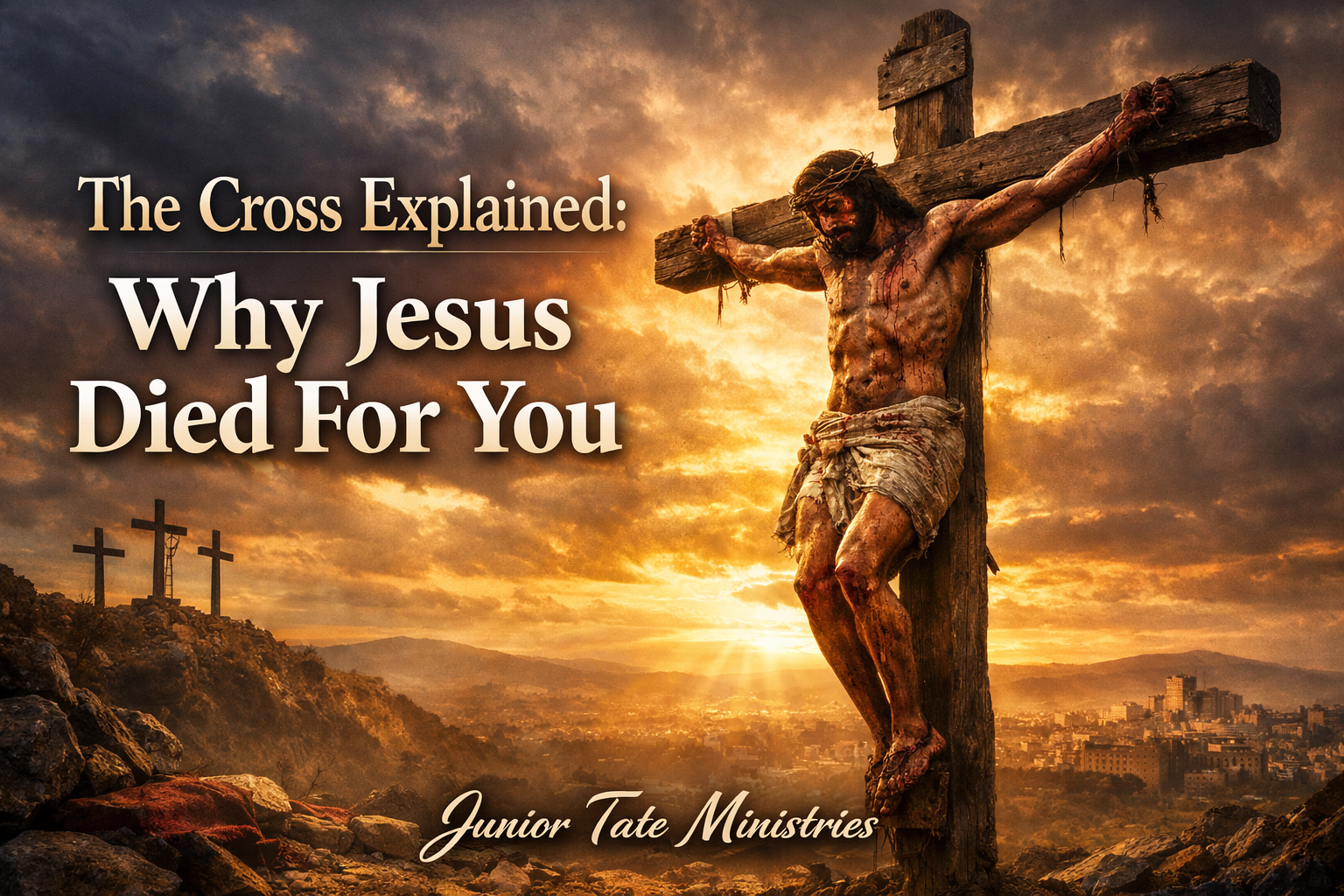
The Cross Explained: Why Jesus Died for YOU!

The Central Message of the Bible The cross of Jesus Christ is not merely a historical symbol, a religious emblem, or a decorative ornament—it is the very heart of God’s redemptive plan for mankind. From Genesis to Revelation, Scripture points toward one pivotal moment in human history: the death of Jesus Christ on the cross. Without the cross, there is no salvation, no forgiveness of sins, no reconciliation with God, and no eternal life. The Bible does not present the cross as an accident, tragedy, or afterthought. It was foreordained by God, prophesied centuries in advance, and fulfilled exactly according to Scripture. Jesus did not die because men were stronger than Him—He died because He willingly laid down His life in obedience to the Father, to redeem sinners who could not save themselves. This article will explain—using Scripture alone—why Jesus died, what the cross accomplished, and why it matters personally for you. The Problem the Cross Solved: Man’s Sin Problem Before the cross can be understood, the Bible is clear that humanity faces a universal problem: sin. What the Bible Says About Sin Romans 3:23 (KJV)- “For all have sinned, and come short of the glory of God;” Every human being—without exception—stands guilty before a holy God. Sin is not merely immoral behavior; it is rebellion against God’s authority, resulting in separation from Him. Isaiah 59:2 (KJV)- “But your iniquities have separated between you and your God, and your sins have hid his face from you, that he will not hear.” The Consequence of Sin Is Death Sin carries a penalty, and Scripture defines it clearly. Romans 6:23 (KJV)- “For the wages of sin is death; but the gift of God is eternal life through Jesus Christ our Lord.” This death is not only physical but spiritual—eternal separation from God. Ezekiel 18:4 (KJV)- “The soul that sinneth, it shall die.” Why Good Works Could Never Save Us Many believe that morality, religious effort, or good deeds can make them acceptable to God. Scripture directly rejects this idea. Ephesians 2:8–9 (KJV)- “For by grace are ye saved through faith; and that not of yourselves: it is the gift of God: Not of works, lest any man should boast.” Titus 3:5 (KJV)- “Not by works of righteousness which we have done, but according to his mercy he saved us…” If salvation could be earned, the cross would be unnecessary. But Scripture teaches the opposite: man is helpless to save himself. God’s Solution: A Substitute Because God is holy and just, sin must be punished. Yet because God is loving and merciful, He provided a substitute. The Pattern of Substitution in the Old Testament From the beginning, God taught that sin requires the shedding of blood. Genesis 3:21 (KJV)- “Unto Adam also and to his wife did the LORD God make coats of skins, and clothed them.” An animal died to cover their shame—pointing forward to a greater sacrifice. Leviticus 17:11 (KJV)- “For the life of the flesh is in the blood: and I have given it to you upon the altar to make an atonement for your souls: for it is the blood that maketh an atonement for the soul.” The Cross Was God’s Plan From the Beginning Jesus’ death was not unexpected—it was foretold. Isaiah’s Prophecy of the Cross Isaiah 53:5–6 (KJV) “But he was wounded for our transgressions, he was bruised for our iniquities: the chastisement of our peace was upon him; and with his stripes we are healed. All we like sheep have gone astray; we have turned every one to his own way; and the LORD hath laid on him the iniquity of us all.” This prophecy was written over 700 years before the crucifixion. Jesus: The Sinless Lamb For a sacrifice to be acceptable, it had to be without blemish. Jesus alone met that requirement. 1 Peter 1:18–19 (KJV)- “Forasmuch as ye know that ye were not redeemed with corruptible things…But with the precious blood of Christ, as of a lamb without blemish and without spot:” 2 Corinthians 5:21 (KJV)- “For he hath made him to be sin for us, who knew no sin; that we might be made the righteousness of God in him.” Jesus did not die for His own sins—He had none. Why Jesus Had to Die on the Cross The Curse of the Law Crucifixion was not random—it carried spiritual meaning. Deuteronomy 21:23 (KJV)- “For he that is hanged is accursed of God…” Galatians 3:13 (KJV)- “Christ hath redeemed us from the curse of the law, being made a curse for us…” Jesus took upon Himself the curse that belonged to us. What Happened at the Cross Jesus Bore Our Sins 1 Peter 2:24 (KJV)- “Who his own self bare our sins in his own body on the tree, that we, being dead to sins, should live unto righteousness…” God’s Wrath Was Satisfied Romans 3:25 (KJV)- “Whom God hath set forth to be a propitiation through faith in his blood…” The cross satisfied God’s justice while displaying His mercy. The Love of God Displayed at the Cross The cross reveals the depth of God’s love. Romans 5:8 (KJV)- “But God commendeth his love toward us, in that, while we were yet sinners, Christ died for us.” John 3:16 (KJV)- “For God so loved the world, that he gave his only begotten Son…” Jesus did not die for the righteous—but for sinners. The Cross Opened the Way to God When Jesus died, something supernatural happened. Matthew 27:50–51 (KJV)- “Jesus, when he had cried again with a loud voice, yielded up the ghost. And, behold, the veil of the temple was rent in twain from the top to the bottom…” The barrier between God and man was removed. Salvation Is Found Only Through the Cross There is no alternative way to God. John 14:6 (KJV)- “Jesus saith unto him, I am the way, the truth, and the life: no man cometh unto the Father, but by me.” Acts 4:12 (KJV)- “Neither is there salvation … Read more

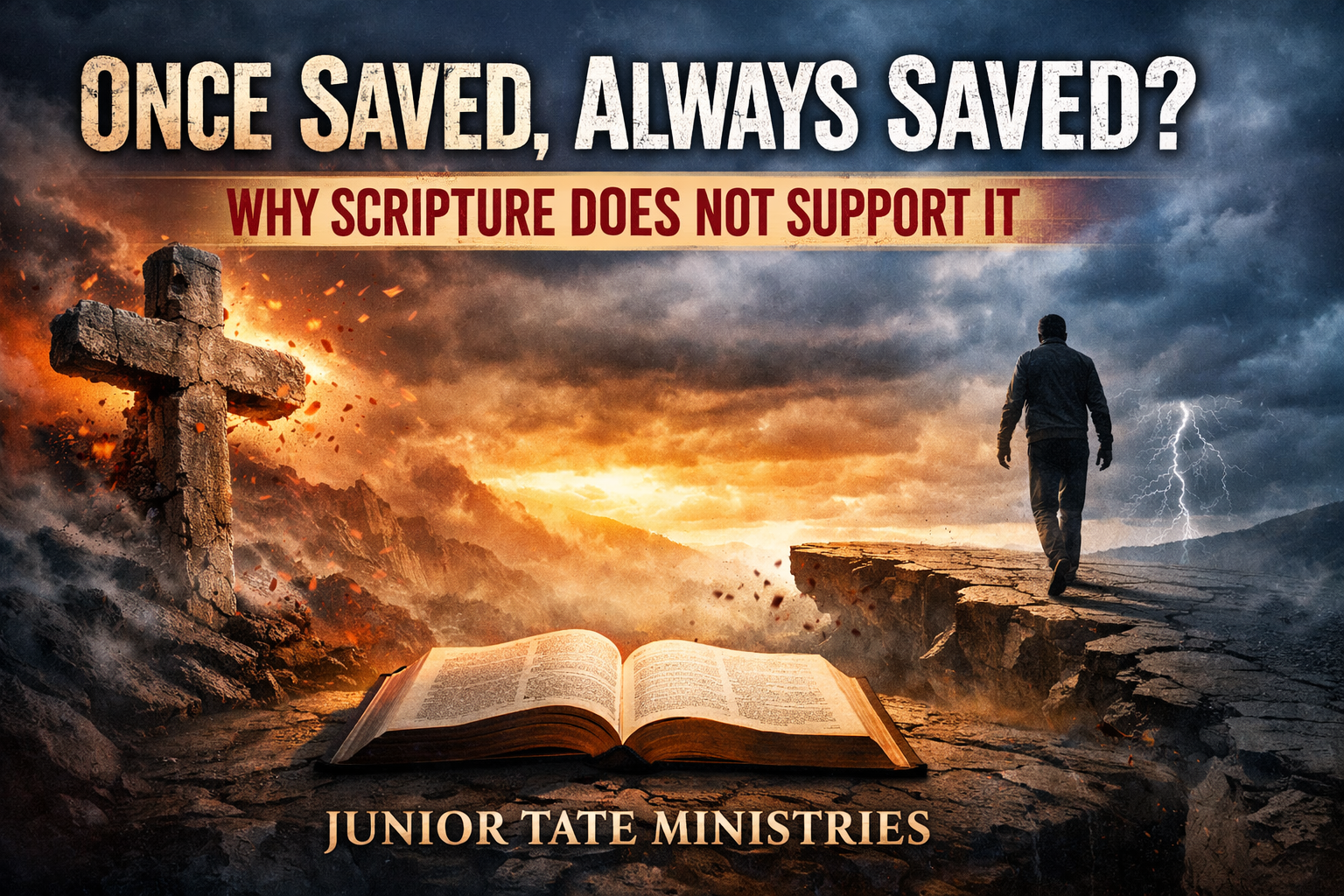
Once Saved, Always Saved? — Why Scripture Does NOT Support It (KJV)

Introduction: Why This Question Matters Few topics create more confusion—and more false assurance—than the phrase “Once Saved, Always Saved.” Many people use it to mean: “If I once prayed a prayer, walked an aisle, or made a profession of faith, then heaven is guaranteed no matter how I live afterward.” But when we let Scripture speak for itself, the Bible repeatedly teaches that saving faith is a living faith that continues, and that God gives real warnings to real people about departing, falling away, drawing back, and turning again into sin and unbelief. This article is not built on denominational traditions or emotional arguments. The goal is simple: Let the Bible define the doctrine. We will use the King James Version (KJV) and quote Scripture in full when we cite it. You can’t lose Salvation because it was a gift from Christ to start with, but you can forfeit Salvation by continually willful sinning. As Scripture says; you can depart from your faith and turn back to your old ways before Salvation. Salvation Is by Grace Through Faith — But Saving Faith Is Not “One Moment Then Done.” The Bible is clear: salvation is not earned by works, religious rituals, or moral improvement. Salvation is a gift of God. Ephesians 2:8–10 (KJV)“For by grace are ye saved through faith; and that not of yourselves: it is the gift of God:Not of works, lest any man should boast.For we are his workmanship, created in Christ Jesus unto good works, which God hath before ordained that we should walk in them.” Notice: we are saved by grace through faith—and we are created in Christ unto good works, not to earn salvation, but because a true new birth produces a new walk. Scripture also shows that a faith that has no fruit is not saving faith. James 2:17–20 (KJV)“Even so faith, if it hath not works, is dead, being alone.Yea, a man may say, Thou hast faith, and I have works: shew me thy faith without thy works, and I will shew thee my faith by my works.Thou believest that there is one God; thou doest well: the devils also believe, and tremble.But wilt thou know, O vain man, that faith without works is dead?” So, Scripture distinguishes between living faith and dead faith. A person can claim to believe, but if their “faith” is merely mental agreement with no transformation, the Bible says it is dead. The Bible Commands Believers to Continue and Endure — Not Assume A core problem with the OSAS slogan is that it can turn assurance into presumption—the idea that past words guarantee future salvation regardless of present reality. Scripture repeatedly calls God’s people to continue, hold fast, and endure. Continue in the Faith Colossians 1:21–23 (KJV)“And you, that were sometime alienated and enemies in your mind by wicked works, yet now hath he reconciledIn the body of his flesh through death, to present you holy and unblameable and unreproveable in his sight:If ye continue in the faith grounded and settled, and be not moved away from the hope of the gospel, which ye have heard, and which was preached to every creature which is under heaven; whereof I Paul am made a minister;” Note the word “If.” Paul describes reconciliation and God’s aim to present believers holy—if they continue and are not moved away. This is not “one-time profession no matter what.” Scripture ties salvation reality to perseverance in the faith. Hold Fast Hebrews 3:12–14 (KJV)“Take heed, brethren, lest there be in any of you an evil heart of unbelief, in departing from the living God.But exhort one another daily, while it is called To day; lest any of you be hardened through the deceitfulness of sin.For we are made partakers of Christ, if we hold the beginning of our confidence stedfast unto the end;” This passage is devastating to casual OSAS thinking. It warns “brethren” about an evil heart of unbelief that results in departing from the living God, and it declares we are made partakers of Christ if we hold our confidence steadfast unto the end. Endure to the End Matthew 24:12–13 (KJV)“And because iniquity shall abound, the love of many shall wax cold.But he that shall endure unto the end, the same shall be saved.” The Bible does not describe salvation as a permission slip to drift into iniquity. Christ warns that abounding sin can cool love, and then speaks plainly: endurance matters. Scripture Gives Real Warnings About Falling Away and Drawing Back If OSAS is meant to teach that falling away is impossible, then why does the Bible give repeated, serious warnings? Warnings in Hebrews: Turning Back Is Deadly Hebrews 10:26–29 (KJV)“For if we sin wilfully after that we have received the knowledge of the truth, there remaineth no more sacrifice for sins,But a certain fearful looking for of judgment and fiery indignation, which shall devour the adversaries.He that despised Moses’ law died without mercy under two or three witnesses:Of how much sorer punishment, suppose ye, shall he be thought worthy, who hath trodden under foot the Son of God, and hath counted the blood of the covenant, wherewith he was sanctified, an unholy thing, and hath done despite unto the Spirit of grace?” This warns against willful sin after receiving the knowledge of the truth, describing someone who trods under foot the Son of God, and treats the blood of the covenant as unholy—someone who had been sanctified in relation to that covenant. Now note the conclusion: Hebrews 10:38–39 (KJV)“Now the just shall live by faith: but if any man draw back, my soul shall have no pleasure in him.But we are not of them who draw back unto perdition; but of them that believe to the saving of the soul.” The Bible explicitly says some draw back unto perdition (destruction). True believers are described as those who believe to the saving of the soul—not those who coast on a past moment while living in rebellion. “Fallen From Grace” — Not … Read more

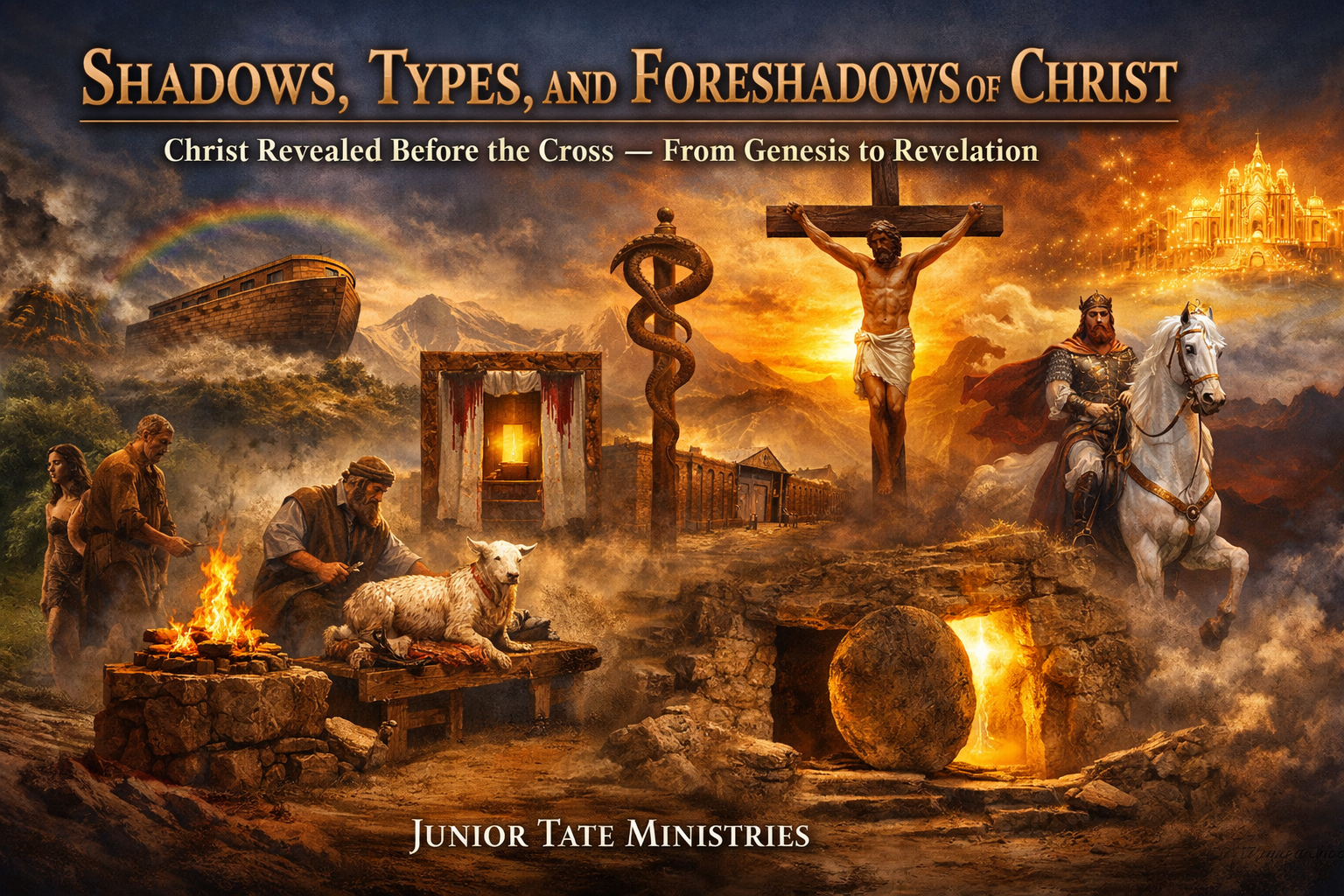
Christ Revealed from Genesis to Revelation — The Unbroken Story of Redemption

By Junior Tate Ministries GODS PLAN FOR THE WORLD! ONE PLAN, ONE REDEEMER, ONE BIBLE, The Bible is not divided in message or purpose. Though it contains many books written across centuries, it reveals one continuous story—God’s plan to redeem fallen mankind through Jesus Christ. Christ is not confined to the New Testament. He is revealed progressively from Genesis to Revelation. Jesus Himself confirmed this truth. Luke 24:27 (KJV) 27 And beginning at Moses and all the prophets, he expounded unto them in all the scriptures the things concerning himself. This article follows Scripture’s own testimony, showing how Christ is revealed by promise, pattern, prophecy, fulfillment, and final glory. CHRIST REVEALED IN GENESIS: CREATOR, PROMISED SEED, AND SUBSTITUTE Christ the Eternal Creator Genesis 1:1 (KJV) 1 In the beginning God created the heaven and the earth. While Genesis declares that God created, later Scripture reveals who was active in creation. John 1:1–3 (KJV) 1 In the beginning was the Word, and the Word was with God, and the Word was God.2 The same was in the beginning with God.3 All things were made by him; and without him was not any thing made that was made.Christ did not begin at Bethlehem. He existed before creation, is fully God, and is the Creator of all things. This establishes His authority to redeem what He created. The Fall of Man and the First Gospel Promise: The Promised Christ Genesis 3:15 (KJV) 15 And I will put enmity between thee and the woman, and between thy seed and her seed; it shall bruise thy head, and thou shalt bruise his heel. This verse introduces the entire redemptive conflict of Scripture. The “seed of the woman” points to a coming Deliverer who would suffer yet ultimately destroy Satan’s authority. This is the first declaration of the gospel, long before the Law or prophets. Blood Sacrifice Established Genesis 4:3–5 (KJV) 3 And in process of time it came to pass, that Cain brought of the fruit of the ground an offering unto the LORD.4 And Abel, he also brought of the firstlings of his flock and of the fat thereof. And the LORD had respect unto Abel and to his offering:5 But unto Cain and to his offering he had not respect. God accepted Abel’s offering because it involved blood. Cain’s offering represented human effort. From the beginning, God established that salvation does not come by works, but by substitutionary sacrifice. Abraham and Isaac — God Provides the Lamb: Christ as the Substitute Genesis 22:7–8 (KJV) 7 And Isaac spake unto Abraham his father, and said, My father… where is the lamb for a burnt offering?8 And Abraham said, My son, God will provide himself a lamb for a burnt offering. God declares He Himself will provide the sacrifice. This anticipates Christ, whom God would provide as the Lamb for the sins of the world. CHRIST REVEALED IN THE LAW: REDEMPTION SHADOWED AND TAUGHT The Passover Lamb Exodus 12:5–7, 13 (KJV)5 Your lamb shall be without blemish…6 …the whole assembly… shall kill it…7 And they shall take of the blood…13 And when I see the blood, I will pass over you. The Passover establishes God’s pattern for redemption with unmistakable clarity. The lamb had to be without blemish, showing that God requires perfection when dealing with sin. The lamb was slain publicly, not privately, showing that redemption was not hidden but openly acknowledged. Most importantly, the blood had to be applied. Simply believing the lamb existed was not enough—obedience to God’s command was required. Judgment did not pass over based on nationality, morality, or effort, but solely on the presence of the blood. This teaches that salvation is never earned; it is received through obedient faith in God’s provision. 1 Corinthians 5:7 (KJV)7 For even Christ our passover is sacrificed for us. Paul confirms that the Passover was never an end in itself. It was a shadow pointing forward to Christ. Just as the lamb died in place of the firstborn, Christ died in place of sinners. The same principle remains—deliverance comes only through the blood God has provided. The Tabernacle — Christ in Shadow Form Hebrews 8:5 (KJV)5 Who serve unto the example and shadow of heavenly things… The tabernacle was not designed by human imagination but by divine instruction. Every measurement, material, and function served as a teaching tool. The altar taught sacrifice. The veil taught separation. The priesthood taught mediation. None of these could remove sin permanently, but all of them pointed forward to the One who would.  The tabernacle reveals that access to God requires sacrifice, mediation, and holiness—needs fully met in Christ. The Law as a Schoolmaster Galatians 3:24 (KJV)24 Wherefore the law was our schoolmaster to bring us unto Christ… The Law exposes sin but offers no cure. It teaches mankind what righteousness looks like while simultaneously showing mankind’s inability to achieve it. By revealing guilt, the Law prepares the heart to seek a Savior. Christ does not oppose the Law; He fulfills its purpose by accomplishing what the Law could never do—remove sin completely. CHRIST REVEALED IN ISRAEL’S HISTORY: DELIVERER AND REDEEMER Joshua — Salvation Through Victory Joshua 1:9 (KJV)9 Have not I commanded thee? Be strong and of a good courage… Joshua leads Israel into the Promised Land, but he does not create the promise—he enforces what God already declared. Victory comes not through military strength but obedience to God’s Word. This mirrors Christ, who leads believers into spiritual rest, not by human effort, but by faith-filled obedience.  Just as Israel could not remain in the wilderness forever, believers are called to move forward in faith under Christ’s leadership. Ruth — The Kinsman-Redeemer Ruth 4:14 (KJV)14 Blessed be the LORD, which hath not left thee this day without a kinsman… The law of redemption required a redeemer to meet specific conditions. He had to be related by blood, willing to redeem, and able to pay the price. Boaz fulfills this role historically, but Christ fulfills it … Read more

What Must I Do to Be Saved? — The Most Important Question You Will Ever Ask!

There is no question more serious, more urgent, and more personal than this:“What must I do to be saved?” This is not a question about religion, church membership, or self-improvement. It is about your soul, your eternal destiny, and where you will spend forever. The Bible records this very question being asked nearly 2,000 years ago, and God has given a clear, unchanging answer. (Acts 16:30–31, KJV)  “And brought them out, and said, Sirs, what must I do to be saved?And they said, Believe on the Lord Jesus Christ, and thou shalt be saved, and thy house.” In this article, we will let Scripture speak for itself. We will not lean on opinions, traditions, or feelings, but on the Word of God alone. God has spoken clearly about: Why Do I Need to Be Saved? Many people think they are “basically good,” or “good enough for heaven.” But God’s Word tells us the truth about our condition. We are all sinners by nature and by choice (Romans 3:10–12, KJV)  “As it is written, There is none righteous, no, not one:There is none that understandeth, there is none that seeketh after God.They are all gone out of the way, they are together become unprofitable;there is none that doeth good, no, not one.” (Romans 3:23, KJV)  “For all have sinned, and come short of the glory of God;” God is perfectly holy. His standard is not “better than most people,” but His own perfect righteousness. To “come short of the glory of God” means that no matter how hard we try, we cannot reach His standard on our own. Sin is not just the “big” things (murder, theft, adultery); it includes every lie, every impure thought, every act of pride, every moment of rebellion against God. Sin has a serious consequence (Romans 6:23, KJV)  “For the wages of sin is death; but the gift of God is eternal life through Jesus Christ our Lord.” A “wage” is what you earn. Because of our sin, what we have earned is death. This includes physical death and, far more serious, spiritual death, eternal separation from God in hell. God’s Word also reminds us: (Hebrews 9:27, KJV)  “And as it is appointed unto men once to die, but after this the judgment:” Every person will die once, and after death comes judgment. This is why the question, “What must I do to be saved?” is not a theoretical question; it is a personal appointment every soul will face. Who Can Save Me? In a world of religions, ideas, and philosophies, many claim to offer a path to God. But the Bible is clear: only one Person can save you. Salvation is in a Person, not a system (John 14:6, KJV)  “Jesus saith unto him, I am the way, the truth, and the life:no man cometh unto the Father, but by me.” Jesus did not say He is a way or one of many ways. He said, “I am the way.” There is no other road, no back door, no alternate path to the Father. (Acts 4:12, KJV)  “Neither is there salvation in any other: for there is none other name under heaven given among men, whereby we must be saved.” Notice: “none other name.” Not our name, not a church’s name, not a prophet’s name, only the name of Jesus Christ. What did Jesus do to save us? The gospel is not just that Jesus was a good teacher or example. The Bible defines the gospel clearly: (1 Corinthians 15:3–4, KJV)  “For I delivered unto you first of all that which I also received,how that Christ died for our sins according to the scriptures;And that he was buried, and that he rose again the third day according to the scriptures:” This is how God showed His love for us: (Romans 5:8, KJV)  “But God commendeth his love toward us, in that, while we were yet sinners, Christ died for us.” God did not wait for us to become better or clean ourselves up. While we were still sinners, still guilty, still unworthy; Christ died for us. Salvation Is by Grace, Not by Works Most people naturally think: “If I live a good life, I’ll go to heaven.” But God’s Word says the exact opposite. (Ephesians 2:8–9, KJV)  “For by grace are ye saved through faith; and that not of yourselves:it is the gift of God: Not of works, lest any man should boast.” (Titus 3:5, KJV)  “Not by works of righteousness which we have done, but according to his mercy he saved us, by the washing of regeneration, and renewing of the Holy Ghost;” If we could save ourselves by good works, then salvation would not be a gift; it would be a wage we earned. But the Bible says salvation is entirely by grace (God’s undeserved favor) and “not of works.” No one will ever stand in heaven and say, “I am here because I was good enough.” All glory will go to the Lamb who was slain. What Must I Do to Be Saved? Now we return to the question of the Philippian jailer: (Acts 16:30–31, KJV)  “Sirs, what must I do to be saved?And they said, Believe on the Lord Jesus Christ, and thou shalt be saved, and thy house.” The answer God gives is clear: “Believe on the Lord Jesus Christ.” But what does that mean according to Scripture? You must repent Repentance is more than feeling sorry; it is a change of mind toward God and sin, a turning from sin and self to God. (Acts 17:30–31, KJV)  “And the times of this ignorance God winked at; but now commandeth all men everywhere to repent: Because he hath appointed a day, in the which he will judge the world in righteousness by that man whom he hath ordained; whereof he hath given assurance unto all men, in that he hath raised him from the dead.” (Luke 13:3, KJV)  “I tell you, Nay: but, except ye repent, ye shall all … Read more

Not Everyone Who Dies Goes to a Better Place — Only Those Saved by Christ Do!

Introduction One of the most common phrases spoken at funerals, memorials, and moments of grief is this: “They’re in a better place now.” While often said with compassion and good intentions, this statement is not universally true according to Scripture. The Bible does not teach that every person who dies automatically goes to heaven or enters a better place. Rather, Scripture consistently and clearly teaches that eternal destiny is determined by one’s relationship to Jesus Christ. This article will examine, strictly from Scripture, what the Bible actually says about life after death, heaven and hell, salvation through Christ alone, and why only those who are saved truly go to a better place. No personal opinions will be offered—only what the Word of God plainly declares. All Scripture quotations are taken from the King James Version (KJV). The Reality of Death According to Scripture Death is a universal certainty. Scripture affirms that every human being will face physical death, but it also teaches that death is not the end. Hebrews 9:27 (KJV)- “And as it is appointed unto men once to die, but after this the judgment:” This verse establishes two unchangeable truths: There is no suggestion here that death itself automatically leads to peace, rest, or a better place. Judgment follows death, and judgment implies accountability before God. What Jesus Taught About Life After Death Jesus Christ spoke more about eternity, heaven, and hell than any other figure in Scripture. His words are authoritative and unmistakable. John 5:28–29 (KJV)-  “Marvel not at this: for the hour is coming, in the which all that are in the graves shall hear his voice, And shall come forth; they that have done good, unto the resurrection of life; and they that have done evil, unto the resurrection of damnation.” Jesus teaches two distinct resurrections: Not all who die experience the same outcome. The Narrow Way vs. the Broad Way Jesus directly contradicted the idea that most people end up in a good place after death. Matthew 7:13–14 (KJV)- “Enter ye in at the strait gate: for wide is the gate, and broad is the way, that leadeth to destruction, and many there be which go in thereat: Because strait is the gate, and narrow is the way, which leadeth unto life, and few there be that find it.” According to Christ Himself: This alone disproves the notion that everyone who dies goes to a better place. The Rich Man and Lazarus: A Clear Picture from Jesus Jesus gave a vivid, unmistakable account of two men who died and went to two very different places. Luke 16:22–26 (KJV)- “And it came to pass, that the beggar died, and was carried by the angels into Abraham’s bosom: the rich man also died, and was buried; And in hell he lift up his eyes, being in torments, and seeth Abraham afar off, and Lazarus in his bosom. And he cried and said, Father Abraham, have mercy on me, and send Lazarus, that he may dip the tip of his finger in water, and cool my tongue; for I am tormented in this flame. But Abraham said, Son, remember that thou in thy lifetime receivedst thy good things, and likewise Lazarus evil things: but now he is comforted, and thou art tormented. And beside all this, between us and you there is a great gulf fixed: so that they which would pass from hence to you cannot; neither can they pass to us, that would come from thence.” Key truths from Jesus’ words: Only one of them went to a better place. Salvation Is the Determining Factor Scripture is explicit that salvation through Jesus Christ alone determines eternal destiny. John 14:6 (KJV)- “Jesus saith unto him, I am the way, the truth, and the life: no man cometh unto the Father, but by me.” There is no alternative route, no exception clause, and no universal pass into heaven. Why Good Works Cannot Save Many assume that being a “good person” ensures a better place after death. Scripture denies this completely. Ephesians 2:8–9 (KJV)- “For by grace are ye saved through faith; and that not of yourselves: it is the gift of God: Not of works, lest any man should boast.” Titus 3:5 (KJV)- “Not by works of righteousness which we have done, but according to his mercy he saved us, by the washing of regeneration, and renewing of the Holy Ghost;” Salvation is not earned—it is received through faith in Christ. The Condition of Those Who Are Not Saved Scripture does not soften or obscure the fate of those who reject Christ. John 3:18 (KJV)- “He that believeth on him is not condemned: but he that believeth not is condemned already, because he hath not believed in the name of the only begotten Son of God.” Condemnation is not postponed until death—it already exists for those outside of Christ. Hell Is a Real Place — Not a Metaphor Jesus repeatedly warned of hell as a literal place of punishment. Matthew 10:28 (KJV)- “And fear not them which kill the body, but are not able to kill the soul: but rather fear him which is able to destroy both soul and body in hell.” Revelation 20:15 (KJV)- “And whosoever was not found written in the book of life was cast into the lake of fire.” Hell is not symbolic. It is not temporary. It is not a better place. Eternal Life Is Only in Christ The Bible makes an exclusive claim regarding eternal life. 1 John 5:11–12 (KJV)-  “And this is the record, that God hath given to us eternal life, and this life is in his Son. He that hath the Son hath life; and he that hath not the Son of God hath not life.” There are only two categories: The Judgment Seat of Christ vs. the Great White Throne Scripture distinguishes between judgments for believers and unbelievers. 2 Corinthians 5:10 (KJV)- “For we must all appear before the judgment seat of Christ; that every one may receive the things done in his body, according to … Read more

“We Do NOT Become Angels When We Die — What the Bible Actually Teaches”(All Scripture quotations are from the King James Version)

By: Junior Tate Ministries Many people say things like, “Heaven gained another angel today,” or “When we die, we become angels watching over our loved ones.” These phrases are often spoken from a heart of love and comfort—but they are not what the Bible teaches. God’s Word is clear: humans and angels are two completely different kinds of created beings, with different purposes and different roles in God’s plan. When believers die, we do not become angels. Instead, the Bible reveals something far greater and more glorious for the redeemed in Christ. In this article, we will carefully walk through Scripture to see: We will let the Bible speak for itself and build our understanding from the Word of God—not from traditions, stories, or popular sayings. What Happens When We Die? The Bible teaches that death is not the end of our existence. Our body dies, but our soul and spirit continue. Death and Judgment Hebrews 9:27 – “And as it is appointed unto men once to die, but after this the judgment:” Every person has an appointment with death (unless they are alive at the rapture), and after death comes judgment. The Bible does not say, “After death we become angels,” but “after this the judgment.” Believers Are Present with the Lord For those who are saved, death brings them immediately into the presence of the Lord. 2 Corinthians 5:8 – “We are confident, I say, and willing rather to be absent from the body, and to be present with the Lord.” Paul teaches that to be “absent from the body” (physical death) is to be “present with the Lord” for the believer. He says nothing about changing into angels; instead, he speaks of being with Christ. Paul also says: Philippians 1:23 – “For I am in a strait betwixt two, having a desire to depart, and to be with Christ; which is far better:” To “depart” this life is to “be with Christ.” This is the believer’s hope—not becoming an angel, but being in the presence of the Savior.  The Unbeliever’s Condition After Death Jesus gives us a serious picture of what happens to the unsaved after death in Luke 16. Luke 16:22–23 –“And it came to pass, that the beggar died, and was carried by the angels into Abraham’s bosom: the rich man also died, and was buried; And in hell he lift up his eyes, being in torments, and seeth Abraham afar off, and Lazarus in his bosom.” Notice two important truths: Again, Scripture shows a clear distinction between humans and angels. Angels serve in God’s plan around death, but the dead person does not turn into an angel. How God Created Humans and Angels Differently To understand why we do not become angels, we must see how God created each group. Humanity Created in God’s Image From the beginning, God tells us something unique about humans: Genesis 1:26–27 –“And God said, Let us make man in our image, after our likeness: and let them have dominion over the fish of the sea, and over the fowl of the air, and over the cattle, and over all the earth, and over every creeping thing that creepeth upon the earth.So God created man in his own image, in the image of God created he him; male and female created he them.” Humans are made in the image of God. The Bible never says this about angels. God also formed man uniquely: Genesis 2:7 – “And the LORD God formed man of the dust of the ground, and breathed into his nostrils the breath of life; and man became a living soul.” We see God personally forming man and breathing into him. Humanity has a special place and relationship in God’s creation. Angels Created as Ministering Spirits The Bible also speaks clearly about the nature and role of angels: Colossians 1:16 – “For by him were all things created, that are in heaven, and that are in earth, visible and invisible, whether they be thrones, or dominions, or principalities, or powers: all things were created by him, and for him:” Angels are part of the “invisible” creation—thrones, dominions, principalities, and powers. They are created beings, but different in nature from mankind. Hebrews describes their role: Hebrews 1:13–14 –“But to which of the angels said he at any time, Sit on my right hand, until I make thine enemies thy footstool?Are they not all ministering spirits, sent forth to minister for them who shall be heirs of salvation?” Angels are ministering spirits. They serve those who will inherit salvation—but they are not the ones inheriting salvation in the way humans do. They serve the redeemed; they are not the redeemed. This same chapter emphasizes that the Son (Jesus Christ) is better than the angels, and that believers are brought into sonship with God through Christ (see Hebrews 1 and 2). Humans Are Lower Than Angels Now—but Will Be Exalted in Christ Right now, humans are in a lower position than angels in strength and glory, but that is temporary. Made a Little Lower Than the Angels The psalmist writes: Psalm 8:4–5 –“What is man, that thou art mindful of him? and the son of man, that thou visitest him?For thou hast made him a little lower than the angels, and hast crowned him with glory and honour.” Man is “a little lower than the angels” at present. Hebrews applies this also to Christ in His incarnation: Hebrews 2:7–9 –“Thou madest him a little lower than the angels; thou crownedst him with glory and honour, and didst set him over the works of thy hands: Thou hast put all things in subjection under his feet. For in that he put all in subjection under him, he left nothing that is not put under him. But now we see not yet all things put under him. But we see Jesus, who was made a little lower than the angels for the suffering of death, crowned with glory and honour; that … Read more

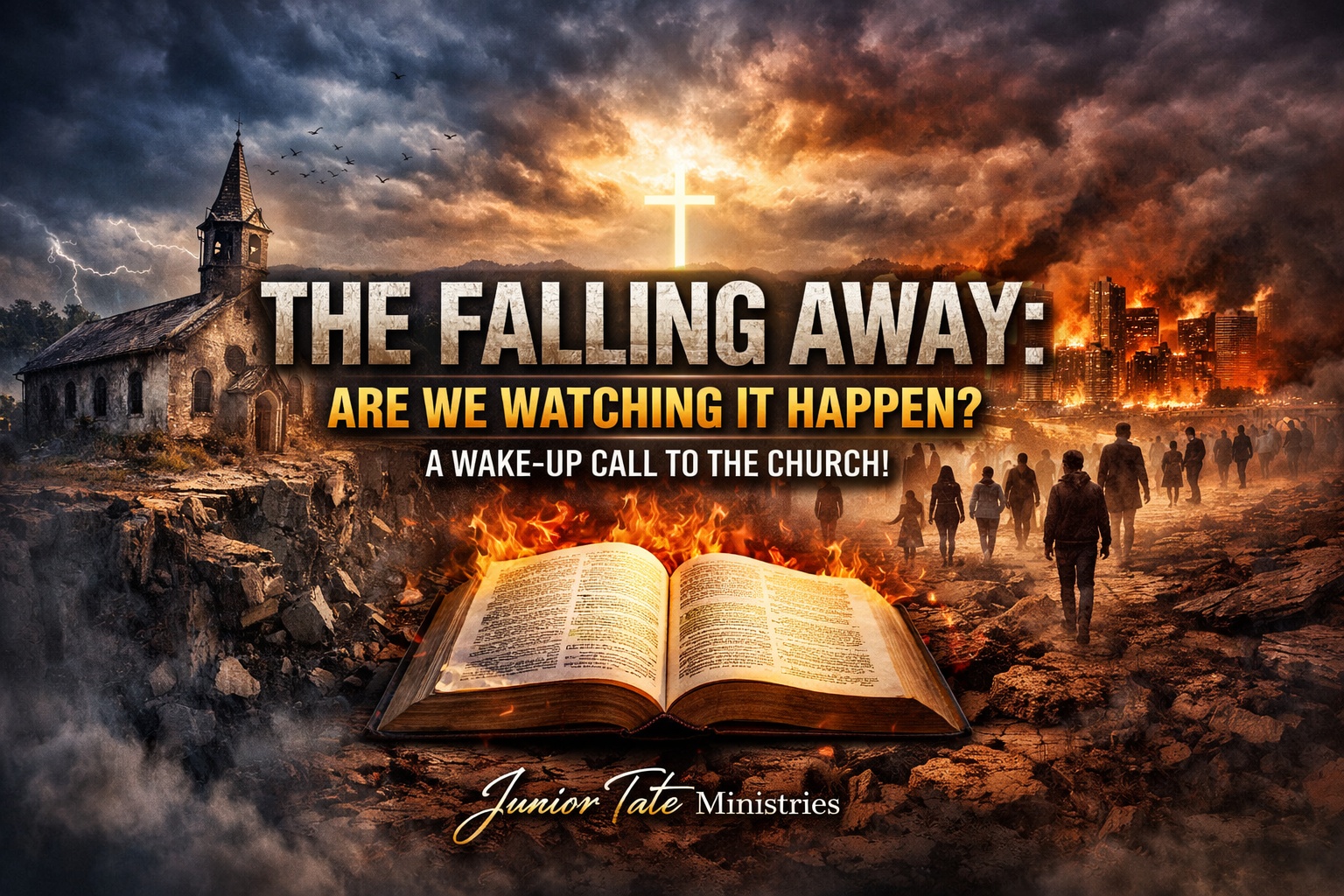
THE FALLING AWAY: ARE WE WATCHING IT HAPPEN?

A Biblical Examination of End-Time ApostasyBy Junior Tate Ministries Introduction The Bible teaches that before the return of Jesus Christ and the revealing of the Antichrist, there will be a dramatic and unmistakable falling away, a departure from the faith that once defined true biblical Christianity. This falling away is not speculation, cultural commentary, or personal interpretation. It is prophesied clearly and repeatedly in the Word of God. The apostle Paul, the Lord Jesus Christ, Peter, Jude, and John, all warned that in the last days many would turn away from sound doctrine, follow false teachers, embrace doctrines of devils, and reject the truth. As we examine the world, the modern church landscape, and the rapid spiritual drift taking place, the question becomes urgent: Are we watching the falling away happen before our very eyes? This article explores that question in detail, using complete KJV Scripture, with no opinions added, so we can understand the prophetic hour we are living in and the responsibility of believers to contend for the faith, stand on truth, and remain faithful until Christ returns. THE BIBLICAL FOUNDATION OF THE FALLING AWAY The central prophecy concerning the falling away is found in 2 Thessalonians 2:3 (KJV): “Let no man deceive you by any means: for that day shall not come, except there come a falling away first, and that man of sin be revealed, the son of perdition.” Paul tells us that “that day.” the Day of the Lord, connected to God’s judgment and the revealing of the Antichrist, will not come until something major happens first: The Falling Away. The Greek word is apostasia, meaning departure, defection, or rebellion. It refers to a departure from Biblical truth, not a departure from culture or tradition. Paul says this event is massive, and world-changing, marking the final stage before the rise of the Antichrist. Jesus also spoke directly about this end-time apostasy in Matthew 24:10–12 (KJV): “And then shall many be offended, and shall betray one another, and shall hate one another. And many false prophets shall rise, and shall deceive many. And because iniquity shall abound, the love of many shall wax cold.” Jesus described: He did not say “few.” He said many. APOSTASY IN THE LAST DAYS IS A MAJOR BIBLICAL WARNING The Bible does not treat apostasy as a minor issue. It presents it as one of the major signs of the end times. The Spirit Speaks “Expressly” About It 1 Timothy 4:1 (KJV): “Now the Spirit speaketh expressly, that in the latter times some shall depart from the faith, giving heed to seducing spirits, and doctrines of devils.” Paul emphasizes that the Holy Spirit speaks expressly, clearly and unmistakably about this. Key warnings: This falling away is not random; it is spiritually engineered by demonic influence. People Will Turn Away From Truth 2 Timothy 4:3–4 (KJV): “For the time will come when they will not endure sound doctrine; but after their own lusts shall they heap to themselves teachers, having itching ears; And they shall turn away their ears from the truth, and shall be turned unto fables.” This describes our world today with astonishing accuracy: False Teachers Will Increase 2 Peter 2:1–2 (KJV): “But there were false prophets also among the people, even as there shall be false teachers among you, who privily shall bring in damnable heresies…” Peter warns: The falling away is not a small minority drifting! Scripture says many. THE CHARACTER OF THOSE WHO FALL AWAY The Bible doesn’t just say that people will fall away, it describes what they will look like and how they will behave. Lovers of Pleasure More Than Lovers of God 2 Timothy 3:1–5 (KJV): “This know also, that in the last days perilous times shall come.For men shall be lovers of their own selves… lovers of pleasures more than lovers of God;Having a form of godliness, but denying the power thereof: from such turn away.” Many will: They Will Reject Sound Doctrine Apostasy begins with refusing truth. Jesus said in John 17:17 (KJV): “Sanctify them through thy truth: thy word is truth.” When people reject the Word: They Will Walk After Their Own Lusts Jude 18–19 (KJV): “How that they told you there should be mockers in the last time, who should walk after their own ungodly lusts. These be they who separate themselves, sensual, having not the Spirit.” Apostasy is not intellectual, it is moral. People turn from truth because truth confronts sin. HOW THE FALLING AWAY IS OCCURRING TODAY Based on Scripture alone, there are several unmistakable signs that we are witnessing this falling away right now. The Rejection of Biblical Authority Millions now treat the Bible as optional.Churches debate issues the Bible settled thousands of years ago. But Scripture says: Psalm 119:89 (KJV): “For ever, O LORD, thy word is settled in heaven.” Isaiah 40:8 (KJV): “The grass withereth, the flower fadeth: but the word of our God shall stand for ever.” The modern world questions what God says.The falling church questions why God said it. Churches Turning Toward the World Instead of the church influencing the world, the world is influencing the church. Jesus prayed in John 17:15–16 (KJV): “I pray not that thou shouldest take them out of the world, but that thou shouldest keep them from the evil. They are not of the world” But today: This is a major sign of apostasy. The Rise of False Gospels Paul warned in Galatians 1:8–9 (KJV): “But though we, or an angel from heaven, preach any other gospel unto you than that which we have preached unto you, let him be accursed.” Today we see: These are not the gospel of Christ.They are the foundation of apostasy. The Explosion of False Teachers Online Jesus warned that many false prophets shall rise (Matthew 24:11). Today: THE FALLING AWAY AND THE RISE OF THE ANTICHRIST The Bible connects apostasy directly to the appearance of the Antichrist. 2 Thessalonians 2:3 (KJV) says the falling away happens first, then: “that man … Read more

“The Twelve – Ordinary Men, Extraordinary Missions.” A Bible-Based Study Into the Lives of the Disciples.

By: Junior Tate Ministries God’s Pattern – Ordinary People, Extraordinary Work From Genesis to Revelation, God delights in using ordinary people to accomplish extraordinary things. The twelve men whom Jesus chose as His apostles were not famous scholars, political leaders, or wealthy influencers. They were fishermen, a tax collector, a former zealot, and men with weaknesses, fears, and failures—just like us. Yet under the hand of Christ and in the power of the Holy Ghost, these ordinary men were sent on an extraordinary mission: to take the gospel from a small region in Israel to the “uttermost part of the earth.” The Bible describes God’s method plainly: “For ye see your calling, brethren, how that not many wise men after the flesh, not many mighty, not many noble, are called:  But God hath chosen the foolish things of the world to confound the wise; and God hath chosen the weak things of the world to confound the things which are mighty; And base things of the world, and things which are despised, hath God chosen, yea, and things which are not, to bring to nought things that are, that no flesh should glory in his presence.”  (1 Corinthians 1:26–29, KJV) The story of the Twelve is a living example of this truth. Jesus Chooses the Twelve The choosing of the Twelve was not random, rushed, or accidental. It was done in perfect obedience to the Father’s will, bathed in prayer. “And it came to pass in those days, that he went out into a mountain to pray, and continued all night in prayer to God. And when it was day, he called unto him his disciples: and of them he chose twelve, whom also he named apostles.” (Luke 6:12–13, KJV) Mark tells us more about their purpose: “And he ordained twelve, that they should be with him, and that he might send them forth to preach, And to have power to heal sicknesses, and to cast out devils.” (Mark 3:14–15, KJV) Notice three key things: They were ordinary men—but chosen and ordained by an extraordinary Lord. Their Ordinary Backgrounds Fishermen: Peter, Andrew, James, and John Several of the Twelve were fishermen—hard-working, common men with calloused hands and simple lives. “And Jesus, walking by the sea of Galilee, saw two brethren, Simon called Peter, and Andrew his brother, casting a net into the sea: for they were fishers. And he saith unto them, Follow me, and I will make you fishers of men. And they straightway left their nets, and followed him. And going on from thence, he saw other two brethren, James the son of Zebedee, and John his brother, in a ship with Zebedee their father, mending their nets; and he called them. And they immediately left the ship and their father, and followed him.” (Matthew 4:18–22, KJV) There was nothing remarkable in the world’s eyes about these men. Yet when Jesus called, they immediately left what was familiar to follow Him. A Tax Collector: Matthew (Levi) Tax collectors were despised in Israel as collaborators with Rome and sinners.  “And as he passed by, he saw Levi the son of Alphaeus sitting at the receipt of custom, and said unto him, Follow me. And he arose and followed him.” (Mark 2:14, KJV) Matthew’s former life as a tax collector shows that Christ can redeem even a hated profession and turn a man into a Gospel writer and witness of grace. A Zealot: Simon the Canaanite Simon is called “Simon the Canaanite” in Matthew’s list of the apostles (Matthew 10:4, KJV). Luke identifies him as “Simon called Zelotes” (Luke 6:15, KJV). These titles refer to the same disciple and highlight the idea of zeal—an intensity of conviction and passion that, in that era, was often associated with strong resistance to Roman rule. It’s important not to confuse Simon with Judas Iscariot. Matthew lists them one after the other: “Simon the Canaanite, and Judas Iscariot, who also betrayed him” (Matthew 10:4, KJV). Judas is a different man, and the phrase “who also betrayed him” is describing Judas, not Simon. Luke makes this distinction explicit by listing “Simon called Zelotes” and then separately naming “Judas Iscariot, which also was the traitor” (Luke 6:15–16, KJV). Jesus took a man known for intensity and redirected that zeal toward the kingdom of God. Whatever Simon’s passions had been before, Christ formed him into a witness whose loyalty was no longer driven by politics, but by the Person of Christ and the mission of the gospel. Their Weaknesses and Failures These twelve were not spiritual super-heroes. The Scriptures honestly record their arguments, fears, doubts, and failures. Peter: Bold and Broken Peter is often the spokesman of the group, quick to speak and quick to stumble. After Peter confessed Jesus as the Christ (Matthew 16:16), he later denied Him three times. Before this failure, Jesus warned him: “And the Lord said, Simon, Simon, behold, Satan hath desired to have you, that he may sift you as wheat:But I have prayed for thee, that thy faith fail not: and when thou art converted, strengthen thy brethren.” (Luke 22:31–32, KJV) When Peter did deny Christ, the Bible describes his deep sorrow: “And the Lord turned, and looked upon Peter. And Peter remembered the word of the Lord, how he had said unto him, Before the cock crow, thou shalt deny me thrice. And Peter went out, and wept bitterly.” (Luke 22:61–62, KJV) Peter was an ordinary man prone to fear, yet Jesus prayed for him and later used him mightily. Thomas: Doubting Then Declaring Thomas is often remembered as “doubting Thomas,” but Scripture gives us a fuller picture. When Jesus was going back toward danger in Judea: “Then said Thomas, which is called Didymus, unto his fellow disciples, Let us also go, that we may die with him.” (John 11:16, KJV)  Later, after the resurrection, Thomas struggled to believe: “Then saith he to Thomas, reach hither thy finger, and behold my hands; and reach hither thy hand, and … Read more

THE DAYS OF NOAH AND THE RETURN OF CHRIST

A Biblical Examination of the Last Days Through Scripture alone (KJV) By Junior Tate Ministries Introduction The return of Jesus Christ is the blessed hope of every believer. Scripture teaches that the coming of the Lord will be sudden, visible, and global. Jesus Himself gives us one of the clearest indicators of the timing and character of His return when He says the last days will resemble “the days of Noah.” This is not a vague or mystical comparison. Jesus points us to a historical period filled with specific moral conditions, spiritual realities, and global events. In Matthew 24, Jesus does not direct us to speculation, philosophy, or human opinion, but to divine history recorded in the Word of God. By understanding the days of Noah, we gain insight into the world conditions leading up to Christ’s Second Coming. This article will examine: This study is rooted in complete KJV Scripture, carefully explained with Scripture interpreting Scripture. Jesus’ Own Warning: “As the Days of Noah Were” The foundation for this entire study is found in Jesus’ words: Matthew 24:37–39 (KJV) 37 But as the days of Noe were, so shall also the coming of the Son of man be.38 For as in the days that were before the flood they were eating and drinking, marrying and giving in marriage, until the day that Noe entered into the ark,39 And knew not until the flood came, and took them all away; so shall also the coming of the Son of man be. Jesus teaches four essential truths about the last days: This is not speculation. Jesus makes the comparison Himself. So we must ask: What exactly were the days of Noah like? To answer that, we go to Genesis 6. The Moral and Spiritual Condition of Noah’s Day Extreme Wickedness Filled the Earth Genesis 6:5 (KJV) 5 And GOD saw that the wickedness of man was great in the earth, and that every imagination of the thoughts of his heart was only evil continually. The wickedness of mankind was: When Jesus said the last days would be like this, He meant moral corruption would not be occasional or limited, but worldwide and constant. The Earth Was Filled With Violence Genesis 6:11–12 (KJV) 11 The earth also was corrupt before God, and the earth was filled with violence.12 And God looked upon the earth, and, behold, it was corrupt; for all flesh had corrupted his way upon the earth. Violence was not regional; it was global. Society had normalized it. Humanity had “corrupted his way,” meaning people rejected the ways of God and embraced their own ways. Jesus says the world before His coming will mirror this. The Fallen Angels and Their Offspring in the Days of Noah Another defining characteristic of the days of Noah was the unnatural corruption brought into humanity when fallen angels; referred to in Scripture as “sons of God” left their proper place and took human women as wives. This union produced a race of giants, contributing to the deep moral decay that filled the earth. The Bible states clearly: Genesis 6:1–4 (KJV) 1 And it came to pass, when men began to multiply on the face of the earth, and daughters of men were born unto them,2 That the sons of God saw the daughters of men that they were fair; and they took them wives of all which they chose.3 And the LORD said, My spirit shall not always strive with man, for that he also is flesh: yet his days shall be an hundred and twenty years.4 There were giants in the earth in those days; and also after that, when the sons of God came in unto the daughters of men, and they bare children to them, the same became mighty men which were of old, men of renown. These “sons of God” are understood in Scripture to be angels. Job uses the same term: Job 1:6 (KJV) 6 Now there was a day when the sons of God came to present themselves before the LORD, and Satan came also among them. Jude explains that certain angels left their original habitation—their God-given order—and committed great sin in the days before the Flood. These angels are now held in chains awaiting judgment. Jude 6 (KJV) 6 And the angels which kept not their first estate, but left their own habitation, he hath reserved in everlasting chains under darkness unto the judgment of the great day. Peter also refers to this same incident when he writes: 2 Peter 2:4 (KJV) 4 For if God spared not the angels that sinned, but cast them down to hell, and delivered them into chains of darkness, to be reserved unto judgment… This angelic rebellion, combined with human wickedness, filled the earth with corruption and violence, accelerating God’s judgment. Jesus’ comparison of His return to “the days of Noah” means that the world will again experience widespread spiritual rebellion, demonic deception, and intensified supernatural darkness, just as it was when fallen angels influenced humanity before the Flood. Humanity Rejected the Preaching of Righteousness Noah was not simply a builder; he was a preacher. 2 Peter 2:5 (KJV) 5 And spared not the old world, but saved Noah the eighth person, a preacher of righteousness, bringing in the flood upon the world of the ungodly. For over a hundred years, Noah warned the people of God’s judgment. The world ignored him. They dismissed his message. Likewise, in the last days: 2 Peter 3:3–4 (KJV) 3 Knowing this first, that there shall come in the last days scoffers, walking after their own lusts,4 And saying, Where is the promise of his coming? for since the fathers fell asleep, all things continue as they were from the beginning of the creation. Mockery and unbelief will fill the earth; just like in Noah’s day. Noah Found Grace, Not Because of Merit But Because of God’s Favor Genesis 6:8 (KJV) 8 But Noah found grace in the eyes of the LORD. Even in … Read more

Good People Don’t Go to Heaven — Forgiven People Do

(All Scripture quotations are from the King James Version) By Junior Tate Ministries A Common but Dangerous Misunderstanding Many people today believe that “good people” go to heaven. They measure goodness by human standards, being kind, honest most of the time, helping others, going to church occasionally, or simply “trying their best.” But the Word of God gives a very different picture. According to Scripture, heaven is not the reward of “good people,” but the gift of a holy God to forgiven sinners who have been saved by grace through faith in Jesus Christ. This article is not based on human opinion or religious tradition. It is built on the clear teaching of the Bible. When we simply let God speak through His Word, we quickly see that no one is good enough, everyone is guilty, and only those who are forgiven through Christ will enter heaven. God’s Standard Is Not “Good”: It Is Perfect Holiness Most people compare themselves to other people. “I’m not perfect,” they say, “but I’m better than a lot of folks.” The problem is, God does not compare us with other sinners. He measures us by His own perfect righteousness. Peter writes: 1 Peter 1:15–16 (KJV) “But as he which hath called you is holy, so be ye holy in all manner of conversation; Because it is written, Be ye holy; for I am holy.” God is holy; completely pure, without sin, spotless in His character and ways. His standard for entering His presence is not “overall goodness” but absolute holiness. Jesus set that same standard: Matthew 5:48 (KJV) “Be ye therefore perfect, even as your Father which is in heaven is perfect.” This is not a suggestion. It is a divine requirement. To stand before a holy God on our own merits would require perfection, not just being “better than most,” but completely sinless in thought, word, and deed. The Bible Declares That No One Is Truly Good Once we understand God’s standard, we quickly see the problem. The Bible clearly and repeatedly states that no one is righteous in themselves. Romans 3:10–12 (KJV) “As it is written, There is none righteous, no, not one:There is none that understandeth, there is none that seeketh after God.They are all gone out of the way, they are together become unprofitable;there is none that doeth good, no, not one.” This is God’s verdict on the entire human race. Not one person, in his or her natural condition, meets God’s righteous standard. Later in the same chapter, Paul writes: Romans 3:23 (KJV) “For all have sinned, and come short of the glory of God;” “All” means everyone; moral people, religious people, church members, preachers, and so-called “good people.” We have all sinned. We have all “come short” of God’s glory, His holy standard. Even what we think of as “righteousness” is corrupted by sin: Isaiah 64:6 (KJV) “But we are all as an unclean thing, and all our righteousnesses are as filthy rags; and we all do fade as a leaf; and our iniquities, like the wind, have taken us away.” Notice it says “our righteousnesses,” not our worst deeds, but our very best efforts are like “filthy rags” before a holy God. Good works cannot erase guilt. They cannot wash away sin. James adds: James 2:10 (KJV) “For whosoever shall keep the whole law, and yet offend in one point, he is guilty of all.” God’s law is like a chain. Break one link, and the whole chain is broken. One sin makes us a lawbreaker. One violation brings guilt. By this standard, every person stands condemned apart from God’s mercy. Even Jesus Denied the Idea of Human “Goodness” When a morally upright young man came to Jesus and called Him “good,” the Lord used that moment to correct his wrong view of goodness. Mark 10:17–18 (KJV) “And when he was gone forth into the way, there came one running, and kneeled to him, and asked him, Good Master, what shall I do that I may inherit eternal life?And Jesus said unto him, Why callest thou me good? there is none good but one, that is, God.” Jesus was not denying His own deity; He was exposing the young man’s shallow understanding of “good.” According to Jesus, only God is truly good. Any goodness we think we have is far below the perfect goodness of God. If “good people” went to heaven based on their own goodness, Jesus would have told this man what “good deed” to do to earn eternal life. Instead, the Lord exposed the man’s heart and showed him that he was not ready to submit to God (Mark 10:19–22). Human goodness will always fall short of saving faith. A Parable That Destroys the “Good Person” Illusion Jesus told a powerful parable to confront those who trusted in their own goodness: Luke 18:9–14 (KJV) “And he spake this parable unto certain which trusted in themselves that they were righteous, and despised others: Two men went up into the temple to pray; the one a Pharisee, and the other a publican. The Pharisee stood and prayed thus with himself, God, I thank thee, that I am not as other men are, extortioners, unjust, adulterers, or even as this publican.I fast twice in the week, I give tithes of all that I possess.And the publican, standing afar off, would not lift up so much as his eyes unto heaven,but smote upon his breast, saying, God be merciful to me a sinner.I tell you, this man went down to his house justified rather than the other:for every one that exalteth himself shall be abased; and he that humbleth himself shall be exalted.” The Pharisee represents the “good person” who measures himself against others. He boasts in his religious works and morality. The publican (tax collector) represents the sinner who knows he is unworthy and cries out for mercy. Jesus said the publican, not the Pharisee, went home “justified.” To be justified means to be declared righteous … Read more