
By: Junior Tate
What the Early Church Endured for the Name of Jesus
The book of Acts records the birth, growth, persecution, endurance, and expansion of the early Church. It begins with the risen Jesus Christ commissioning His disciples to be witnesses and ends with the apostle Paul preaching the kingdom of God while under Roman custody. Between those two points, Acts records an unmistakable truth; following Jesus Christ could be costly.
The early Christians did not follow Christ because discipleship promised them an easy life. They followed Him because they believed He had risen from the dead and that He alone was Lord and Saviour. Their faith brought them into conflict with religious authorities, political rulers, violent mobs, false accusers, prison systems, and a culture that often rejected the Gospel they preached.
Some were threatened.
Some were beaten.
Some lost freedom.
Some were driven from their homes.
Some were imprisoned.
Some were falsely accused.
Some were stoned.
Some were killed.
Yet persecution did not silence the Gospel.
The book of Acts is not primarily a book about suffering. It is a book about the continuing work of Jesus Christ through the Holy Ghost and His witnesses. However, suffering repeatedly appears because the Gospel entered a world that did not always welcome its message.
The cost of following Christ in Acts therefore cannot be separated from the mission Christ gave His followers.
Christ Called His Disciples to Be Witnesses
Before Jesus ascended into Heaven, He told His disciples that they would receive power from the Holy Ghost and become His witnesses.
Acts 1:6-8 (KJV)
“When they therefore were come together, they asked of him, saying, Lord, wilt thou at this time restore again the kingdom to Israel?
And he said unto them, It is not for you to know the times or the seasons, which the Father hath put in his own power.
But ye shall receive power, after that the Holy Ghost is come upon you: and ye shall be witnesses unto me both in Jerusalem, and in all Judaea, and in Samaria, and unto the uttermost part of the earth.”
The mission was enormous.
They were to begin in Jerusalem, the very city where Jesus had been rejected and crucified. From there the Gospel would move into Judaea, Samaria, and eventually toward the uttermost part of the earth.
Jesus did not promise that everyone would welcome them.
He promised power to witness.
The word “witness” is important throughout Acts. These men testified to what they knew concerning Jesus Christ, especially His resurrection. Their message was not merely a philosophy or moral system. They declared that Jesus had died, risen from the dead, and was Lord.
That testimony immediately began to create opposition.
The Gospel Was Preached Boldly in Jerusalem
After the Holy Ghost came at Pentecost, Peter preached publicly concerning Jesus Christ.
Acts 2:22-24 (KJV)
“Ye men of Israel, hear these words; Jesus of Nazareth, a man approved of God among you by miracles and wonders and signs, which God did by him in the midst of you, as ye yourselves also know:
Him, being delivered by the determinate counsel and foreknowledge of God, ye have taken, and by wicked hands have crucified and slain:
Whom God hath raised up, having loosed the pains of death: because it was not possible that he should be holden of it.”
Peter openly declared that Jesus had been crucified and raised from the dead.
This was courageous because the same city had recently witnessed the crucifixion of Christ. The apostles were not preaching in a distant place where no one knew what had happened. They were speaking openly in Jerusalem.
Thousands believed the Gospel, but opposition soon appeared.
Peter and John Are Arrested for Preaching Jesus
Acts chapter 3 records the healing of a lame man at the temple. Peter used the miracle as an opportunity to preach Christ. The religious authorities responded by arresting Peter and John.
Acts 4:1-4 (KJV)
“And as they spake unto the people, the priests, and the captain of the temple, and the Sadducees, came upon them,
Being grieved that they taught the people, and preached through Jesus the resurrection from the dead.
And they laid hands on them, and put them in hold unto the next day: for it was now eventide.
Howbeit many of them which heard the word believed; and the number of the men was about five thousand.”
The apostles were imprisoned because they preached Jesus and the resurrection.
Notice the contrast.
The preachers were arrested, but the Gospel continued working.
They were put in custody, but many believed.
Opposition could restrain the messengers temporarily, but it could not imprison the Word of God.
Following Christ had already begun to cost the apostles their freedom.
Peter Refuses to Stop Speaking of Christ
The rulers questioned Peter and John and commanded them not to speak or teach in the name of Jesus.
Acts 4:18-20 (KJV)
“And they called them, and commanded them not to speak at all nor teach in the name of Jesus.
But Peter and John answered and said unto them, Whether it be right in the sight of God to hearken unto you more than unto God, judge ye.
For we cannot but speak the things which we have seen and heard.”
This passage establishes an important principle.
The apostles respected authority, but when earthly authority commanded them to disobey God, their loyalty to God came first.
They did not organize violence.
They did not threaten the rulers.
They simply refused to stop speaking about Jesus.
Their words were direct:
“We cannot but speak the things which we have seen and heard.”
For Peter and John, silence would have required disobedience to Christ.
That is one of the costs of discipleship. There may be moments when faithfulness to Christ brings conflict with those who want the Christian message silenced.
The apostles chose faithfulness.
The Early Church Prayed for Boldness, Not an Easy Life
After Peter and John were released, the believers gathered and prayed.
Their prayer is revealing.
They did not primarily ask God to remove every threat. They asked for boldness to continue speaking His Word.
Acts 4:29-31 (KJV)
“And now, Lord, behold their threatenings: and grant unto thy servants, that with all boldness they may speak thy word,
By stretching forth thine hand to heal; and that signs and wonders may be done by the name of thy holy child Jesus.
And when they had prayed, the place was shaken where they were assembled together; and they were all filled with the Holy Ghost, and they spake the word of God with boldness.”
They acknowledged the threats.
They knew the danger was real.
Yet their concern was not merely personal safety.
Their desire was to remain faithful witnesses.
The answer came: “they spake the word of God with boldness.”
Biblical boldness is not arrogance. It is courage to speak God’s truth despite opposition.
The Apostles Are Imprisoned Again
Opposition increased as the Church continued growing.
Acts 5:17-20 (KJV)
“Then the high priest rose up, and all they that were with him,(which is the sect of the Sadducees,)and were filled with indignation,
And laid their hands on the apostles, and put them in the common prison.
But the angel of the Lord by night opened the prison doors, and brought them forth, and said,
Go, stand and speak in the temple to the people all the words of this life.”
Once again the apostles were imprisoned.
Once again God demonstrated that human authority could not stop His purpose.
The angel released them, but the instruction was not to hide.
It was:
“Go, stand and speak in the temple.”
They were sent directly back into public ministry.
This reveals something important about deliverance. God delivered them from prison, but He did not deliver them from their calling. Their release was not permission to abandon the mission. They were freed so they could continue preaching.
“We Ought to Obey God Rather Than Men”
The apostles returned to the temple and taught. They were arrested again and brought before the council.
The high priest reminded them that they had been ordered not to teach in Jesus’ name.
Peter answered:
Acts 5:27-32 (KJV)
“And when they had brought them, they set them before the council: and the high priest asked them,
Saying, Did not we straitly command you that ye should not teach in this name? and, behold, ye have filled Jerusalem with your doctrine, and intend to bring this man’s blood upon us.
Then Peter and the other apostles answered and said, We ought to obey God rather than men.
The God of our fathers raised up Jesus, whom ye slew and hanged on a tree.
Him hath God exalted with his right hand to be a Prince and a Saviour, for to give repentance to Israel, and forgiveness of sins.
And we are his witnesses of these things; and so is also the Holy Ghost, whom God hath given to them that obey him.”
Their answer was clear:
“We ought to obey God rather than men.”
The apostles were not seeking confrontation for its own sake. But they could not obey a command requiring them to stop the ministry Christ had given them.
Following Christ meant that obedience to God took priority over personal comfort and even personal safety.
The Apostles Are Beaten
The council eventually had the apostles beaten.
Acts 5:40-42 (KJV)
“And to him they agreed: and when they had called the apostles, and beaten them, they commanded that they should not speak in the name of Jesus, and let them go.
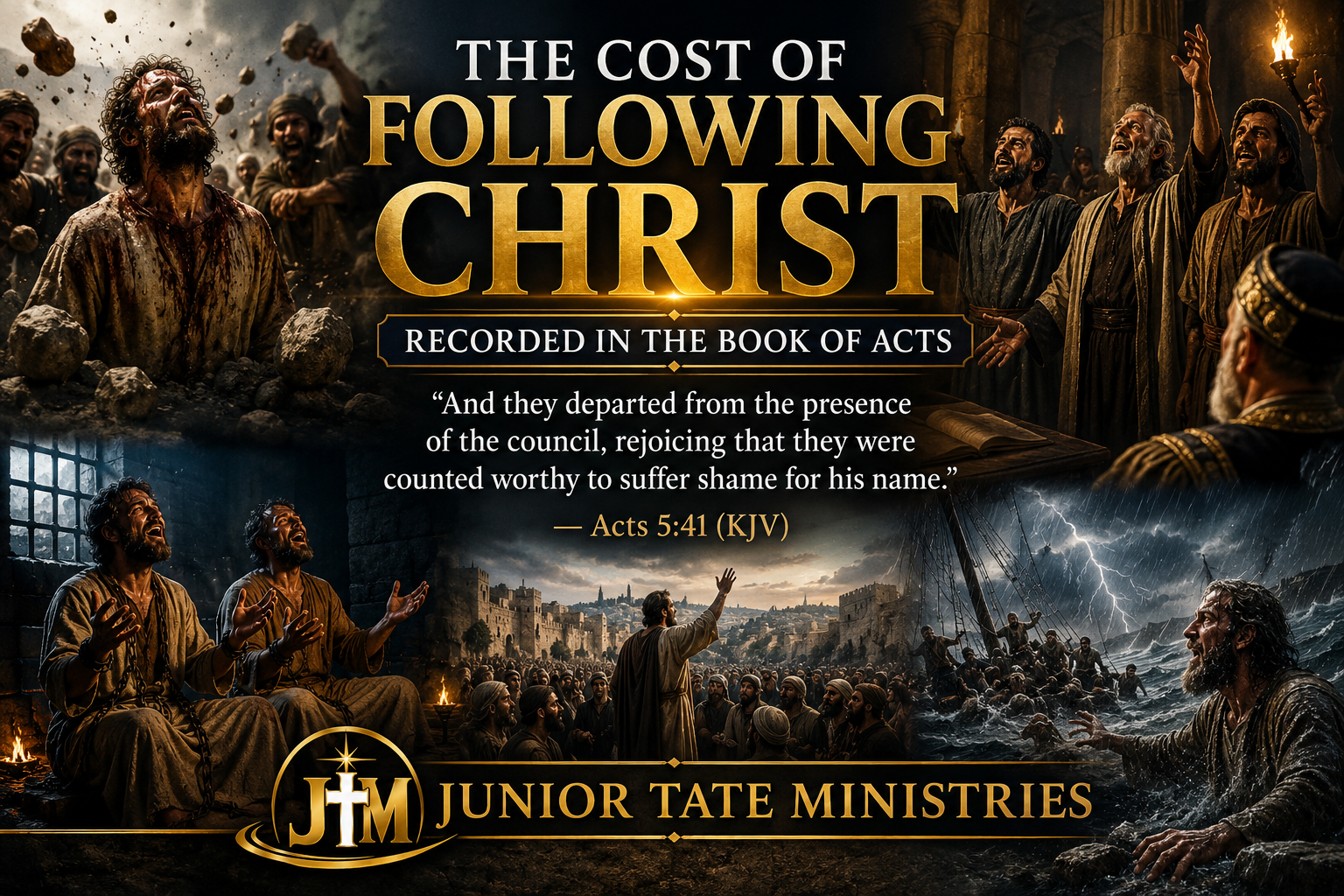
And they departed from the presence of the council, rejoicing that they were counted worthy to suffer shame for his name.
And daily in the temple, and in every house, they ceased not to teach and preach Jesus Christ.”
This is one of the clearest passages concerning the cost of following Christ in Acts.
The apostles were physically beaten.
They were publicly shamed.
They were ordered to stop preaching.
Yet Scripture says they departed “rejoicing that they were counted worthy to suffer shame for his name.”
They were not rejoicing because pain itself was pleasant. Scripture gives no indication that suffering was enjoyable. They rejoiced because their suffering came as a result of faithfulness to Jesus.
Then Acts records something remarkable:
“they ceased not to teach and preach Jesus Christ.”
The beating did not change their message.
It did not stop their ministry.
Every day they continued teaching publicly and from house to house.
The authorities had attempted to silence them through pain, but their devotion to Christ proved stronger than their fear of suffering.
Stephen: The First Recorded Christian Martyr
Acts chapters 6 and 7 introduce Stephen, a man described as full of faith and power.
Acts 6:8-10 (KJV)
“And Stephen, full of faith and power, did great wonders and miracles among the people.
Then there arose certain of the synagogue, which is called the synagogue of the Libertines, and Cyrenians, and Alexandrians, and of them of Cilicia and of Asia, disputing with Stephen.
And they were not able to resist the wisdom and the spirit by which he spake.”
When Stephen’s opponents could not overcome his testimony, false accusations followed.
Acts 6:11-14 (KJV)
“Then they suborned men, which said, We have heard him speak blasphemous words against Moses, and against God.
And they stirred up the people, and the elders, and the scribes, and came upon him, and caught him, and brought him to the council,
And set up false witnesses, which said, This man ceaseth not to speak blasphemous words against this holy place, and the law:
For we have heard him say, that this Jesus of Nazareth shall destroy this place, and shall change the customs which Moses delivered us.”
Stephen paid the cost of false accusation.
Following Christ does not guarantee that everyone will represent believers fairly. In Acts, faithful servants were sometimes accused of things they had not done.
Stephen then gave a lengthy biblical defense before the council. He traced Israel’s history and confronted his hearers with their resistance to God.
Stephen Refuses to Soften the Truth
Near the end of his message, Stephen spoke plainly.
Acts 7:51-53 (KJV)
“Ye stiffnecked and uncircumcised in heart and ears, ye do always resist the Holy Ghost: as your fathers did, so do ye.
Which of the prophets have not your fathers persecuted? and they have slain them which shewed before of the coming of the Just One; of whom ye have been now the betrayers and murderers:
Who have received the law by the disposition of angels, and have not kept it.”
Stephen refused to alter the message simply because his audience was hostile.
His words were not designed to win popularity.
They were meant to confront sin and point to the rejection of “the Just One,” Jesus Christ.
The response was violent.
Stephen Is Stoned to Death
Acts 7:54-60 (KJV)
“When they heard these things, they were cut to the heart, and they gnashed on him with their teeth.
But he, being full of the Holy Ghost, looked up stedfastly into heaven, and saw the glory of God, and Jesus standing on the right hand of God,
And said, Behold, I see the heavens opened, and the Son of man standing on the right hand of God.
Then they cried out with a loud voice, and stopped their ears, and ran upon him with one accord,
And cast him out of the city, and stoned him: and the witnesses laid down their clothes at a young man’s feet, whose name was Saul.
And they stoned Stephen, calling upon God, and saying, Lord Jesus, receive my spirit.
And he kneeled down, and cried with a loud voice, Lord, lay not this sin to their charge. And when he had said this, he fell asleep.”
Stephen became the first recorded Christian martyr in Acts.
His faithfulness cost him his life.
Yet even while being stoned, Stephen looked toward Christ.
He prayed, “Lord Jesus, receive my spirit.”
Then he prayed for those killing him:
“Lord, lay not this sin to their charge.”
His final moments reflected the spirit of Christ, who prayed for those involved in His crucifixion.
Stephen’s death shows the highest earthly cost of discipleship: faithfulness unto death.
But Acts does not present Stephen as defeated.
He saw Jesus standing at the right hand of God.
Earthly men condemned Stephen, but Heaven received him.
Saul Makes Havock of the Church
Stephen’s death was followed by a wider persecution.
A young man named Saul had consented to Stephen’s death. He then became one of the fiercest persecutors of Christians.
Acts 8:1-3 (KJV)
“And Saul was consenting unto his death. And at that time there was a great persecution against the church which was at Jerusalem; and they were all scattered abroad throughout the regions of Judaea and Samaria, except the apostles.
And devout men carried Stephen to his burial, and made great lamentation over him.
As for Saul, he made havock of the church, entering into every house, and haling men and women committed them to prison.”
The persecution affected ordinary believers, not merely apostles and preachers.
Saul entered homes.
Men and women were dragged away.
Believers were imprisoned.
Families were affected.
The Church was scattered.
Following Jesus could cost a believer home, security, freedom, and normal life.
Yet what happened next reveals one of the great patterns of Acts.
Persecution Scattered the Believers, but Spread the Gospel
Acts 8:4 (KJV)
“Therefore they that were scattered abroad went every where preaching the word.”
This verse is extraordinary.
Persecution scattered the Church, but those scattered believers carried the Gospel with them.
Satan attempted to suppress the message.
Instead, the message spread.
The Christians who fled Jerusalem did not leave their faith behind. They went everywhere preaching the Word.
Their circumstances changed, but their Lord did not.
Their addresses changed, but their mission continued.
Their suffering became part of the means through which the Gospel moved beyond Jerusalem.
Philip Preaches in Samaria
One of those who went out was Philip.
Acts 8:5-8 (KJV)
“Then Philip went down to the city of Samaria, and preached Christ unto them.
And the people with one accord gave heed unto those things which Philip spake, hearing and seeing the miracles which he did.
For unclean spirits, crying with loud voice, came out of many that were possessed with them: and many taken with palsies, and that were lame, were healed.
And there was great joy in that city.”
The persecution that scattered believers helped move the Gospel into Samaria, exactly as Jesus had said in Acts 1:8.
The enemies of the Church could scatter Christians geographically, but they could not separate them from Christ or prevent the spread of the Gospel.
Saul Learns That Following Christ Will Include Suffering
The great persecutor Saul was eventually confronted by Jesus Christ on the road to Damascus.
After Saul’s conversion, the Lord spoke to Ananias concerning Saul’s future ministry.
Acts 9:13-16 (KJV)
“Then Ananias answered, Lord, I have heard by many of this man, how much evil he hath done to thy saints at Jerusalem:
And here he hath authority from the chief priests to bind all that call on thy name.
But the Lord said unto him, Go thy way: for he is a chosen vessel unto me, to bear my name before the Gentiles, and kings, and the children of Israel:
For I will shew him how great things he must suffer for my name’s sake.”
This statement is important.
Jesus did not promise Saul an easy ministry.
He said:
“I will shew him how great things he must suffer for my name’s sake.”
Saul, later known as Paul, had caused Christians to suffer. Now he would become a faithful witness to Christ and would himself experience suffering.
His suffering did not save him. Salvation was by the grace of Christ. But suffering would become part of his calling as he carried the Gospel before Gentiles, kings, and Israel.
The Persecutor Becomes the Persecuted
After Saul began preaching Christ, opposition quickly arose.
Acts 9:20-25 (KJV)
“And straightway he preached Christ in the synagogues, that he is the Son of God.
But all that heard him were amazed, and said; Is not this he that destroyed them which called on this name in Jerusalem, and came hither for that intent, that he might bring them bound unto the chief priests?
But Saul increased the more in strength, and confounded the Jews which dwelt at Damascus, proving that this is very Christ.
And after that many days were fulfilled, the Jews took counsel to kill him:
But their laying await was known of Saul. And they watched the gates day and night to kill him.
Then the disciples took him by night, and let him down by the wall in a basket.”
Saul had once traveled to Damascus intending to arrest Christians.
Now others plotted to kill him because he preached Christ.
His change of allegiance brought immediate cost.
He had once possessed authority and letters from the high priest. Now he escaped the city by being lowered down a wall in a basket.
The persecutor had become the persecuted.
Paul Faces Rejection in Jerusalem
After Saul returned to Jerusalem, believers were initially afraid of him because they remembered his past.
Barnabas helped bring him to the apostles.
But Saul soon faced opposition from those rejecting his message.
Acts 9:28-30 (KJV)
“And he was with them coming in and going out at Jerusalem.
And he spake boldly in the name of the Lord Jesus, and disputed against the Grecians: but they went about to slay him.
Which when the brethren knew, they brought him down to Caesarea, and sent him forth to Tarsus.”
Again, bold preaching was followed by threats against his life.
The cost of following Christ was becoming a pattern in Paul’s ministry.
James Is Killed by Herod
Acts chapter 12 records political persecution of the Church under Herod.
Acts 12:1-4 (KJV)
“Now about that time Herod the king stretched forth his hands to vex certain of the church.
And he killed James the brother of John with the sword.
And because he saw it pleased the Jews, he proceeded further to take Peter also.(Then were the days of unleavened bread.)
And when he had apprehended him, he put him in prison, and delivered him to four quaternions of soldiers to keep him; intending after Easter to bring him forth to the people.”
James, one of the apostles, was killed with the sword.
Peter was arrested and imprisoned.
The passage also exposes the political nature of some persecution. Herod saw that James’s death pleased certain people, so he arrested Peter as well.
James died.
Peter was miraculously delivered.
This reminds us that God does not always deliver His servants in the same manner.
One servant may be rescued from death.
Another may glorify God through death.
Both remain under God’s sovereignty.
Peter Sleeps in Prison
Peter was placed under heavy guard while the Church prayed for him.
Acts 12:5-7 (KJV)
“Peter therefore was kept in prison: but prayer was made without ceasing of the church unto God for him.
And when Herod would have brought him forth, the same night Peter was sleeping between two soldiers, bound with two chains: and the keepers before the door kept the prison.
And, behold, the angel of the Lord came upon him, and a light shined in the prison: and he smote Peter on the side, and raised him up, saying, Arise up quickly. And his chains fell off from his hands.”
God miraculously delivered Peter.
But the lesson is not that faithful Christians will always be rescued from imprisonment or death. James had just been killed.
The lesson is that God remains sovereign in both circumstances.
The Church prayed.
Peter was delivered.
James had died faithfully.
Neither persecution nor death could defeat the mission of Christ.
Paul and Barnabas Are Persecuted at Antioch
As Paul and Barnabas carried the Gospel farther into the Gentile world, opposition continued.
Acts 13:49-52 (KJV)
“And the word of the Lord was published throughout all the region.
But the Jews stirred up the devout and honourable women, and the chief men of the city, and raised persecution against Paul and Barnabas, and expelled them out of their coasts.
But they shook off the dust of their feet against them, and came unto Iconium.
And the disciples were filled with joy, and with the Holy Ghost.”
They were expelled from the region.
Once again, rejection did not mean failure.
The Word spread throughout the region.
The missionaries moved on.
The disciples were filled with joy and the Holy Ghost.
Following Christ sometimes means continuing faithfully even when a door closes through hostility.
Threats of Stoning at Iconium
At Iconium, division formed over the preaching of the Gospel.
Acts 14:1-7 (KJV)
“And it came to pass in Iconium, that they went both together into the synagogue of the Jews, and so spake, that a great multitude both of the Jews and also of the Greeks believed.
But the unbelieving Jews stirred up the Gentiles, and made their minds evil affected against the brethren.
Long time therefore abode they speaking boldly in the Lord, which gave testimony unto the word of his grace, and granted signs and wonders to be done by their hands.
But the multitude of the city was divided: and part held with the Jews, and part with the apostles.
And when there was an assault made both of the Gentiles, and also of the Jews with their rulers, to use them despitefully, and to stone them,
They were ware of it, and fled unto Lystra and Derbe, cities of Lycaonia, and unto the region that lieth round about:
And there they preached the gospel.”
They learned of a plan to stone them and left.
Leaving was not cowardice. They continued preaching elsewhere.
Acts does not teach that courage means refusing every opportunity to escape danger. At times the apostles remained under pressure. At other times they moved on.
The constant factor was not their location.
It was their faithfulness to the Gospel.
Paul Is Stoned at Lystra
The threat of stoning became reality at Lystra.
Acts 14:19-22 (KJV)
“And there came thither certain Jews from Antioch and Iconium, who persuaded the people, and, having stoned Paul, drew him out of the city, supposing he had been dead.
Howbeit, as the disciples stood round about him, he rose up, and came into the city: and the next day he departed with Barnabas to Derbe.
And when they had preached the gospel to that city, and had taught many, they returned again to Lystra, and to Iconium, and Antioch,
Confirming the souls of the disciples, and exhorting them to continue in the faith, and that we must through much tribulation enter into the kingdom of God.”
Paul was stoned and dragged outside the city because his attackers believed he was dead.
Yet he rose, continued his ministry, and later returned to strengthen believers in the same region.
His message to those disciples was realistic:
“We must through much tribulation enter into the kingdom of God.”
He did not teach that following Christ guaranteed freedom from hardship.
He prepared believers for endurance.
Tribulation did not mean God had abandoned them.
It was something Christians could encounter while remaining faithful to God.
Paul and Silas Are Beaten and Imprisoned
Acts chapter 16 records one of the best-known examples of suffering and worship.
Paul cast a spirit of divination out of a young woman. Her masters had made money through her condition. When their financial gain disappeared, they turned against Paul and Silas.
Acts 16:19-24 (KJV)
“And when her masters saw that the hope of their gains was gone, they caught Paul and Silas, and drew them into the marketplace unto the rulers,
And brought them to the magistrates, saying, These men, being Jews, do exceedingly trouble our city,
And teach customs, which are not lawful for us to receive, neither to observe, being Romans.
And the multitude rose up together against them: and the magistrates rent off their clothes, and commanded to beat them.
And when they had laid many stripes upon them, they cast them into prison, charging the jailor to keep them safely:
Who, having received such a charge, thrust them into the inner prison, and made their feet fast in the stocks.”
Paul and Silas were beaten with many stripes.
They were placed in the inner prison.
Their feet were placed in stocks.
The physical suffering was real.
Yet their response reveals the depth of their faith.
Paul and Silas Pray and Sing at Midnight
Acts 16:25-26 (KJV)
“And at midnight Paul and Silas prayed, and sang praises unto God: and the prisoners heard them.
And suddenly there was a great earthquake, so that the foundations of the prison were shaken: and immediately all the doors were opened, and every one’s bands were loosed.”
They prayed.
They sang praises.
The other prisoners listened.
Their worship became a witness.
God then sent an earthquake that opened the doors and loosened the prisoners’ bonds.
The jailer, believing the prisoners had escaped, prepared to kill himself, but Paul stopped him.
This led to one of the clearest salvation questions in Acts.
Acts 16:29-34 (KJV)
“Then he called for a light, and sprang in, and came trembling, and fell down before Paul and Silas,
And brought them out, and said, Sirs, what must I do to be saved?
And they said, Believe on the Lord Jesus Christ, and thou shalt be saved, and thy house.
And they spake unto him the word of the Lord, and to all that were in his house.
And he took them the same hour of the night, and washed their stripes; and was baptized, he and all his, straightway.
And when he had brought them into his house, he set meat before them, and rejoiced ,believing in God with all his house.”
Their suffering became part of the setting in which the jailer heard the Gospel.
Paul and Silas did not suffer in order to earn salvation. Their suffering became an opportunity to display faithfulness and proclaim the Saviour.
The Gospel Brings Opposition at Thessalonica
Paul’s preaching in Thessalonica produced both conversions and hostility.
Acts 17:5-8 (KJV)
“But the Jews which believed not, moved with envy, took unto them certain lewd fellows of the baser sort, and gathered a company, and set all the city on an uproar, and assaulted the house of Jason, and sought to bring them out to the people.
And when they found them not, they drew Jason and certain brethren unto the rulers of the city, crying, These that have turned the world upside down are come hither also;
Whom Jason hath received: and these all do contrary to the decrees of Caesar, saying that there is another king, one Jesus.
And they troubled the people and the rulers of the city, when they heard these things.”
The opposition affected not only Paul but those who received him.
Jason and other believers were dragged before the rulers.
This reveals another cost of following Christ: association with Gospel ministry could bring public trouble.
Faithfulness could affect social standing, reputation, and security.
Yet the Gospel continued.
Paul Is Mocked in Athens
Not every cost involved physical persecution.
In Athens, Paul experienced intellectual mockery.
When he preached the resurrection, some laughed at the message.
Acts 17:32-34 (KJV)
“And when they heard of the resurrection of the dead, some mocked: and others said,We will hear thee again of this matter.
So Paul departed from among them.
Howbeit certain men clave unto him, and believed: among the which was Dionysius the Areopagite, and a woman named Damaris, and others with them.”
Some mocked.
Some wanted to hear more.
Some believed.
Faithfulness to Christ sometimes means enduring ridicule rather than physical violence.
Paul did not change the resurrection message to gain approval from intellectual culture.
He preached truth and allowed hearers to respond.
Paul Faces Violence in Corinth
The Lord encouraged Paul while he ministered in Corinth.
Acts 18:9-11 (KJV)
“Then spake the Lord to Paul in the night by a vision, Be not afraid, but speak, and hold not thy peace:
For I am with thee, and no man shall set on thee to hurt thee: for I have much people in this city.
And he continued there a year and six months, teaching the word of God among them.”
The command “Be not afraid” shows that fear was a real possibility.
Courage does not mean a person never feels the pressure of danger.
God encouraged Paul to keep speaking.
The promise was not that opposition would disappear. In fact, Acts immediately records another attack.
Acts 18:12-13 (KJV)
“And when Gallio was the deputy of Achaia, the Jews made insurrection with one accord against Paul, and brought him to the judgment seat,
Saying, This fellow persuadeth men to worship God contrary to the law.”
Paul continued facing accusations, but the Lord remained with him.
The Gospel Threatens Idolatrous Business at Ephesus
Acts chapter 19 shows that the Gospel can confront economic systems built around idolatry.
A silversmith named Demetrius made shrines associated with the goddess Diana. The spread of Christianity threatened his trade.
Acts 19:23-27 (KJV)
“And the same time there arose no small stir about that way.
For a certain man named Demetrius, a silversmith, which made silver shrines for Diana, brought no small gain unto the craftsmen;
Whom he called together with the workmen of like occupation, and said, Sirs, ye know that by this craft we have our wealth.
Moreover ye see and hear, that not alone at Ephesus, but almost throughout all Asia, this Paul hath persuaded and turned away much people, saying that they be no gods, which are made with hands:
So that not only this our craft is in danger to be set at nought; but also that the temple of the great goddess Diana should be despised, and her magnificence should be destroyed, whom all Asia and the world worshippeth.”
The Gospel challenged idolatry.
That challenge threatened profits.
The result was a public uproar.
This teaches that resistance to Christianity is not always merely theological. Sometimes people resist truth because it threatens financial interests, social customs, or established systems.
Paul’s ministry affected the culture because people were turning away from idols.
Paul Knows Bonds and Afflictions Await Him
As Paul journeyed toward Jerusalem, he spoke to the elders from Ephesus.
His words reveal his willingness to suffer in obedience to Christ.
Acts 20:22-24 (KJV)
“And now, behold, I go bound in the spirit unto Jerusalem, not knowing the things that shall befall me there:
Save that the Holy Ghost witnesseth in every city, saying that bonds and afflictions abide me.
But none of these things move me, neither count I my life dear unto myself, so that I might finish my course with joy, and the ministry, which I have received of the Lord Jesus, to testify the gospel of the grace of God.”
Paul knew that bonds and afflictions awaited him.
He did not know every detail.
But he knew suffering was ahead.
His response was not carelessness about life. Rather, his calling mattered more to him than personal preservation.
His desire was:
“That I might finish my course with joy.”
And:
“The ministry, which I have received of the Lord Jesus.”
Paul understood that his life belonged to Christ.
That is one of the deepest costs of discipleship recorded in Acts: surrendering the right to make personal comfort the highest goal.
Believers Beg Paul Not to Go to Jerusalem
At Caesarea, the prophet Agabus gave a dramatic warning.
Acts 21:10-14 (KJV)
“And as we tarried there many days, there came down from Judaea a certain prophet, named Agabus.
And when he was come unto us, he took Paul’s girdle, and bound his own hands and feet, and said, Thus saith the Holy Ghost, So shall the Jews at Jerusalem bind the man that owneth this girdle, and shall deliver him into the hands of the Gentiles.
And when we heard these things, both we, and they of that place, besought him not to go up to Jerusalem.
Then Paul answered, What mean ye to weep and to break mine heart? for I am ready not to be bound only, but also to die at Jerusalem for the name of the Lord Jesus.
And when he would not be persuaded, we ceased, saying, The will of the Lord be done.”
Paul knew imprisonment was coming.
His friends wept.
They begged him not to go.
Paul answered:
“I am ready not to be bound only, but also to die at Jerusalem for the name of the Lord Jesus.”
This was not empty boasting. Paul had already been beaten, imprisoned, threatened, and stoned.
His willingness was rooted in devotion to Christ.
The believers eventually responded:
“The will of the Lord be done.”
Following Christ means submitting even our future to the Lord’s will.
Paul Is Beaten by a Mob in Jerusalem
Paul’s arrival in Jerusalem eventually led to violence.
Acts 21:27-32 (KJV)
“And when the seven days were almost ended, the Jews which were of Asia, when they saw him in the temple, stirred up all the people, and laid hands on him,
Crying out, Men of Israel, help: This is the man, that teacheth all men every where against the people, and the law, and this place: and further brought Greeks also into the temple, and hath polluted this holy place.
(For they had seen before with him in the city Trophimus an Ephesian, whom they supposed that Paul had brought into the temple.)
And all the city was moved ,and the people ran together: and they took Paul, and drew him out of the temple: and forthwith the doors were shut.
And as they went about to kill him, tidings came unto the chief captain of the band, that all Jerusalem was in an uproar.
Who immediately took soldiers and centurions, and ran down unto them: and when they saw the chief captain and the soldiers, they left beating of Paul.”
The accusation concerning Trophimus was based on an assumption.
Paul was attacked because people believed something that had not been established as true.
Again Acts shows that servants of Christ can suffer through misunderstanding and false accusations.
The mob intended to kill Paul.
Roman soldiers intervened.
But Paul’s imprisonment began a new stage of ministry.
Paul Uses His Chains as an Opportunity to Testify
Paul later testified before rulers, governors, and kings.
His imprisonment did not end his witness.
Before King Agrippa, Paul openly described his conversion and calling.
Acts 26:15-18 (KJV)
“And I said, Who art thou, Lord? And he said, I am Jesus whom thou persecutest.
But rise, and stand upon thy feet: for I have appeared unto thee for this purpose, to make thee a minister and a witness both of these things which thou hast seen, and of those things in the which I will appear unto thee;
Delivering thee from the people, and from the Gentiles, unto whom now I send thee,
To open their eyes, and to turn them from darkness to light, and from the power of Satan unto God, that they may receive forgiveness of sins, and inheritance among them which are sanctified by faith that is in me.”
Paul’s chains placed him before people who may otherwise never have heard his testimony personally.
Following Christ cost Paul freedom, but even captivity became a place of ministry.
Paul Refuses to Be Ashamed of His Testimony
Before Agrippa, Paul explained his obedience to Christ.
Acts 26:19-23 (KJV)
“Whereupon, O king Agrippa, I was not disobedient unto the heavenly vision:
But shewed first unto them of Damascus, and at Jerusalem, and throughout all the coasts of Judaea, and then to the Gentiles, that they should repent and turn to God, and do works meet for repentance.
For these causes the Jews caught me in the temple, and went about to kill me.
Having therefore obtained help of God, I continue unto this day, witnessing both to small and great, saying none other things than those which the prophets and Moses did say should come:
That Christ should suffer, and that he should be the first that should rise from the dead, and should shew light unto the people, and to the Gentiles.”
Paul directly connected his suffering with his obedience to the heavenly vision.
He said:
“I was not disobedient.”
His preaching led people to attempt to kill him, but he continued witnessing.
The source of his endurance was not merely personal determination.
He said:
“Having therefore obtained help of God, I continue unto this day.”
Faithful endurance required divine help.
Paul Appeals to Caesar
Paul eventually exercised his legal right as a Roman citizen and appealed to Caesar.
Acts 25:10-12 (KJV)
“Then said Paul, I stand at Caesar’s judgment seat, where I ought to be judged: to the Jews have I done no wrong, as thou very well knowest.
For if I be an offender, or have committed any thing worthy of death, I refuse not to die: but if there be none of these things whereof these accuse me, no man may deliver me unto them. I appeal unto Caesar.
Then Festus, when he had conferred with the council, answered, Hast thou appealed unto Caesar? unto Caesar shalt thou go.”
Paul’s willingness to suffer did not mean he refused lawful protection.
This is an important balance.
Christians in Acts did not deliberately seek pain.
They sometimes fled danger.
They sometimes used legal rights.
They sometimes accepted miraculous deliverance.
But they never made avoiding suffering more important than obeying Christ.
Paul used Roman law while remaining completely committed to the Gospel.
The Voyage to Rome Brings Further Hardship
Paul’s journey to Rome as a prisoner included a dangerous storm and shipwreck.
Acts chapter 27 describes days of violent weather and fear.
Yet God assured Paul that he would reach Caesar.
Acts 27:21-25 (KJV)
“But after long abstinence Paul stood forth in the midst of them, and said, Sirs, ye should have hearkened unto me, and not have loosed from Crete, and to have gained this harm and loss.
And now I exhort you to be of good cheer: for there shall be no loss of any man’s life among you, but of the ship.
For there stood by me this night the angel of God, whose I am, and whom I serve,
Saying, Fear not, Paul; thou must be brought before Caesar: and, lo, God hath given thee all them that sail with thee.
Wherefore, sirs, be of good cheer: for I believe God, that it shall be even as it was told me.”
Paul was a prisoner in a dangerous storm, yet he became the voice of hope aboard the ship.
His statement summarizes his identity:
“Whose I am, and whom I serve.”
Paul belonged to God.
That truth remained unchanged whether he stood in a synagogue, sat in prison, faced a mob, appeared before a king, or endured a storm at sea.
Paul Is Bitten by a Viper
After surviving the shipwreck, Paul encountered another danger.
Acts 28:1-6 (KJV)
“And when they were escaped, then they knew that the island was called Melita.
And the barbarous people shewed us no little kindness: for they kindled a fire, and received us every one, because of the present rain, and because of the cold.
And when Paul had gathered a bundle of sticks, and laid them on the fire, there came a viper out of the heat, and fastened on his hand.
And when the barbarians saw the venomous beast hang on his hand, they said among themselves, No doubt this man is a murderer, whom, though he hath escaped the sea, yet vengeance suffereth not to live.
And he shook off the beast into the fire, and felt no harm.
Howbeit they looked when he should have swollen, or fallen down dead suddenly: but after they had looked a great while, and saw no harm come to him, they changed their minds, and said that he was a god.”
The incident again demonstrates that hardship should not automatically be interpreted as evidence that God has abandoned someone.
Paul had obeyed Christ.
He was still experiencing danger.
God preserved him because his mission was not finished.
Acts Ends with Paul Still a Prisoner
The book of Acts does not end with Paul living in earthly comfort.
It ends with him in Rome under restriction.
Yet the Gospel remains unhindered.
Acts 28:30-31 (KJV)
“And Paul dwelt two whole years in his own hired house, and received all that came in unto him,
Preaching the kingdom of God, and teaching those things which concern the Lord Jesus Christ, with all confidence, no man forbidding him.”
This ending is powerful.
Paul was restricted.
The Gospel was not.
He was under Roman authority.
Jesus was still Lord.
Paul could not travel freely.
People came to him.
He continued preaching.
Acts ends not with the triumph of Rome, but with the continued proclamation of the kingdom of God and Jesus Christ.
The Cost Was Not the Same for Every Believer
The book of Acts shows different forms and degrees of suffering.
Stephen was killed.
James was killed.
Peter was imprisoned and miraculously released.
Paul was beaten, stoned, arrested, and eventually taken to Rome.
Ordinary Christians were scattered from Jerusalem.
Jason was dragged before rulers.
Paul and Barnabas were expelled from regions.
Some believers suffered social pressure.
Some faced public ridicule.
Others faced death.
Therefore, Scripture does not teach that every believer will experience exactly the same form of suffering.
The common requirement is faithfulness to Christ.
We should not judge another believer’s devotion by measuring how much physical suffering he has experienced. Suffering itself does not make a person spiritual, and persecution does not save anyone.
Salvation is by grace through faith in Jesus Christ.
The lesson of Acts is that no earthly cost should cause believers to deny Christ or abandon His truth.
Following Christ May Cost Popularity
The apostles were opposed by influential leaders.
Stephen was hated for speaking truth.
Paul was mocked by philosophers.
The Gospel caused division in cities.
Faithfulness to Christ does not guarantee universal approval.
There are times when telling the truth will make a believer unpopular.
Acts repeatedly demonstrates that the goal of Christian witness is not to make everyone approve of the messenger. The goal is to faithfully proclaim Christ.
Following Christ May Cost Comfort
Paul and Silas spent a night wounded in prison.
Paul traveled under difficult conditions.
Missionaries faced opposition from city to city.
Disciples were scattered from Jerusalem.
The Christian life described in Acts was not organized around personal comfort.
That does not mean comfort is sinful or that believers should intentionally make life difficult. It means comfort cannot become the believer’s master.
When comfort and obedience conflict, Christ must come first.
Following Christ May Cost Freedom
Peter was imprisoned.
The apostles were imprisoned.
Paul and Silas were imprisoned.
Paul spent years under Roman custody.
The early Christians understood that physical chains could not separate them from Christ.
The Gospel remained powerful inside prisons.
The Philippian jailer was saved in connection with Paul and Silas’s imprisonment.
Paul testified before rulers because he was a prisoner.
What appeared to be limitation became opportunity in the hands of God.
Following Christ May Cost Relationships and Security
The great persecution after Stephen’s death scattered believers from Jerusalem.
People left familiar homes and communities.
Acts does not provide every personal detail concerning these families, so we should not invent what Scripture does not say. But being scattered necessarily changed their circumstances.
The cost was real.
Yet they went everywhere preaching the Word.
Security had been shaken, but faith remained.
Following Christ May Cost Reputation
Christians were falsely accused repeatedly.
Stephen faced false witnesses.
Paul was accused of teaching against the people, law, and temple.
Paul and Silas were accused of troubling the city.
Believers at Thessalonica were associated with people accused of turning the world upside down.
A Christian should strive to maintain an honest testimony, but faithfulness does not guarantee that everyone will speak truthfully about him.
Acts teaches believers not to measure truth by public reputation.
Following Christ Can Cost Life Itself
Stephen died.
James died.
Paul declared himself ready to die.
The early Church knew that confession of Christ could have ultimate earthly consequences.
Yet death was not considered the end.
Stephen saw Jesus.
The believers mourned, but the Gospel continued.
The resurrection of Christ gave them hope beyond death.
The courage of the early Church cannot be understood apart from their confidence that Jesus had conquered the grave.
Suffering Was Never Presented as the Means of Salvation
This distinction must be made clearly.
The believers in Acts were not saved because they suffered.
They suffered because they belonged to Christ and faithfully proclaimed Him.
The Gospel message remained salvation through faith in Jesus.
When the Philippian jailer asked:
“What must I do to be saved?”
Paul and Silas did not tell him to suffer.
They answered:
Acts 16:31 (KJV)
“And they said, Believe on the Lord Jesus Christ, and thou shalt be saved, and thy house.”
Salvation comes through Jesus Christ.
Suffering is not payment for sin.
Jesus paid the price for sin.
Christian suffering is a consequence that may accompany faithful discipleship in a fallen and hostile world.
The Early Church Did Not Seek Persecution
Another important lesson is that the believers in Acts did not deliberately try to make people persecute them.
They did not seek suffering as proof of spirituality.
When threatened with stoning, Paul and Barnabas fled to another region.
When Paul’s life was threatened in Damascus, believers lowered him over the wall.
When Paul faced injustice, he used his Roman citizenship.
When warned about danger, believers took practical precautions.
Therefore, the cost of following Christ should not be confused with deliberately creating unnecessary conflict.
The apostles were bold, but they were not reckless for the sake of appearing courageous.
Their commitment was simple:
Obey God.
Preach Christ.
Tell the truth.
Accept whatever cost faithfulness required.
The Power Behind Their Endurance
How did these believers continue?
Acts repeatedly points to the Holy Ghost.
Jesus had promised power in Acts 1:8.
The believers were filled with the Holy Ghost and spoke boldly.
Stephen died while full of the Holy Ghost.
Paul was strengthened by the Lord.
The courage recorded in Acts was not merely human toughness.
The Church depended upon God.
This is essential because no believer knows in advance what future faithfulness may cost.
The answer is not to imagine ourselves naturally strong enough for every possible trial.
The answer is to depend upon the God who strengthened His servants in Acts.
The Cost Produced a Powerful Witness
Again and again, suffering created opportunities for testimony.
Peter preached before the council.
Stephen testified before his accusers.
Paul and Silas worshipped where prisoners could hear.
The Philippian jailer heard the Gospel.
Paul testified before governors and kings.
Paul encouraged men during the storm.
Paul preached while under Roman custody.
The enemy repeatedly attempted to silence the Church, but suffering often moved the Gospel into places it might not otherwise have gone.
This does not mean suffering itself is good.
It means God is able to use even suffering for His purpose.
The Church Grew in the Midst of Opposition
One of the great themes of Acts is that persecution repeatedly fails to stop the Gospel.
After Peter and John were arrested, thousands believed.
After the apostles were beaten, they continued preaching daily.
After Stephen was killed, scattered believers preached everywhere.
After Paul was threatened, he went to another city.
After Paul and Silas were beaten, a jailer believed.
After Paul was imprisoned, he testified before rulers.
At the end of Acts, Paul was still preaching.
The Church’s survival did not depend upon favorable political conditions.
It depended upon the risen Christ.
What the Book of Acts Teaches Believers Today
The cost of following Christ recorded in Acts should challenge believers in every generation.
It teaches us that Christianity is more than convenient religion.
Jesus is Lord.
If He is Lord, He must remain Lord when obedience is difficult.
Acts teaches believers to value truth more than popularity.
It teaches us to value obedience more than comfort.
It teaches us to value the Gospel more than reputation.
It teaches us to remain faithful when misunderstood.
It teaches us to pray for boldness.
It teaches us not to assume hardship means God has abandoned us.
It teaches us that God can use suffering for Gospel opportunities.
It teaches us that earthly opposition cannot overthrow Christ’s kingdom.
Most importantly, it teaches us to keep our eyes upon Jesus rather than upon the cost.
The apostles were not obsessed with suffering.
They were devoted to Christ.
Suffering became bearable because Christ was worthy.
A Warning against Comfortable Christianity
There is a danger in reducing Christianity to something that exists only to make life comfortable.
The believers in Acts would not recognize that message.
Their faith brought joy, fellowship, salvation, spiritual power, and hope.
But it also brought sacrifice.
They did not ask whether obedience was convenient.
They asked whether it was right before God.
Peter said:
“We ought to obey God rather than men.”
Paul said:
“Neither count I my life dear unto myself.”
Stephen looked into Heaven while stones struck his body.
Paul and Silas sang while their backs bore the wounds of beating.
These examples should cause every believer to examine his own priorities.
Would we remain faithful if following Christ became unpopular?
Would we still speak truth if people mocked us?
Would we continue serving if obedience cost us financially?
Would we stand for Christ if friends rejected us?
Would we obey God if government authorities ordered us to deny biblical truth?
Those questions should not be answered carelessly or pridefully.
The proper prayer is that God would give us grace to remain faithful whatever comes.
The Cost Is Great, but Christ Is Greater
Acts records severe costs, but it never presents the Christian life as hopeless.
The believers possessed something greater than what persecution could take away.
They knew Jesus Christ was alive.
They knew sins could be forgiven.
They knew the Holy Ghost was with them.
They knew death did not have the final word.
They knew God’s kingdom would stand.
Stephen could face death because he saw Jesus.
Paul could endure suffering because he belonged to Christ.
The apostles could rejoice after being beaten because they considered suffering for His name an honor.
The question is not whether suffering is pleasant.
It is whether Jesus Christ is worthy.
Acts answers that question through the lives of those who followed Him.
He is worthy.
A Word to Those Who Are Suffering for Christ
Some believers around the world continue to experience serious persecution because of their faith.
Acts provides encouragement without minimizing suffering.
The early Church prayed.
The early Church supported one another.
The early Church continued proclaiming Christ.
The early Church trusted God.
Sometimes God delivered His servants miraculously.
Sometimes He allowed them to suffer.
Sometimes He allowed them to die.
But He never ceased to be Lord.
The believer’s security is ultimately not found in escaping every earthly trial.
It is found in belonging to Jesus Christ.
Paul’s statement during the storm remains powerful:
“Whose I am, and whom I serve.”
If you belong to Christ, suffering cannot change whose you are.
A Word to the Unsaved
The greatest issue is not whether a person is willing to suffer for Christianity.
The first question is whether that person knows Jesus Christ as Saviour.
The apostles suffered because they had been changed by the risen Christ.
The Gospel they preached was not “suffer enough and God will accept you.”
Their Gospel was Jesus Christ.
Peter preached:
Acts 4:10-12 (KJV)
“Be it known unto you all, and to all the people of Israel, that by the name of Jesus Christ of Nazareth, whom ye crucified, whom God raised from the dead, even by him doth this man stand here before you whole.
This is the stone which was set at nought of you builders, which is become the head of the corner.
Neither is there salvation in any other: for there is none other name under heaven given among men, whereby we must be saved.”
Salvation is in Jesus Christ alone.
He died for sinners.
He rose from the dead.
He offers forgiveness and eternal life.
The early believers were willing to suffer because they knew the One they preached was truly alive.
The same Saviour is offered today.
Conclusion: They Counted Christ Worth the Cost
The book of Acts presents Christianity in its early expansion with remarkable honesty.
Following Jesus was glorious, but it was not always easy.
Peter and John were arrested.
The apostles were threatened.
They were beaten.
Stephen was falsely accused and stoned to death.
Believers were driven from Jerusalem.
Men and women were imprisoned.
James was killed with the sword.
Peter was imprisoned.
Paul and Barnabas were expelled from cities.
Paul was threatened with stoning.
Paul was stoned and left for dead.
Paul and Silas were beaten and placed in stocks.
Believers were dragged before rulers.
Paul faced mobs, accusations, imprisonment, storms, and years of confinement.
Yet the Gospel continued.
The apostles did not stop preaching.
Stephen did not deny Christ.
The scattered believers went everywhere preaching the Word.
Paul did not abandon his calling.
Paul and Silas sang in prison.
The Church prayed.
The Holy Ghost gave boldness.
Souls were saved.
Churches were established.
The message spread from Jerusalem toward the nations.
The cost was real.
But Christ was greater than the cost.
The book of Acts does not teach believers to chase persecution. It teaches them not to abandon Christ when persecution comes.
It does not tell Christians to seek suffering.
It tells them to seek faithfulness.
It does not teach that pain earns salvation.
It teaches that those who have been saved by Jesus should remain loyal to Him whatever obedience may cost.
The early believers understood something the modern Church must never forget:
Jesus Christ is worthy of complete devotion.
He is worthy when the crowds listen.
He is worthy when the crowds mock.
He is worthy when doors open.
He is worthy when prison doors close.
He is worthy in freedom.
He is worthy in chains.
He is worthy in life.
He is worthy even in death.
The cost of following Christ may be great.
But the book of Acts demonstrates that those who truly knew the risen Lord believed He was worth everything.
If the Holy Spirit is convicting and pulling at your heart strings today, give in to Him and follow the prayer below for your salvation in Jesus Christ!
You may not ever get another chance to except Christ as your personal Savior and Lord! Your next breath is not promised!
Come! He’s Waiting on You!
Prayer to Salvation
Heavenly Father,
I come before You today admitting that I am a sinner in need of Your mercy and grace.
Your Word says in Romans 10:9–10 that if I confess with my mouth the Lord Jesus and believe in my heart that God hath raised Him from the dead, I shall be saved.
Today, I confess Jesus Christ as my Lord and my Savior. I believe with all my heart that He died for my sins, was buried, and rose again the third day.
Lord Jesus, I ask You to forgive me of all my sins. Wash me clean in Your precious blood. I turn from my old life and surrender fully to You.
Come into my heart, make me a new creature, and fill me with the Holy Spirit. From this day forward, I choose to follow You, live by Your Word, and walk in the new life You have given me.
Thank You, Lord, for saving me, for forgiving me, and for writing my name in the Lamb’s Book of Life. I give You all the glory, honor, and praise.
In Jesus’ name I pray, Amen.
juniortateministires.com
greatcommissiontoday.com