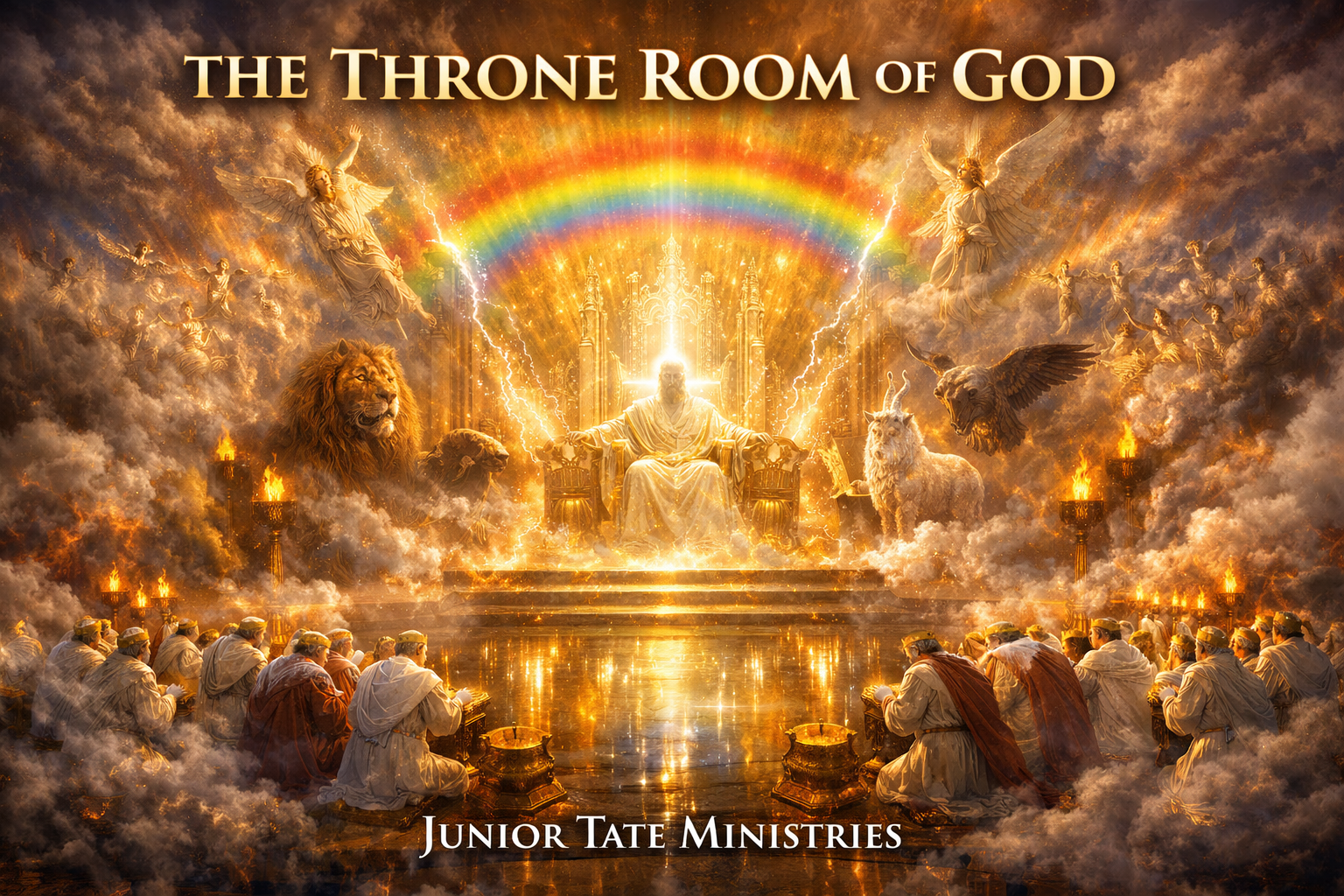
Introduction: Why the Throne Room Matters The Bible does not present God as distant, uncertain, or hidden behind confusion. It repeatedly reveals Him as the sovereign King, holy, eternal, and enthroned above all creation. When Scripture opens the curtain and shows the throne room of God, it is not given to satisfy curiosity, but to produce reverence, repentance, worship, and confidence. The throne room scenes in the Word of God show who God is, what He is like, what Heaven is centered on, and how all history moves according to His authority. From the Old Testament prophets to the New Testament revelation, the throne room is shown as the center of reality. Empires rise and fall on earth, but Heaven is not shaken. Kings make decrees, but God’s throne stands forever. Satan accuses, but God judges righteously. The saints suffer, but God reigns. The future unfolds, not by human power, but by the One seated upon the throne. In this article, we will walk through the clearest throne room passages in Scripture, especially Isaiah 6, Ezekiel 1 and 10, Daniel 7, and Revelation 4–5, using the King James Version (KJV) and staying anchored to what the Bible actually says. God Enthroned: The Unshakable Center of Heaven Before Scripture describes creatures, crowns, or worship, it establishes something foundational: God is on the throne. The throne is the place of rule, authority, judgment, and dominion. Heaven is not chaotic; Heaven is ordered around the throne of God. The psalmist declares: Psalm 11:4 (KJV)“The LORD is in his holy temple, the LORD’S throne is in heaven: his eyes behold, his eyelids try, the children of men.” God’s throne is not only a symbol of power, it is connected to His holiness and His perfect knowledge. He sees. He tests. He judges. The throne room is not merely beautiful; it is morally pure and perfectly righteous. Scripture also says: Psalm 47:8 (KJV)“God reigneth over the heathen: God sitteth upon the throne of his holiness.” Notice the phrase: “the throne of his holiness.” Heaven’s government is not like earth’s governments. God’s rule is holy, completely separate from sin, corruption, and injustice. And again: Psalm 103:19 (KJV)“The LORD hath prepared his throne in the heavens; and his kingdom ruleth over all.” The throne room reveals that God’s kingdom does not compete with other kingdoms as an equal rival. His kingdom rules over all. This is the foundation of every prophetic vision that follows. Isaiah’s Vision: Holiness, Worship, and Cleansing One of the most direct throne room scenes is found in Isaiah 6. Isaiah is not shown Heaven so he can feel important, he is shown Heaven so he can see God’s holiness, recognize his sin, and be commissioned to speak God’s Word. Isaiah 6:1–8 (KJV)“1 In the year that king Uzziah died I saw also the Lord sitting upon a throne, high and lifted up, and his train filled the temple.2 Above it stood the seraphims: each one had six wings; with twain he covered his face, and with twain he covered his feet, and with twain he did fly.3 And one cried unto another, and said, Holy, holy, holy, is the LORD of hosts: the whole earth is full of his glory.4 And the posts of the door moved at the voice of him that cried, and the house was filled with smoke.5 Then said I, Woe is me! for I am undone; because I am a man of unclean lips, and I dwell in the midst of a people of unclean lips: for mine eyes have seen the King, the LORD of hosts.6 Then flew one of the seraphims unto me, having a live coal in his hand, which he had taken with the tongs from off the altar:7 And he laid it upon my mouth, and said, Lo, this hath touched thy lips; and thine iniquity is taken away, and thy sin purged.8 Also I heard the voice of the Lord, saying, Whom shall I send, and who will go for us? Then said I, Here am I; send me.” This throne room scene teaches several unchanging truths: The throne room is not entertainment. It is the place where worship and repentance meet, where sinners are humbled, and where servants are sent. Ezekiel’s Vision: The Glory of God and the Living Creatures Ezekiel’s throne room vision is one of the most detailed descriptions in the Bible. It reveals that God’s glory is overwhelming, and His throne is associated with heavenly beings that move with purpose and perfect order. Ezekiel 1:26–28 (KJV)“26 And above the firmament that was over their heads was the likeness of a throne, as the appearance of a sapphire stone: and upon the likeness of the throne was the likeness as the appearance of a man above upon it.27 And I saw as the colour of amber, as the appearance of fire round about within it, from the appearance of his loins even upward, and from the appearance of his loins even downward, I saw as it were the appearance of fire, and it had brightness round about.28 As the appearance of the bow that is in the cloud in the day of rain, so was the appearance of the brightness round about. This was the appearance of the likeness of the glory of the LORD. And when I saw it, I fell upon my face, and I heard a voice of one that spake.” Ezekiel describes “the likeness of a throne” and “the likeness as the appearance of a man.” Scripture is careful with language because God’s glory cannot be captured fully by human words. Yet the emphasis is clear: there is a throne, there is a divine presence, and the glory causes Ezekiel to fall on his face. Ezekiel later connects this throne scene directly to the cherubim and the glory of God: Ezekiel 10:1 (KJV)“Then I looked, and, behold, in the firmament that was above the head of the cherubims there appeared over them as it … Read more